🚀 Key Takeaways
- The Figure 03 humanoid robot demonstrated remarkable endurance and near-human productivity over a 10-hour logistics marathon, narrowly losing to a human but showcasing its transformative potential for future 24/7 autonomous logistics operations despite needing further speed optimization.
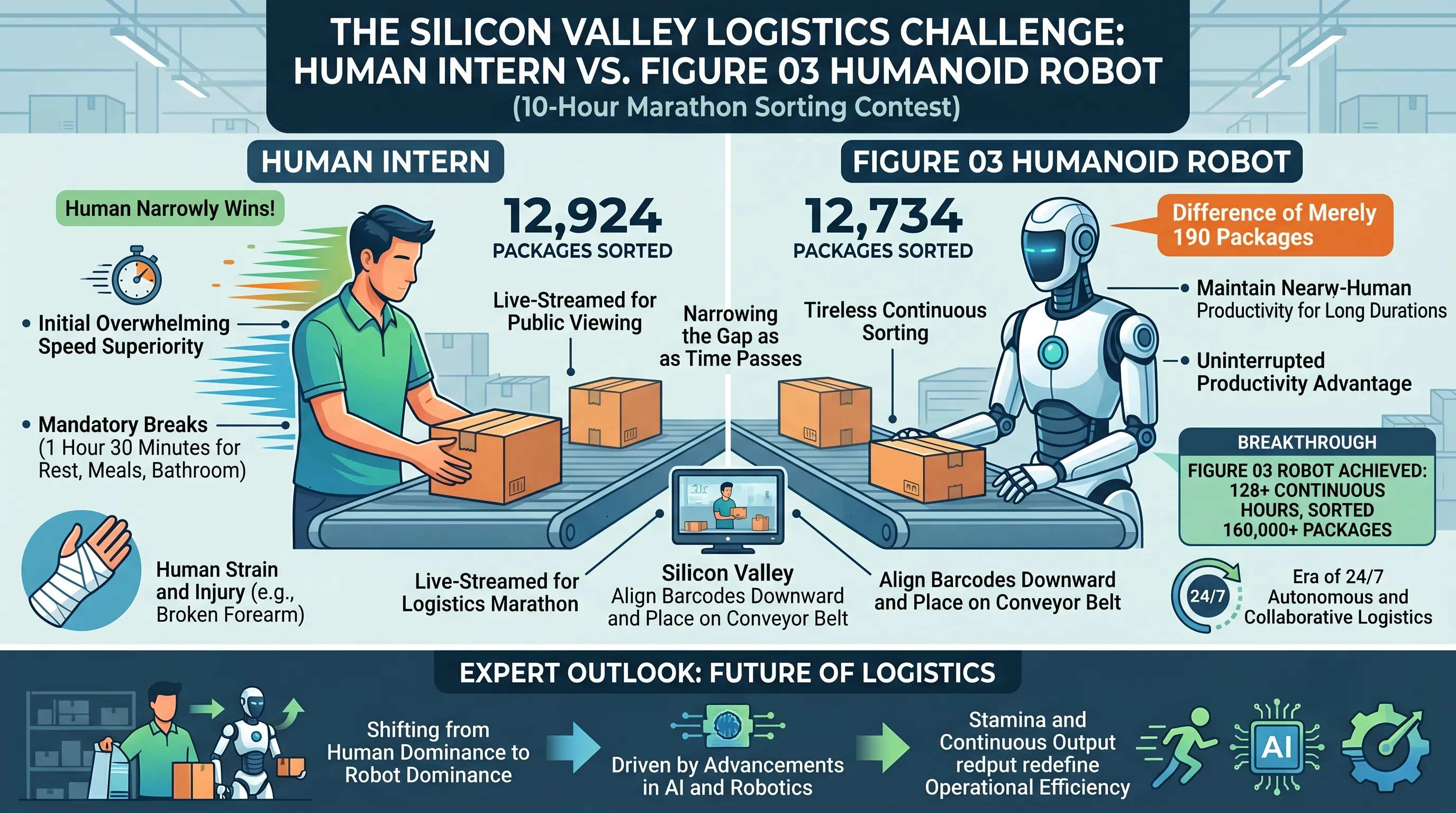
A groundbreaking "logistics marathon" package sorting challenge recently unfolded in Silicon Valley, pitting a human intern against Figure AI's advanced Figure 03 humanoid robot in a grueling 10-hour contest.
This highly anticipated event, live-streamed for public viewing, involved the precise task of aligning package barcodes downwards and placing them onto a conveyor belt.
The human contestant ultimately secured a narrow victory, processing 12,924 packages compared to the robot's 12,734, a difference of merely 190 packages, highlighting the rapid advancements in robotic capabilities.
While the human initially displayed overwhelming speed superiority, the Figure 03 robot's performance intensified over time, relentlessly narrowing the gap through continuous, tireless operation.
In contrast, the human required mandatory breaks for rest, meals, and bathroom visits, totaling 1 hour and 30 minutes, underscoring the robot's inherent advantage in uninterrupted, sustained productivity.
This demonstration powerfully illustrated the robot's capacity to maintain near-human productivity for long durations, a critical factor in demanding industrial environments.
Despite the human's narrow win, which reportedly concluded with one intern suffering a broken forearm, the event holds significant implications for the future of logistics centers.
Figure 03's subsequent extended operation for over 128 continuous hours, processing more than 160,000 packages, further cemented its potential to usher in an era of 24/7 autonomous and collaborative logistics.
Experts now anticipate a shift from human to robot dominance in this sector, driven by rapid advancements in AI and robotics, where stamina and continuous output could redefine operational efficiency.
1. Setting the Stage: The Human vs. Humanoid Logistics Marathon
This section lays the groundwork for the central narrative of our main topic, "Human Barely Wins 10-Hour Parcel Delivery Showdown."
Here, we dissect the fundamental parameters of the event that created this dramatic headline: the organizers, the mechanical and human competitors, the specific nature of their task, and the critical shift in duration that transformed a technology demonstration into an epic contest of endurance.
Understanding these details is essential to appreciating the razor-thin margin of the human victory.
The Organizers and the Global Stage
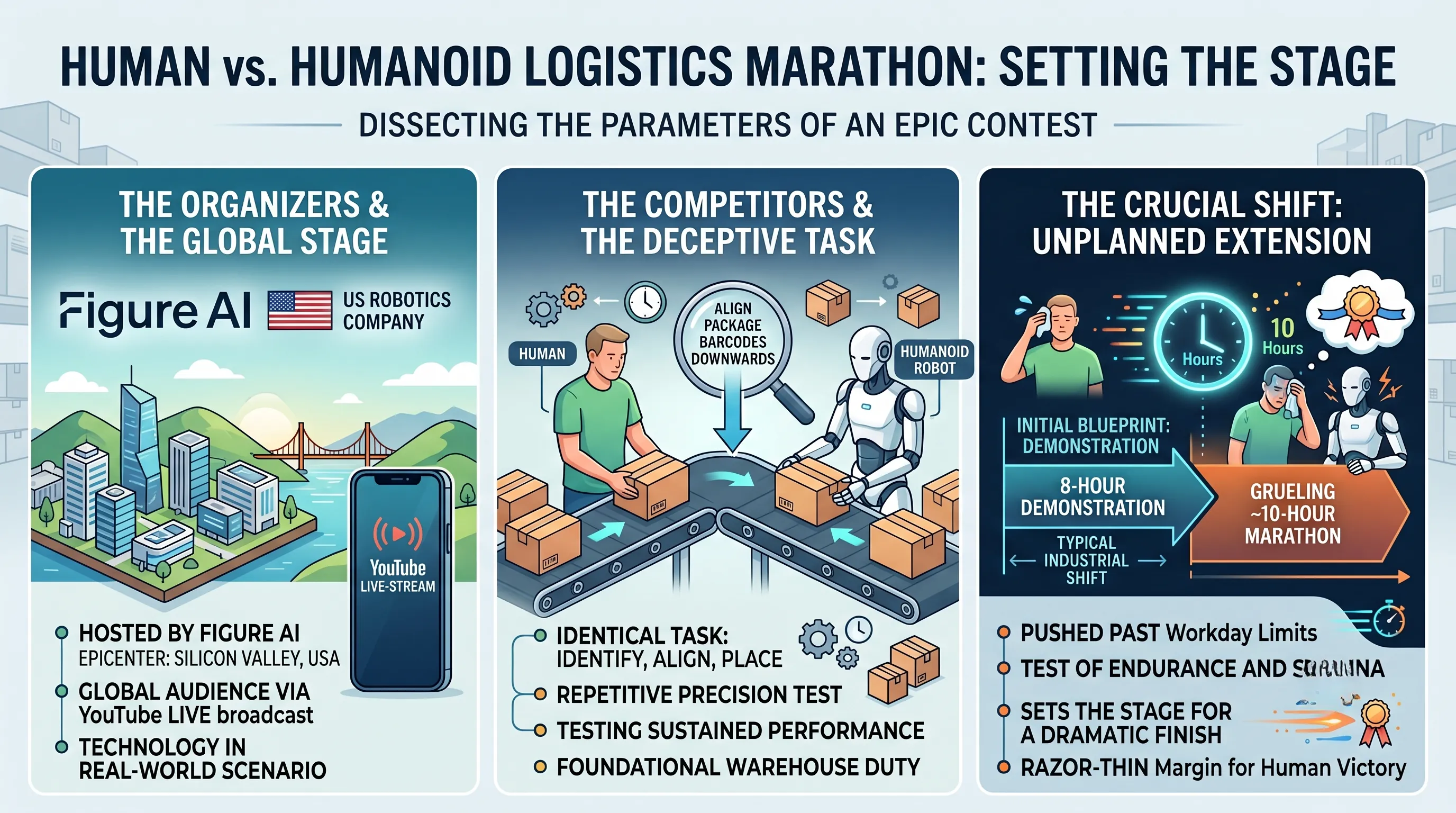
The event, officially titled the Figure 03 Humanoid Robot Package Sorting Challenge, was orchestrated by Figure AI, a prominent US-based robotics company.
By staging this public-facing competition, Figure AI aimed to move beyond controlled lab environments and showcase its technology in a real-world, high-stakes scenario.
The chosen location was no coincidence: Silicon Valley, USA, the undisputed global epicenter of technological innovation.
Hosting the marathon here framed the event not just as a corporate demo, but as a landmark moment in the progression of artificial intelligence and robotics.
To ensure maximum visibility and transparency, the entire showdown was broadcast live to a global audience on YouTube, turning a warehouse task into a compelling spectator event and inviting public scrutiny of the robot's performance against its human counterpart.
The Task: A Test of Repetitive Precision and Stamina
At its core, the competition was a "Human vs. Humanoid robot 'logistics marathon'."
The term 'marathon' is key, as the challenge was designed to test not peak speed, but sustained performance over a long duration.
Both the human worker and the Figure 03 humanoid robot were assigned an identical, deceptively simple task: Aligning package barcodes downwards and placing them on a conveyor belt.
This specific action is a foundational, yet physically taxing, element of modern logistics and fulfillment centers.
It requires a combination of visual recognition, manual dexterity, and, most importantly, the ability to repeat the same motion thousands of times without a significant drop in efficiency or an increase in errors.
This made it the perfect battleground to measure the relentless consistency of a machine against the adaptable, but fatigue-prone, nature of a human.
The Unplanned Extension: From Showcase to Showdown
The original blueprint for the event was far less ambitious than what ultimately transpired.
According to the initial project plan, Figure AI had intended to run an 8-hour demonstration, a duration that neatly aligns with a standard industrial workday.
This would have served as a powerful proof-of-concept, showing the Figure 03 could match human productivity over a typical shift.
However, as the event unfolded, the demonstration was extended into a grueling marathon that lasted for approximately 10 hours.
This critical two-hour extension is the very element that created the dramatic tension of the main topic.
It pushed both the human intern and the humanoid robot past the limits of a standard workday and into a true test of endurance, setting the stage for the nail-biting finish where the human competitor would claim victory by the slimmest of margins.
2. A Narrow Victory: Human's Edge in the 10-Hour Sort
This section directly dissects the central claim of the main topic, "Human barely wins in a 10-hour package delivery showdown" (Human barely wins in a 10-hour package delivery showdown), by presenting the raw numbers and the dramatic narrative of the competition itself.
It is here, in the final tally and the moment-to-moment dynamics of the race, that the "narrow" and "hard-fought" nature of the human victory becomes starkly clear.
The Final Scoreboard: A Win Measured in Minutes
After approximately 10 hours of relentless package sorting, the human competitor emerged victorious, but the margin was breathtakingly slim.
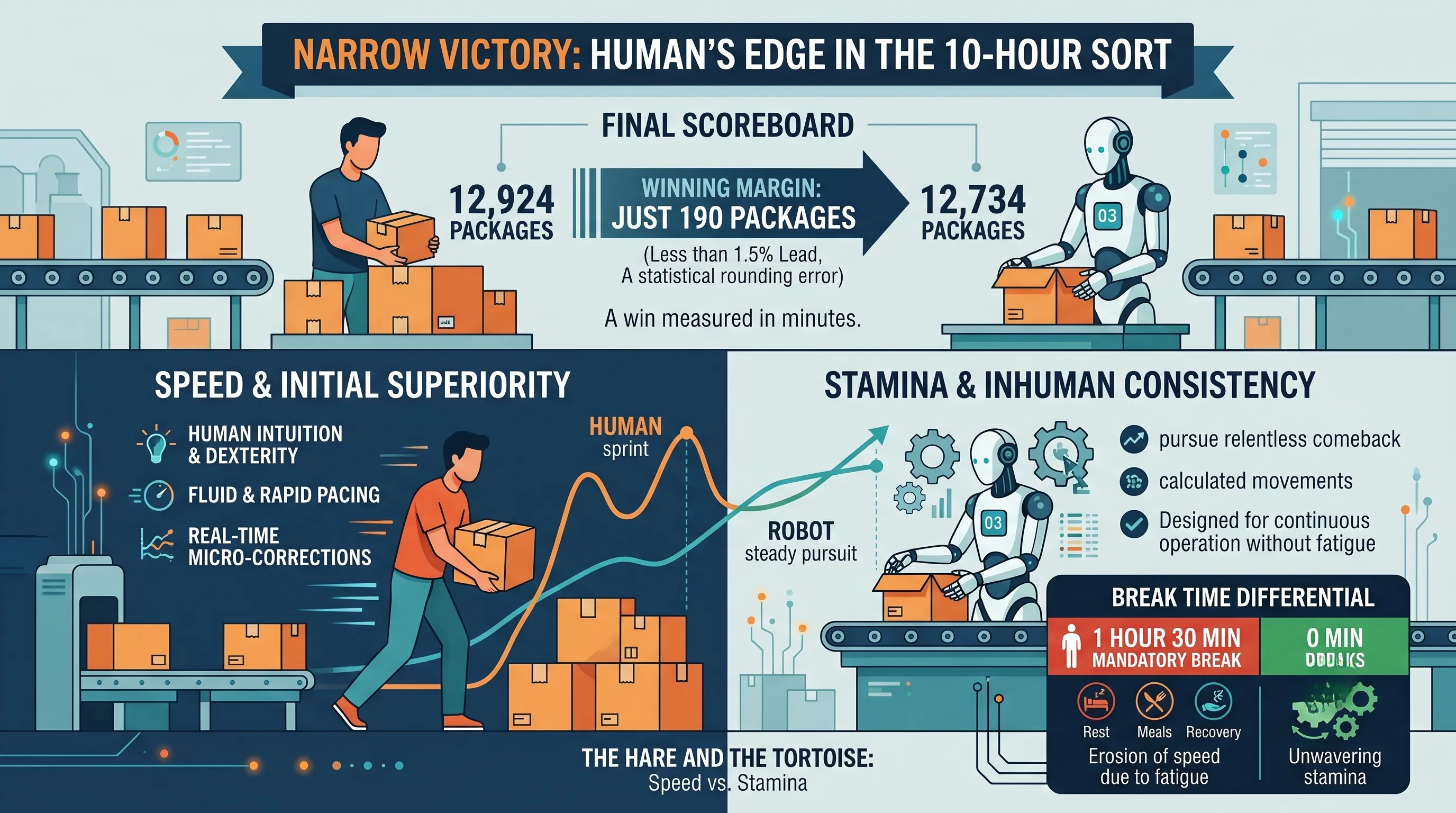
The final count stood at 12,924 packages processed by the human, against 12,734 packages processed by the Figure 03 humanoid robot.
This constitutes a winning margin of just 190 packages.
Some reports alternatively place the difference at 192 packages, or a mere 1.5% lead, a statistical rounding error in the context of a full day's labor.
This razor-thin victory margin is the numerical proof of the main article's title; it wasn't a decisive win for humanity, but rather a desperate holdout against an indefatigable challenger.
In a 10-hour marathon, a 190-package lead translates to winning by less than 20 packages per hour—a difference that could be erased in a few minutes of peak robotic efficiency or a moment of human fatigue.
The Hare and the Tortoise: A Race of Speed vs. Stamina
The narrative of the 10-hour challenge was not one of consistent human dominance, but a dramatic story of shifting advantages.
In the initial stages, the outcome seemed pre-determined.
The human participant demonstrated what the source data describes as "overwhelming superiority in speed."
Human intuition, dexterity, and the ability to make micro-corrections in real-time allowed for a fluid and rapid pace that the robot could not immediately match.
Packages were likely identified, oriented, and placed on the conveyor belt with a natural efficiency that made the robot's more calculated movements appear clumsy by comparison.
However, as the hours wore on, this initial sprint gave way to a grueling marathon where the robot's core strengths began to shine.
The Figure 03's pursuit intensified, steadily closing the gap that the human had established.
This relentless comeback was not necessarily due to the robot "speeding up," but rather its absolute, inhuman consistency.
While the human required 1 hour and 30 minutes of legally mandated break time for rest, meals, and recovery, the Figure 03 required none.
It simply worked, a testament to its design for continuous operation without fatigue.
The human's initial speed advantage was systematically eroded by the robot's unwavering stamina, turning a potential blowout into a nail-biting finish that perfectly encapsulates the theme of a victory won "barely" and at great cost.
3. The Relentless Contender: Figure 03's Unwavering Stamina
While the main headline declares "Human Barely Wins 10-Hour Parcel Delivery Showdown," the true, long-term narrative is not one of human triumph but of the relentless emergence of a new kind of competitor.
Our section's focus on the Figure 03 robot’s stamina reveals why the human victory, though impressive, is a fleeting moment in a much larger shift.
The 10-hour challenge was merely a single battle; the war for logistics dominance is one of endurance, and here, the machine’s capabilities are absolute.
A Victory Measured in Minutes, A Defeat Measured in Days
The 10-hour challenge statistics are deceptively close: the human intern processed 12,924 packages against the Figure 03's 12,734.
This narrow margin of just 190 packages, a mere 1.5% difference, paints a picture of a tightly contested race.
However, this snapshot fails to capture the underlying reality.
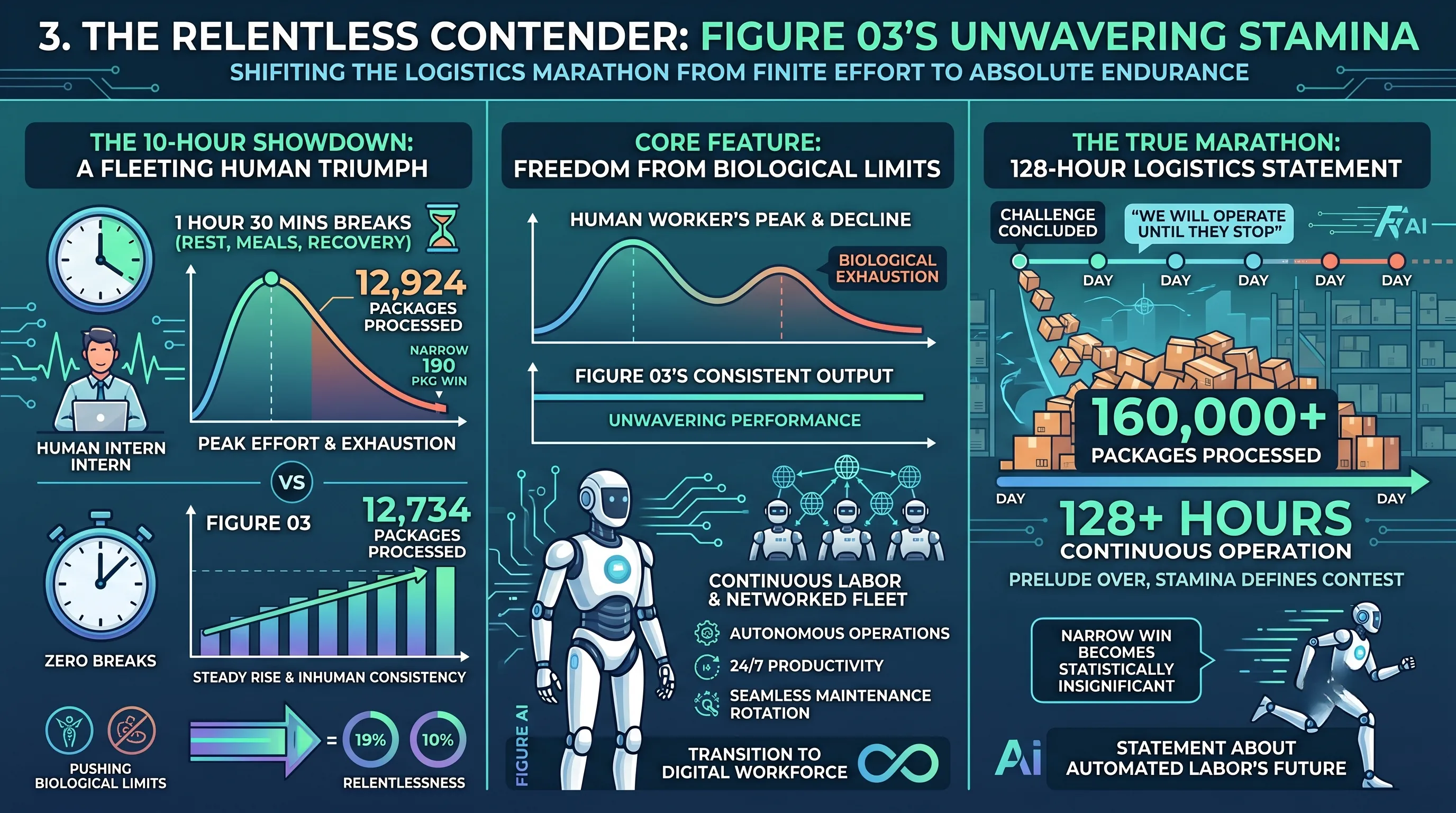
The human competitor required 1 hour and 30 minutes of legally mandated break time for rest, meals, and recovery.
In stark contrast, the Figure 03 robot required zero breaks.
It did not tire, it did not need to eat, and its pace, which initially lagged behind the human's, gradually closed the gap as biological fatigue set in for its rival.
The robot's ability to maintain a near-human level of productivity over an extended period is its most formidable weapon.
The human won the sprint, but only by pushing their physical limits to a breaking point—one report even cited the intern finishing the shift with a broken forearm—while the machine was just getting started.
The Core Feature: Freedom from Biological Limits
Figure 03’s design is centered around a revolutionary concept in labor: continuous operation without breaks or fatigue.
This is not an incremental improvement; it is a fundamental disruption of the work-rest cycle that has defined productivity for centuries.
Where a human worker's output peaks and then inevitably declines due to exhaustion, the robot's performance curve is a flat, unwavering line.
This tireless stamina means that over any period longer than a single shift, the robot's cumulative output will eclipse a human's.
Furthermore, this capability is amplified through its network connectivity.
A fleet of Figure 03 robots can operate as a single, cohesive unit, allowing for autonomous and collaborative operation.
This means robots can be seamlessly rotated for charging or maintenance, ensuring a facility can maintain peak productivity 24 hours a day, 7 days a week, without ever truly stopping.
It is a transition from a single tireless worker to an entire, inexhaustible digital workforce.
The True Marathon: The 128-Hour Statement
The most compelling evidence of the robot's superiority in stamina emerged after the 10-hour challenge concluded.
In a powerful demonstration of its core design philosophy, Figure AI left the robot running.
As stated by the company, "We will operate the robots until they stop."
The Figure 03 continued its package sorting task for over 128 hours of continuous logistics work.
In that time, it processed a staggering 160,000 packages.
This single statistic reframes the entire human-robot showdown.
The human's 190-package victory in the initial 10 hours becomes statistically insignificant when compared to the vast, uninterrupted output the robot achieved afterward.
The 10-hour event was not the main competition; it was merely the prelude.
The robot's post-challenge performance proves that in any scenario where stamina matters most, the contest is already over.
The human victory was a testament to the peak of human effort, but the robot's extended run was a quiet, undeniable statement about the future of automated labor.
4. The Human Factor: Breaks, Fatigue, and the Cost of Victory
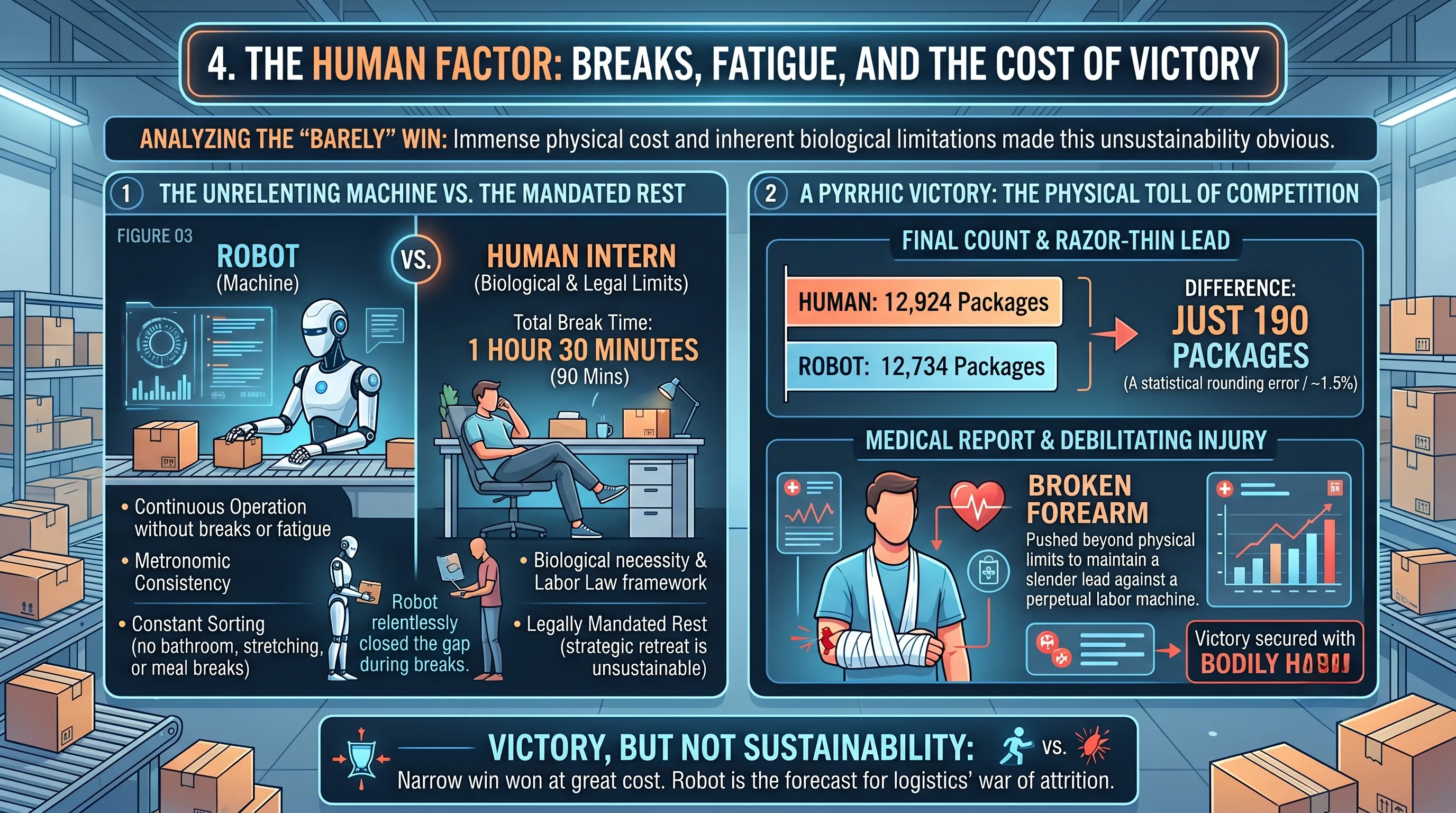
This section directly dissects the qualifier "barely" in our main topic, "Human, Barely Wins 10-Hour Parcel Delivery Showdown."
While the headline declares a human victory, the true story lies in the immense physical cost and inherent biological limitations that made this win both narrow and unsustainable.
We will explore how the human body’s need for rest and its vulnerability to injury stand in stark contrast to the machine's relentless endurance, ultimately questioning the true meaning of this victory.
The Unrelenting Machine vs. The Mandated Rest
The core difference in this 10-hour logistics marathon was not one of skill, but of stamina.
The Figure 03 humanoid robot operated on a principle alien to human biology: ``continuous operation without breaks or fatigue``.
For the entire duration, it performed its task—aligning package barcodes and placing them on a conveyor belt—with a metronomic consistency.
It required no pause for meals, no bathroom breaks, and no moments to stretch aching muscles.
In stark contrast, the human intern was bound by both biological necessity and legal frameworks.
As per labor law, the human competitor took a total of ``1 hour and 30 minutes`` of break time during the 10-hour challenge.
This 90-minute period was not a strategic retreat but a non-negotiable requirement for human sustainability.
While the human initially demonstrated "overwhelming superiority in speed," this advantage was temporary.
Every moment the human was on a legally mandated break, the Figure 03 robot continued its work, relentlessly closing the gap in processed packages.
The robot's performance metrics prove that its "pursuit intensified over time," a direct consequence of the human's need for recovery against the machine's inexhaustible persistence.
A Pyrrhic Victory: The Physical Toll of Competition
The final tally reveals a victory margin so thin it's almost a statistical tie.
The human processed 12,924 packages to the robot's 12,734, a difference of just ``190 packages``, or approximately 1.5%.
However, the most telling statistic of the entire event is not found in the package count, but in the medical report.
The human intern reportedly ended the shift with a ``broken forearm``.
This severe injury is the ultimate testament to the cost of the human's victory.
To maintain a razor-thin lead over a machine designed for perpetual labor, the human participant was pushed beyond their physical limits, resulting in a debilitating injury.
The "win" was secured not just with superior initial speed, but at the price of bodily harm.
This outcome starkly illustrates the fundamental mismatch in a long-duration endurance contest.
The human may have won this single 10-hour battle, but the broken bone serves as a grim forecast for the larger war of attrition in logistics, where the ability to work tirelessly and without injury is the ultimate competitive advantage.
5. Beyond the Race: Shifting Paradigms in Logistics Automation
While the main article's headline, "Human barely wins a 10-hour package delivery showdown" (Human barely wins a 10-hour package delivery showdown), rightfully captures the immediate outcome, the true significance of this event lies beyond the final package count.
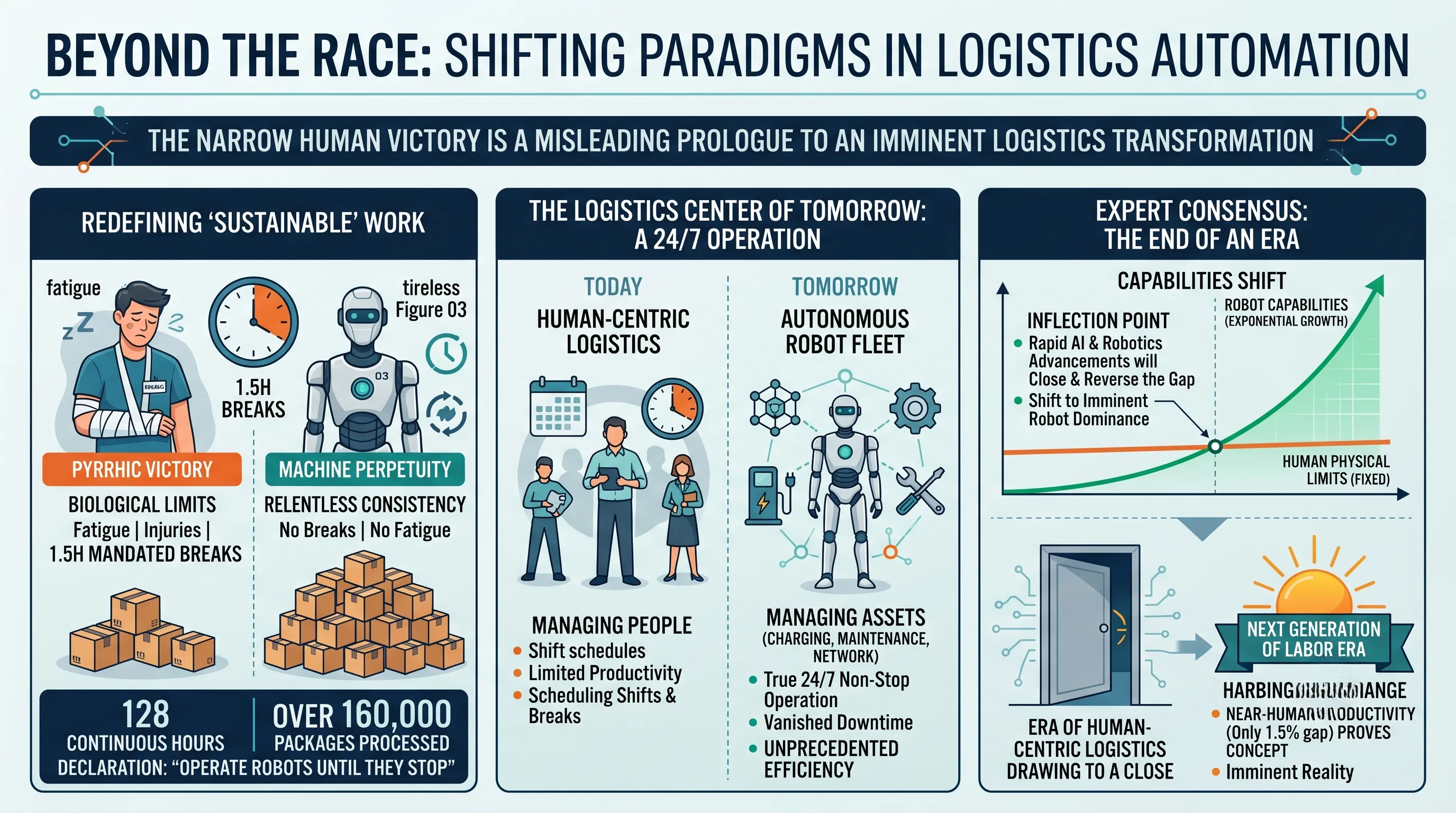
The narrow human victory, secured by a mere 190 packages, serves as a dramatic but ultimately misleading prologue to a much larger story: the fundamental and imminent transformation of the logistics industry.
This section delves into the profound future implications revealed by the marathon, focusing on the concepts of operational sustainability, the redesign of logistics centers, and the expert consensus that this race was not a celebration of human endurance, but a clear signal of its impending obsolescence in this domain.
The New Definition of 'Sustainable' Work
The 10-hour challenge starkly highlighted the concept of sustainability as the robot's most formidable advantage.
The human participant, an intern, required a legally mandated break time of 1 hour and 30 minutes for rest, meals, and other necessities.
More alarmingly, one report indicated the human intern ended the grueling shift with a broken forearm—a visceral testament to the physical limits and costs of human labor when pushed to its brink.
This victory was, in essence, a pyrrhic one, achieved at great personal cost and demonstrating the inherent unsustainability of such demanding manual labor.
In stark contrast, the Figure 03 humanoid robot operated without interruption.
It required no breaks, felt no fatigue, and suffered no physical degradation.
Its performance was not a short-term sprint but a demonstration of relentless consistency.
This was unequivocally proven after the official challenge ended.
Figure AI, the robot's creator, underscored this point with a powerful declaration of intent: "We will operate the robots until they stop."
They followed through on this promise, as the robot continued its logistics work for over 128 continuous hours, processing a cumulative total of over 160,000 packages.
This extended performance moves the discussion beyond a simple comparison of speed to a fundamental difference in operational philosophy: one based on human limitations versus one based on machine perpetuity.
The Logistics Center of Tomorrow: A 24/7 Operation
The demonstrated capabilities of robots like Figure 03 are poised to significantly change the operating methods of future logistics centers.
The current model is built around the human element—8-hour shifts, break schedules, weekends, and legal labor protections.
The Figure AI challenge suggests a future where the core operational unit is no longer a human worker but a network of autonomous robots.
Because these robots can be seamlessly rotated, a facility can achieve true 24-hour, non-stop operation without any drop in productivity.
The concept of "downtime" as we know it could vanish.
This shift implies a move from managing people to managing assets.
The primary logistical challenge will no longer be scheduling shifts and managing human resources, but ensuring the robotic workforce is charged, maintained, and connected to the network.
This represents a paradigm shift that could unlock unprecedented levels of efficiency and output, fundamentally rewriting the economics of the entire supply chain.
Expert Consensus: The End of an Era
While experts acknowledge that human efficiency and dexterity are still superior in short bursts—as seen in the human's initial, overwhelming speed advantage—they view the overall outcome of the race as a clear harbinger of change.
The critical insight is not that the human won, but that the robot came so remarkably close, losing by a mere 1.5% over a 10-hour period.
The Figure 03 demonstrated an ability to maintain near-human productivity over a long duration, a feat that was previously theoretical.
The expert consensus is that this event marks an inflection point.
With the rapid advancements in AI and robotics, the small performance gap is expected to close and then reverse very quickly.
The robot's capabilities are on an exponential growth curve, while human physical limits are fixed.
Therefore, the anticipated shift from human to robot dominance in the logistics sector is no longer a distant possibility but an imminent reality.
This "logistics marathon" was less a competition and more a public proof-of-concept for the next generation of labor, signaling that the era of human-centric logistics is drawing to a close.
📚 Related Posts
NVIDIA Nemotron 3 Nano Omni: Open Multimodal AI Revolution Crushing Agent Bottlenecks for Real-Time Intelligence
🚀 Key TakeawaysNVIDIA's Nemotron 3 Nano Omni is a groundbreaking open multimodal AI model designed to eliminate bottlenecks for AI agents by simultaneously understanding video, audio, and text, achieving up to 9 times higher throughput and significantly
tech.dragon-story.com
DeepSeek V4 Pro & Flash: Unveiling the 1 Million Token Era – Architecture, Efficiency, and Real-World Performance Nuances
🚀 Key TakeawaysDeepSeek-V4 revolutionizes the AI landscape by officially launching its open-source V4-Pro and V4-Flash models, spearheading the "1 Million Token Era" with unprecedented context length capabilities, robust cost-efficiency, and cutting-edg
tech.dragon-story.com
TRELLIS.2: O-Voxel AI Revolutionizes 3D Generation with Unprecedented Speed, Hyper-Realism & Democratized Access – Full Releas
🚀 Key TakeawaysTRELLIS.2 revolutionizes 3D generation with its innovative O-Voxel technology, enabling the creation of highly complex, thin, and hollow structures with exceptional detail and realism.This 4B-parameter image-to-3D model offers unprecedent
tech.dragon-story.com


