🚀 Key Takeaways
- OpenAI has introduced a new Trusted Contact feature for ChatGPT, designed to connect users with pre-designated individuals for support during potential crisis situations, thereby strengthening AI's role in real-world support systems.
OpenAI has officially rolled out a significant new safety feature for ChatGPT: the Trusted Contact feature.
This innovative, optional tool is designed to strengthen AI's role in connecting users with real-world support systems, primarily during crisis situations where a user might be at risk.
The introduction of this feature elevates the ongoing discussion around AI safety and user well-being, pushing the boundaries of how AI can responsibly interact with human emotional states and potential vulnerabilities.
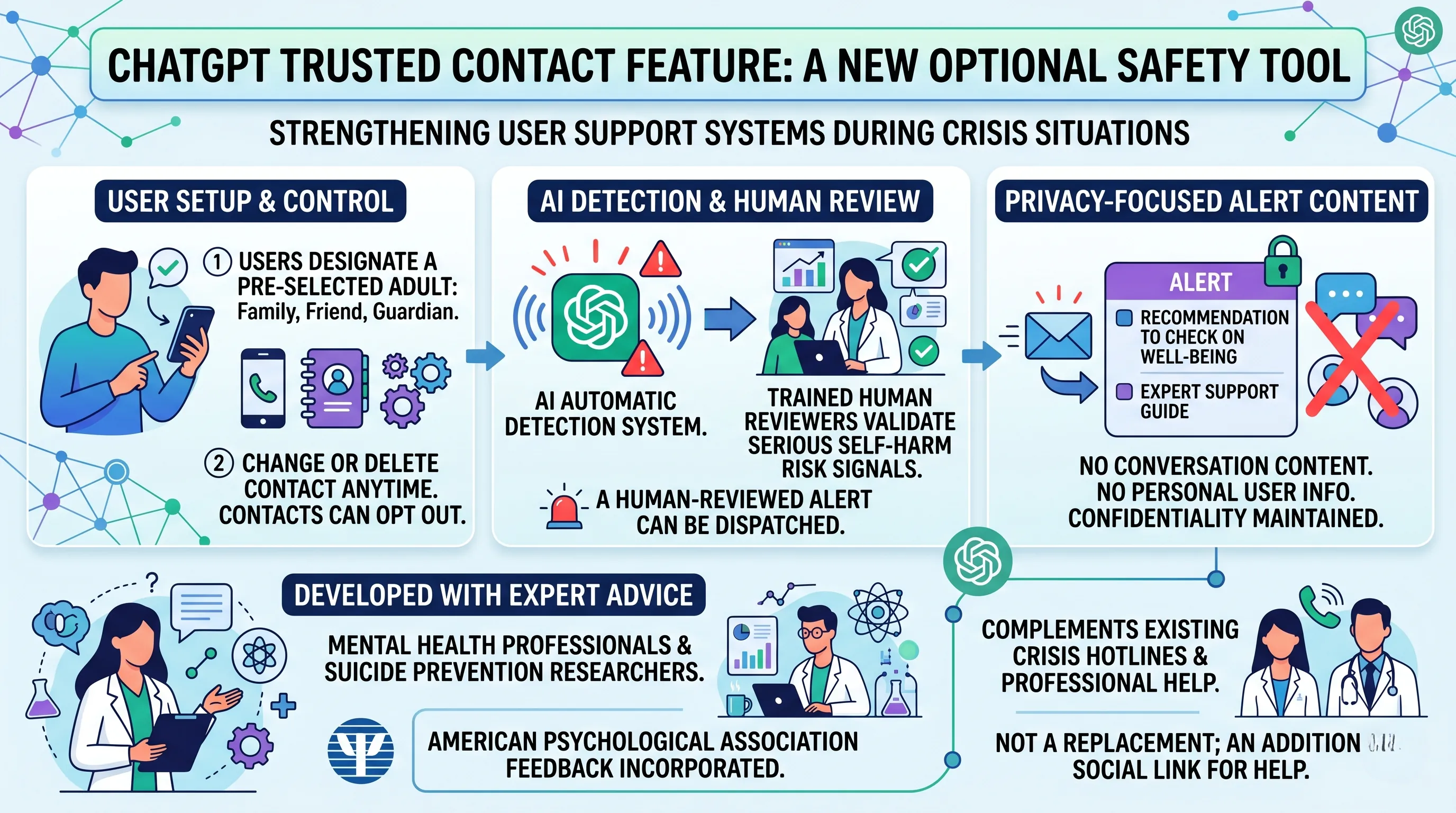
The feature operates by allowing users to designate a pre-selected adult – such as a family member, friend, or guardian – as a Trusted Contact within their ChatGPT settings.
Should ChatGPT's automatic detection system and trained human reviewers identify serious self-harm risk signals in conversations, a human-reviewed alert can be dispatched to the designated contact.
These alerts are strictly privacy-focused; they contain no conversation content or personal user information, only a recommendation to check on the user's well-being and an expert support guide, ensuring user confidentiality is maintained.
Developed with extensive advice from mental health professionals and suicide prevention researchers, and incorporating feedback from organizations like the American Psychological Association, the Trusted Contact feature is a testament to OpenAI's commitment to user safety and responsible AI development.
It is crucial to understand that this feature complements existing crisis hotlines and mental health support systems; it is not intended to replace professional treatment or emergency services, but rather to serve as an additional link for users to seek help from their social circle in times of need.
Users retain full control, with the ability to change or delete their Trusted Contact anytime, and registered contacts can also opt out of the feature.
1. ChatGPT's Trusted Contact: Bridging AI Safety with Real-World Support
This section provides a detailed analysis of the newly introduced "Trusted Contact" feature, the central subject of our main article, "CHATGPT, ‘TRUSTED CONTACT’ Feature Officially Introduced".
We will dissect its core mechanics, from user activation to the privacy-centric alert system, to understand how OpenAI is attempting to bridge the gap between AI-driven safety protocols and tangible, real-world human support.
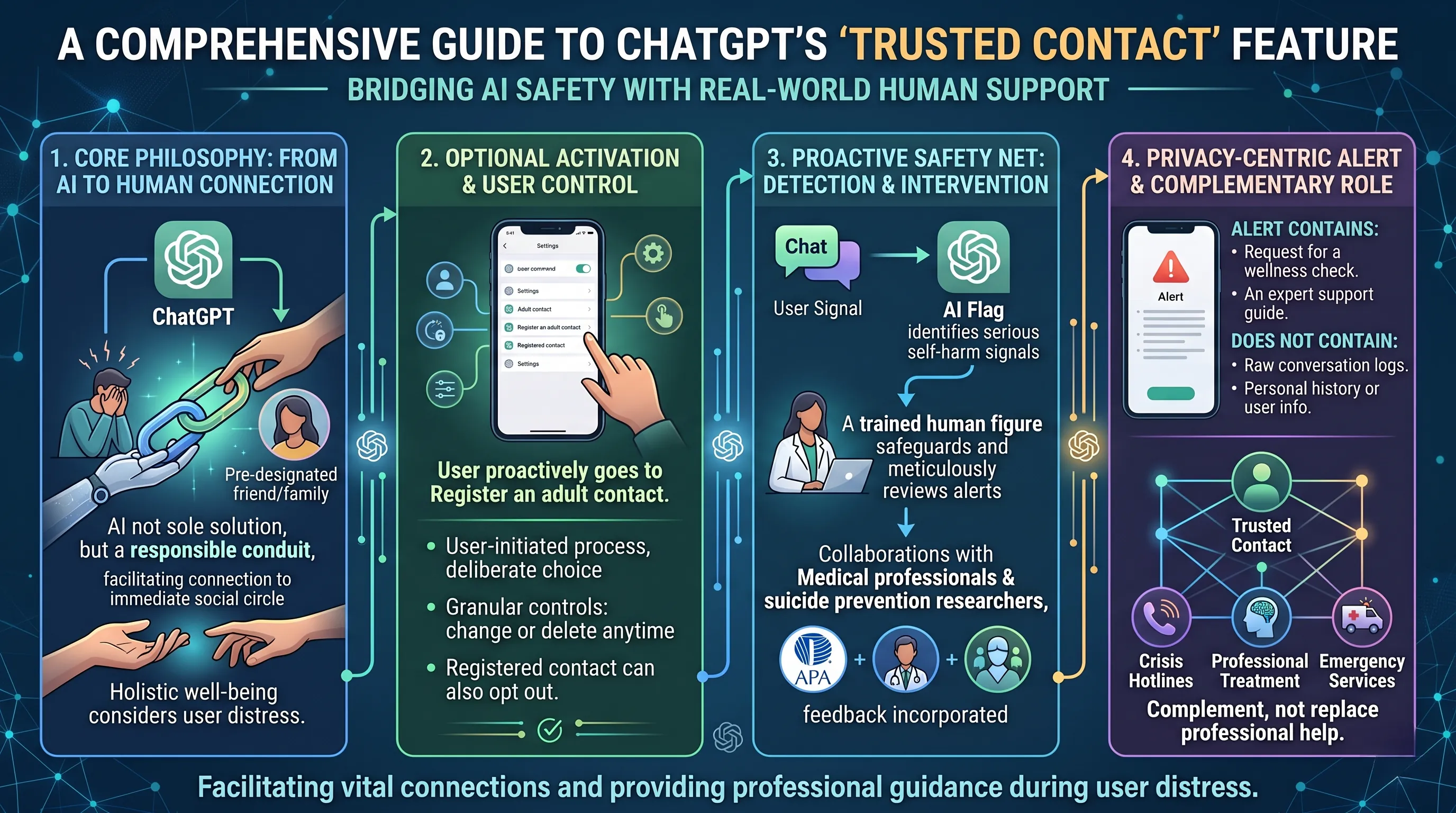
The Core Philosophy: From AI Companion to a Bridge for Human Connection
At its heart, the Trusted Contact feature is an optional safety net designed to connect users experiencing a crisis with a pre-designated individual in their life, such as a family member, a close friend, or a guardian.
OpenAI's stated goal transcends the typical boundaries of AI functionality; it aims to strengthen AI's role in connecting users to real-world support systems.
This represents a significant philosophical shift. The AI is not positioned as the sole solution or a digital therapist, but rather as a responsible conduit to human intervention.
This approach is deeply rooted in established mental health principles, as confirmed by experts who note that social connection is a strong protective factor against suicide risk.
By facilitating this connection, ChatGPT is leveraging its platform to potentially create a new, accessible link for users who might otherwise be isolated during a moment of profound distress, allowing them to receive help from their immediate social circle.
This feature elevates the industry-wide conversation about AI safety, demonstrating a maturation of the technology from a pure information provider to a platform that actively considers the holistic well-being of its users.
Activation and Control: Putting the User Firmly in Command
The implementation of Trusted Contact is built on a foundation of user consent and control.
Activation is a deliberate, user-initiated process: a user must navigate to their settings and proactively register one adult as their Trusted Contact.
The optional nature of this feature is critical; it is not an automatic or default setting, ensuring that users consciously opt into this layer of safety.
This control is not a one-time decision.
OpenAI has built in granular controls that empower the user throughout the experience. A user can change or delete their designated contact at any time, offering flexibility as life circumstances and relationships evolve.
Furthermore, control extends to the designated contact themselves, who can opt out of the feature if they do not wish to be registered.
Experientially, this design choice is paramount. It frames the feature not as a surveillance mechanism, but as a personal safety tool that the user owns and manages, which is essential for building the trust required for adoption.
The Proactive Safety Net: How Detection and Intervention Work
The trigger mechanism for a Trusted Contact alert is a sophisticated, two-stage process designed to balance proactive intervention with accuracy and responsibility.
The process begins when ChatGPT's automatic detection system identifies serious self-harm risk signals within a user's conversation.
However, an alert is not dispatched based on this automated flag alone.
Critically, all potential alerts are reviewed by a trained human before any action is taken.
This human-in-the-loop system is a crucial safeguard against the nuances and contextual complexities that an AI might misinterpret, drastically reducing the potential for false positives and unnecessary alarm.
This meticulous review process underscores the feature's responsible design, which was developed with advice from mental health professionals and suicide prevention researchers.
The collaboration with over 260 medical professionals across 60 countries and the incorporation of feedback from organizations like the American Psychological Association lend significant clinical credibility to the system's architecture, ensuring that the intervention protocol is both technologically advanced and grounded in expert-validated safety practices.
Privacy by Design: The Anatomy of a Trusted Contact Alert
Perhaps the most thoughtfully engineered aspect of the Trusted Contact feature is its unwavering commitment to user privacy.
The content of the alert sent to a trusted contact is intentionally minimal and carefully curated to protect the user.
The alerts do NOT include any conversation content or personal information from the user's ChatGPT history.
This is a non-negotiable privacy firewall that ensures a user's vulnerable expressions remain confidential.
Instead, the alert contains two key components:
1. A simple, direct recommendation for the contact to check on the user's well-being.
2. An expert support guide to equip the contact with resources and information on how to approach the situation constructively.
This "privacy-by-design" approach achieves a delicate balance. It successfully triggers a real-world wellness check without violating the user's trust or exposing sensitive data.
The alert functions as a gentle but urgent nudge for human connection, empowering the trusted contact with professional guidance rather than alarming them with raw, out-of-context conversation logs.
A Complementary Role, Not a Replacement
OpenAI is explicit in positioning the Trusted Contact feature within the broader ecosystem of mental health support.
The company clarifies that the tool is designed to complement existing crisis hotlines and mental health support systems.
It is a new pathway to support, not the only one.
Most importantly, the feature is not a replacement for professional treatment or emergency services.
This disclaimer is vital for managing user expectations and reinforcing the message that in a severe crisis, professional and emergency services remain the primary and most appropriate recourse.
Trusted Contact serves as a valuable addition to the safety landscape, but it operates as one part of a comprehensive, multi-layered support strategy.
2. Built on Expertise: Professional Collaboration and the Feature's Complementary Role
The official introduction of ChatGPT's 'Trusted Contact' feature is not merely a technological update; it is a statement on the responsible integration of AI into sensitive areas of human well-being.
This section directly addresses the foundation of that responsibility, exploring how the feature's credibility and safety are not accidental but are the direct results of a deliberate, expert-led development process.
Understanding this collaborative background is essential to appreciating why the 'Trusted Contact' system is designed as a careful, supportive bridge to human connection rather than an automated solution to a human crisis.
A Foundation Forged by Experts, Not Just Engineers
OpenAI made a critical strategic decision in the feature's conception: this tool would be guided by clinical wisdom, not just code.
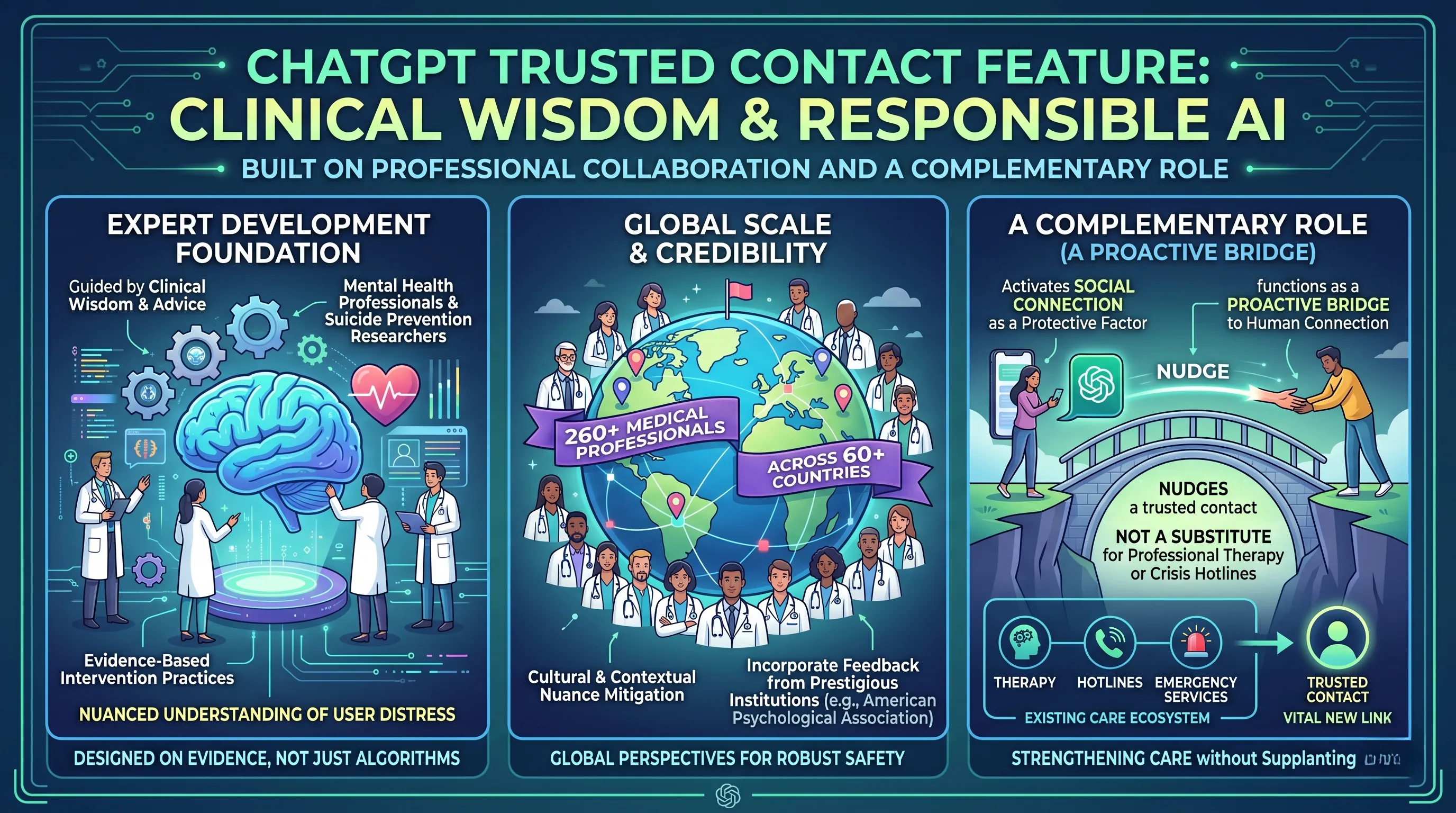
The entire architecture of the Trusted Contact system was designed with the explicit advice and consultation of mental health professionals and leading suicide prevention researchers.
This is a profound distinction from a purely technological approach.
It signifies a recognition that identifying a user in distress requires nuanced understanding that algorithms alone cannot possess.
By embedding the knowledge of psychologists and crisis experts into the development DNA, OpenAI ensured the feature was built on a platform of evidence-based practices for intervention and support.
The goal was never for the AI to 'solve' the user's crisis, but to execute a single, highly specialized task—facilitating a connection to a real-world support system—in a manner deemed safe and effective by those who know the field best.
The Global Scale of Collaboration
The commitment to expert guidance was not a token gesture; it was executed on a global scale to ensure cultural and contextual nuance.
OpenAI's partnership involved an extensive network of over 260 medical professionals spanning 60 countries.
The experiential value of this statistic is immense.
It means the feature's design and triggers were vetted against a wide spectrum of cultural expressions of distress, communication styles, and social norms.
A safety feature developed solely with a North American perspective, for example, might fail to recognize critical warning signs in a user from an Asian or European cultural context.
This global collaboration works to mitigate such blind spots, making the system more robust and universally applicable.
Furthermore, OpenAI incorporated feedback from prestigious external organizations, including the American Psychological Association, adding another layer of institutional credibility and ensuring the feature aligns with established ethical and professional standards in the mental health community.
A Bridge, Not a Destination: The Feature's Complementary Role
Perhaps the most crucial aspect clarified by OpenAI and its professional partners is the feature's intended role.
The Trusted Contact system is explicitly positioned to complement, not replace, professional treatment or emergency services.
It is not a therapist, a crisis hotline, or a substitute for calling emergency responders in a moment of immediate danger.
Instead, it functions as an innovative and proactive bridge.
Its purpose is to activate one of the most powerful, evidence-backed protective factors against self-harm: social connection.
When the system detects a potential risk, it does not attempt to manage the crisis itself; it activates a pathway for a trusted human to intervene with care and concern.
This design philosophy perfectly aligns with expert opinion that the feature can serve as a vital new link for users to seek help from their own social circle.
By automating a 'nudge' to a pre-selected contact, it helps close the gap between feeling isolated in a crisis and reaching out for the human support that is often the most critical first step toward safety.
It strengthens the existing ecosystem of care without ever attempting to supplant it.
3. User Empowerment, Industry Advancement, and the Social Safety Net
The introduction of OpenAI's Trusted Contact feature for ChatGPT is not merely a technical update; it represents a significant philosophical shift in how AI interacts with human vulnerability.
This section analyzes the profound implications of this feature through three critical lenses: its deep respect for user autonomy, its role as a catalyst for industry-wide progress in AI safety, and its function as a new, digitally-enabled component of the social safety net.
The Pillar of Autonomy: Mutual Consent in Digital Support
A core principle that distinguishes the Trusted Contact feature from a simple surveillance tool is its foundational commitment to user and contact autonomy.
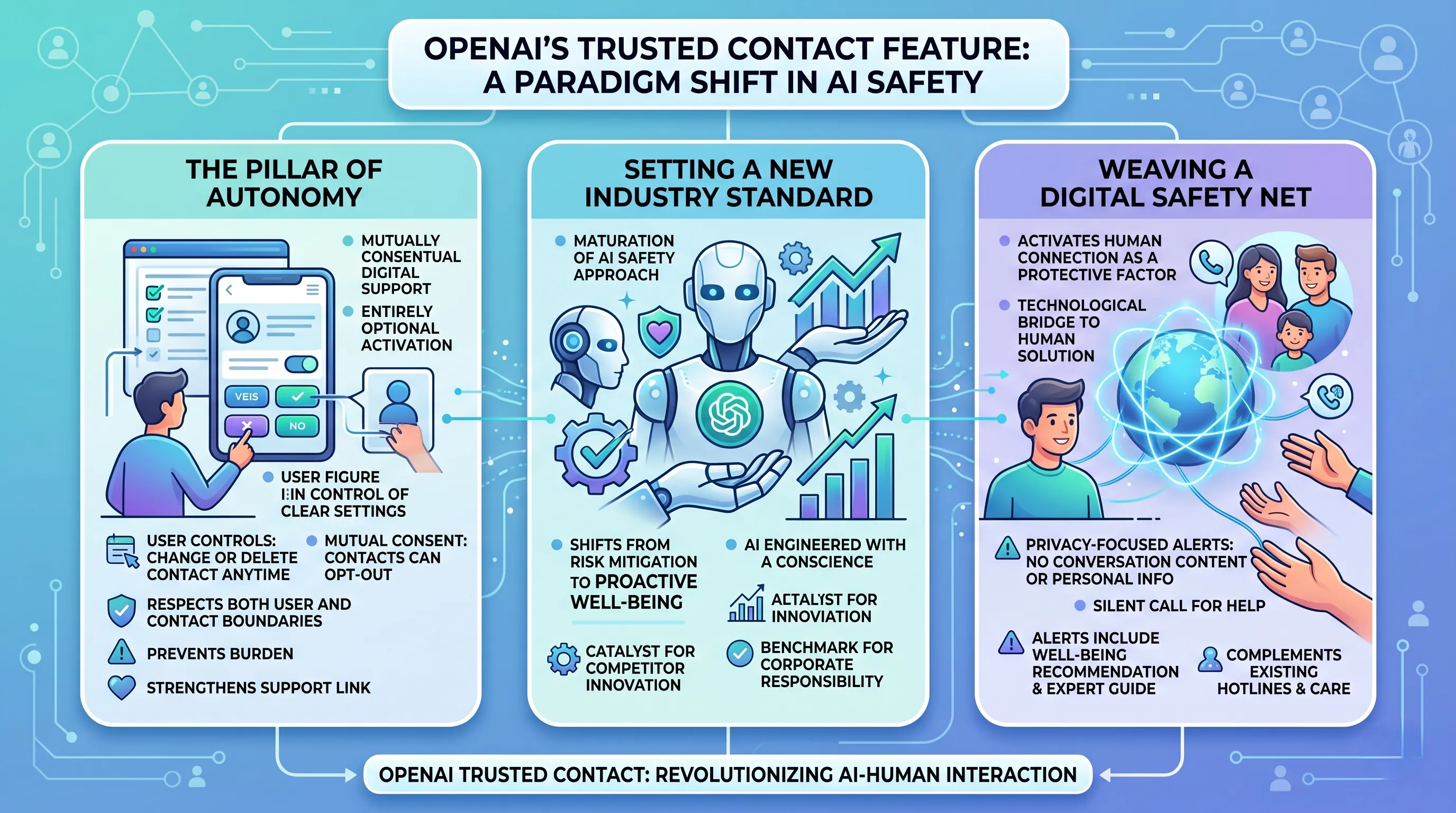
This is not a system imposed upon users; it is an entirely optional feature that an individual must consciously choose to activate.
The power dynamic remains firmly in the user's hands, as they can change or delete their designated contact at any time.
This design provides a crucial psychological safety net, ensuring users never feel trapped by a choice they made previously, which is especially important in the context of fluctuating mental states and personal relationships.
Furthermore, this respect for autonomy extends to the designated contact.
The JSON facts state clearly that registered contacts can also opt out of the feature.
This establishes a system of mutual consent, a sophisticated and empathetic design choice that acknowledges the potential emotional weight on the trusted individual.
It ensures that the person receiving the alert is a willing and prepared participant in the support system, preventing the feature from becoming an unintended burden and strengthening the integrity of the support link itself.
This two-way control mechanism is a testament to the feature's design, which was developed with advice from mental health professionals who understand that healthy support is always built on a foundation of voluntary participation and respected boundaries.
Setting a New Industry Standard for Responsible AI
The launch of the Trusted Contact feature is a landmark event, signaling a maturation of the AI industry's approach to user safety.
Industry evaluation, as cited in our source data, recognizes that this innovation elevates AI safety discussions to a new level.
Previously, conversations about AI safety were often confined to mitigating risks like misinformation, data bias, or preventing malicious use.
This feature moves the industry from a defensive posture of preventing harm to a proactive stance of facilitating well-being.
This evolution is pivotal.
The industry is witnessing a tangible example of how AI is evolving to consider user safety and well-being beyond just providing information.
ChatGPT is no longer just a neutral tool for generating text; it is an ecosystem being engineered with a conscience, capable of recognizing distress signals and connecting users to real-world, human support systems.
This shift has a ripple effect, as it increases the potential for similar features in other AI services.
OpenAI has set a new benchmark for corporate responsibility in the AI space, creating pressure for competitors to move beyond mere functionality and integrate thoughtful, human-centric safety nets into their own platforms.
The feature serves as a powerful proof-of-concept for a future where AI's role includes being a responsible steward of user welfare.
Weaving a Digital Thread into the Human Safety Net
At its heart, the Trusted Contact feature is a technological bridge to a deeply human solution.
Mental health experts universally agree that social connection is a strong protective factor against suicide risk.
Isolation exacerbates crisis, while a connection to a caring individual can be a life-saving anchor.
OpenAI has built its feature directly upon this established psychological principle, using technology not to replace human connection, but to activate it.
The system acts as a new link for users to get help from their social circle during a moment of profound crisis.
For individuals who may find it impossible to voice their distress, the feature serves as a silent call for help.
The alert, which is critically reviewed by a human before being sent, is designed with utmost respect for privacy.
The alert's content explicitly does NOT include conversation content or personal information, instead providing a simple recommendation to check on the user's well-being alongside an expert support guide.
This privacy-centric approach lowers the barrier to seeking help, acting as a gentle nudge to the trusted contact rather than an alarming breach of confidence.
It is vital to understand that this system complements existing crisis hotelines and mental health support systems; it is not a replacement for professional treatment or emergency services.
Instead, it strengthens the overall ecosystem of care, adding another crucial, accessible layer of support that leverages the most powerful resource of all: the care of a trusted friend or family member.
📚 Related Posts
OpenAI's Free 'ChatGPT for Clinicians' (GPT-5.4): 99.6% Accurate AI Outperforms Doctors, Redefining US Healthcare
🚀 Key TakeawaysOpenAI's "ChatGPT for Clinicians" is a free, advanced AI tool leveraging the latest GPT-5.4 model, specifically designed for US medical professionals to enhance efficiency and patient focus.It has demonstrated exceptional performance, wit
tech.dragon-story.com
OpenAI ChatGPT Images 2.0 Unveiled: First Inferential AI Model Transforms Visuals, Text & Multilingual Design for Production on
🚀 Key TakeawaysOpenAI's ChatGPT Images 2.0 (GPT-Image-2), officially released on April 21, 2026, represents a transformative leap as the first inferential image model.It excels in executing complex visual tasks, generating highly practical outputs such
tech.dragon-story.com
AI Cyber-Pandemic Forces Global Tech Giants to Unite: Project Glasswing, Trusted Alliance, & Quantum Future Revealed
🚀 Key TakeawaysThe urgent unification of global big tech companies is primarily driven by the existential threat posed by AI-driven cyberattacks, capable of inflicting $500 billion in annual global damage and rapidly exploiting vulnerabilities, necessit
tech.dragon-story.com


