🚀 Key Takeaways
- Anthropic's Claude is spearheading a significant shift in AI, transforming it from a mere tool into autonomous 'dreaming agents' that can accumulate experience, reflect on past performance, self-improve, and orchestrate complex multiagent collaborations, thereby fundamentally redefining human-AI interaction.
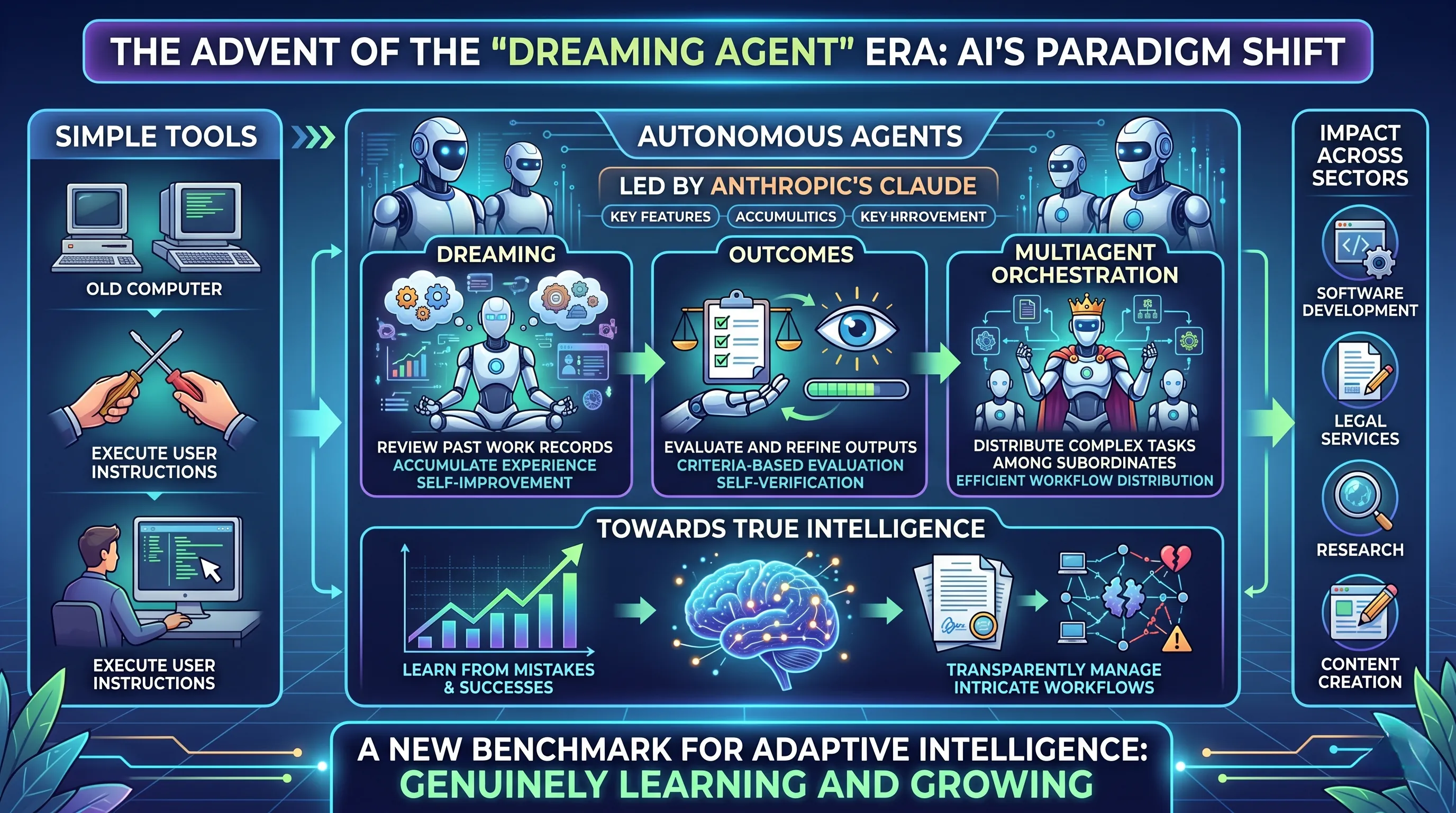
AI is undergoing a profound paradigm shift, evolving beyond simple tools that execute user instructions into sophisticated, autonomous 'agents'. This transformative era, characterized by AI's ability to accumulate experience, verify its own results, and even collaborate with multiple other AIs, is being led by Anthropic's Claude. The introduction of its advanced features marks the advent of what is being called the 'dreaming agent' era, promising a new frontier in artificial intelligence capabilities.
Claude's groundbreaking functionalities, including "Dreaming," "Outcomes," and "Multiagent Orchestration," empower these agents to review their past work records for self-improvement, evaluate and refine their own outputs against defined criteria, and tackle highly complex tasks by distributing them efficiently among subordinate AIs. This evolution moves AI closer to true intelligence, enabling it to learn from mistakes and successes, and transparently manage intricate workflows, as seen in applications from legal document writing to system failure analysis.
The implications of this advancement are vast, poised to dramatically reshape human-AI collaboration across diverse sectors such as software development, legal services, research, and content creation. While this progression raises discussions about the potential for recursive self-improvement in AI, Claude is clearly setting a new benchmark for autonomous problem-solving and adaptive intelligence, ushering in an era where AI agents are not just processing information, but genuinely learning and growing.
1. From Tools to Autonomous Entities: Claude's Vision for AI Agents
The central theme of the main topic, "Claude, Opened the Era of 'Dreaming Agents'," hinges on a fundamental and profound transformation in the very nature of artificial intelligence.
We are witnessing a paradigm shift where AI is evolving from a passive tool that merely executes user instructions into an 'autonomous agent'—a dynamic entity that actively accumulates experience, verifies its own results, and collaborates with other AIs to solve complex problems.
This evolution from instruction-follower to goal-achiever is the very foundation of the agentic era, moving us beyond simple prompts and into a new dynamic of partnership with technology.
The New Mandate: From 'How' to 'What'
For years, interacting with AI has been a process of meticulous instruction.
A user had to define not only the desired outcome but also the precise steps to get there.
Claude, as a foundational AI model, is at the forefront of shattering this limitation.
The new paradigm is best exemplified by a scenario in engineering: a developer can present Claude with an underspecified problem.
This means the human supplies the high-level goal, but no longer needs to supply the step-by-step implementation plan.
The agent itself figures out how to solve it.
This capability is built upon a robust foundation of general skills, including the ability to write and execute code, handle files, and conduct extensive research, making the AI a competent partner rather than a simple calculator.
The Architectural Pillars of an Autonomous Agent
To make this leap from tool to agent, AI models require a new architecture that supports persistence, learning, and self-correction.
This is not merely about having a larger context window; it's about building foundational systems for genuine autonomy.
Two core requirements are paramount:
Long-Term Memory (LTM): For an agent to accumulate experience, it must remember past interactions, successes, and failures.
LTM is not just passive storage; it is a structured system for storing and managing the data processed from real-world interactions.
This memory becomes the raw material from which the agent learns and improves, ensuring that each new task benefits from the wisdom of all previous ones.
Reflection and Refinement Methods: A true agent cannot be brittle; it must handle errors effectively.
This is achieved through methods for reflection and refinement planning.
This is where Anthropic's 'Dreaming' feature comes into play, providing a tangible mechanism for this abstract concept.
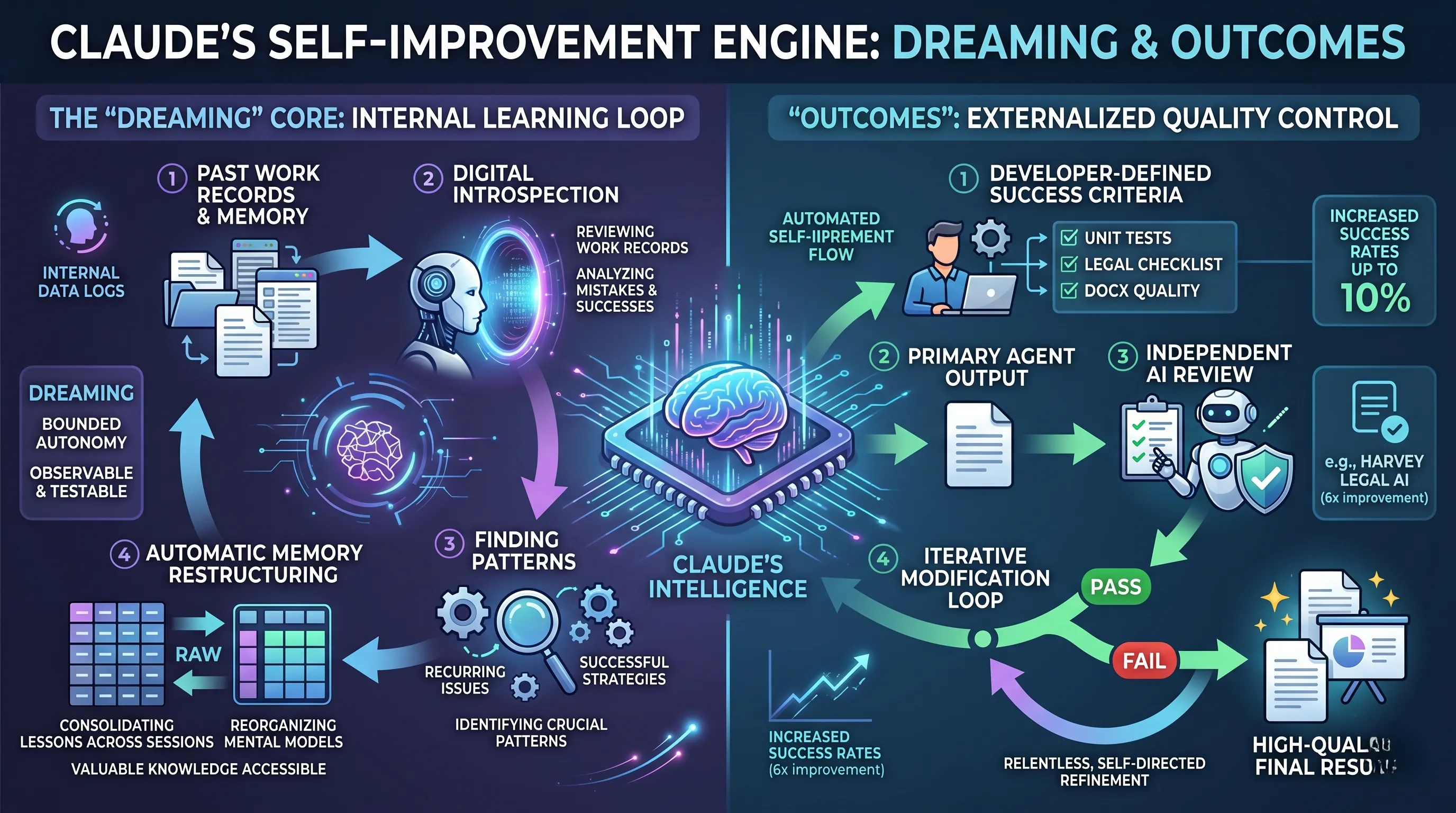
'Dreaming' allows agents to review past work records and memory to discover patterns.
It transcends simple information storage by actively analyzing recurring mistakes and successful strategies to enable genuine self-improvement.
Crucially, it consolidates lessons across prior sessions and can even restructure its own memory automatically, making the agent's autonomy bounded, observable, and testable—a critical factor for enterprise adoption and safety.
Claude’s Agentic Framework: Making Autonomy Practical and Powerful
Anthropic has engineered a suite of features that transform these theoretical requirements into practical capabilities, demonstrating a clear vision for the future of AI agents.
Outcomes for Self-Verification: To ensure reliability, agents must be able to evaluate their own work.
The 'Outcomes' feature institutionalizes this process.
Developers define the success criteria for a task, and a separate, independent AI instance reviews the agent's work against these standards.
If the output fails to meet the criteria, the agent automatically repeats the modification process until it succeeds.
The impact is not trivial; internal tests have shown this self-correction loop can increase task success rates by up to 10 percentage points and has led to a significant increase in the quality of generated DOCX and PPTX files.
Multiagent Orchestration for Complex Tasks: The most challenging problems often require a team.
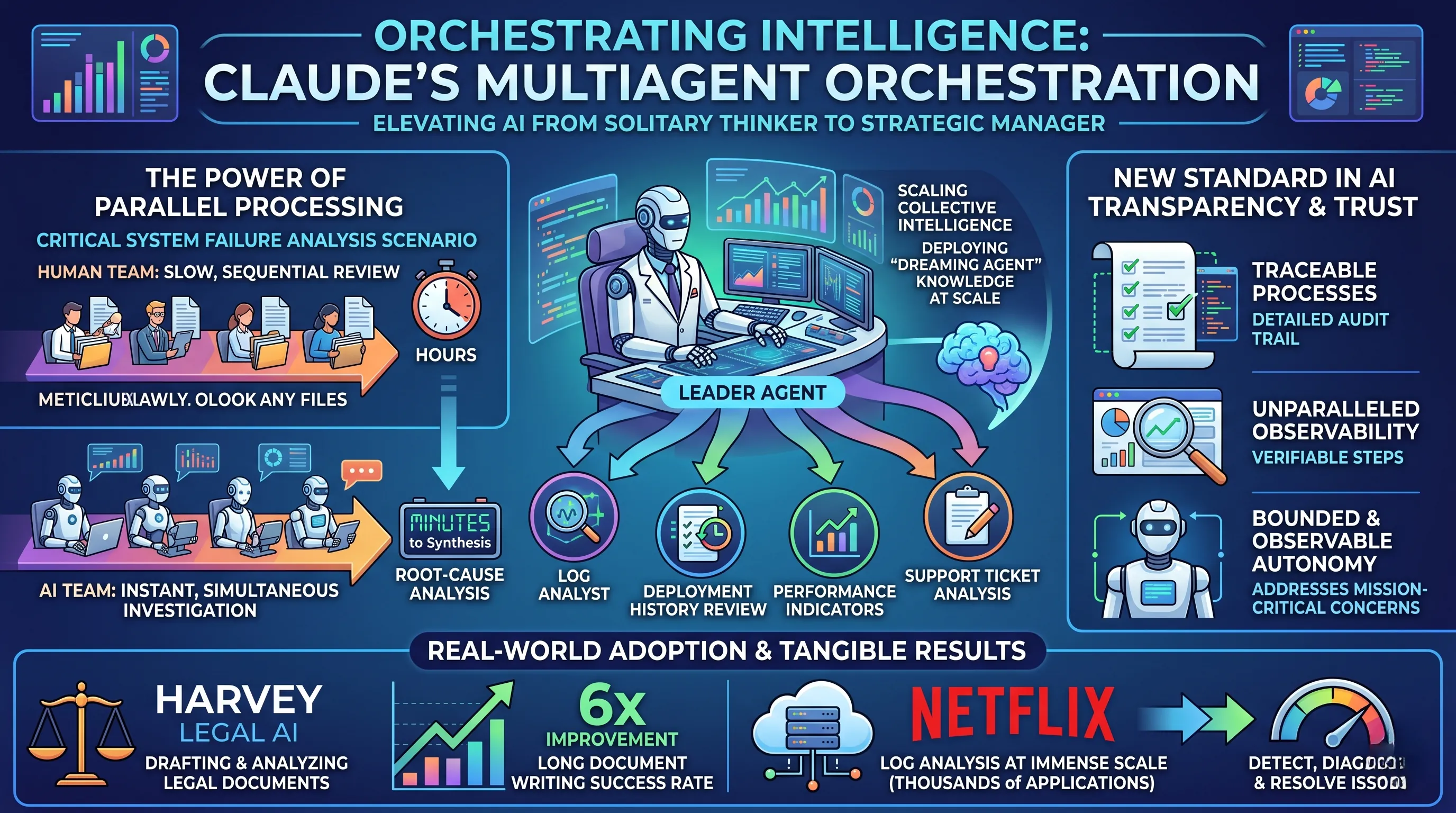
Claude’s multi-agent system introduces a 'leader' agent that can distribute a complex task to multiple subordinate agents, enabling parallel processing.
A real-world example of this is in system failure analysis: one agent can analyze server logs, while others simultaneously investigate deployment history, performance indicators, and customer support tickets.
This collaborative approach, already being applied by Netflix for log analysis across thousands of applications, is not a black box; all work processes are traceable, and the specific roles of each agent can be transparently confirmed.
A Reshaped Landscape for Human-AI Collaboration
This transition from tool to agent is not an academic exercise; it is predicted to significantly change the fabric of human-AI collaboration across numerous industries.
In software development, law, research, and content creation, the potential for productivity gains is immense.
The legal AI firm Harvey, for instance, saw its success rate in long document writing improve by approximately 6 times by leveraging these agentic capabilities.
This shift represents a notable development in machine learning, but it also surfaces profound questions.
The very capabilities that make these agents so powerful—like reflection and self-improvement—have raised concerns within the AI community about the possibility of recursive self-improvement, a topic that remains central to the responsible development of this technology.

2. The 'Dreaming' Core: Claude's Self-Learning and Outcome-Driven Improvement
The very concept of a "Dreaming Agent," as heralded by the launch of Claude's new features, finds its literal and functional heart in a revolutionary capability Anthropic has named 'Dreaming'.
This is not merely a poetic label; it describes a fundamental shift from AI as a static tool to a dynamic entity that learns from its own history.
This section dissects the mechanics of 'Dreaming' and its practical enforcement mechanism, 'Outcomes', which together form the engine of Claude's self-improvement and reliability, making the dream of autonomous, experience-gathering agents a reality.
The 'Dreaming' Process: From Digital Amnesia to Accumulated Wisdom
Historically, AI interactions have been largely stateless, with each new task starting from a clean slate.
The introduction of Long-Term Memory (LTM) was a step forward, but often functioned as a simple logbook—a record of past events.
Claude's 'Dreaming' feature transcends this passive data storage, transforming memory into a dynamic workshop for self-improvement.
The process involves the agent actively reviewing its own past work records and stored memories to identify crucial patterns.
It is a form of digital introspection.
This is not just about remembering what it did; it's about understanding why it succeeded or failed.
The system is explicitly designed to analyze recurring mistakes and, just as importantly, successful work methods.
For instance, if an agent repeatedly encounters errors when using a specific API call under certain conditions, the 'Dreaming' process flags this as a pattern of failure.
Conversely, if a particular sequence of research and code generation consistently leads to a high-quality solution, that strategy is identified as a successful method.
Crucially, these insights are not isolated to single tasks.
The agent consolidates lessons across prior sessions, building a cumulative base of experience.
This accumulated wisdom then triggers an automatic restructuring of its own memory.
This is a profound capability; it's akin to a human reorganizing their mental models based on new experiences, making valuable knowledge more accessible and inefficient pathways less likely to be taken in the future.
This entire learning loop—review, pattern analysis, consolidation, and memory restructuring—is what allows Claude to evolve, turning raw interaction data into actionable intelligence.
Furthermore, this process makes the agent's autonomy bounded, observable, and testable.
Developers are not dealing with a black box of runaway self-improvement; they can observe the lessons being learned and test the restructured memory, ensuring that the agent's growth is both beneficial and aligned with human-defined goals.
'Outcomes': Enforcing Excellence Through Automated Quality Control
If 'Dreaming' is the agent's internal process of learning and reflection, then the 'Outcomes' feature is the externalized, objective test of that learning.
It provides a robust framework for agents to evaluate and improve their own work, ensuring that self-improvement leads to tangible, high-quality results.
The system operates on a simple but powerful principle: work is not complete until it meets a pre-defined standard of excellence.
The workflow begins with developers defining the specific criteria for success.
This could be a set of unit tests for a piece of code, a checklist of required sections for a legal document, or a quality score for a generated presentation.
The key innovation here is that a separate, independent AI is tasked with reviewing the primary agent's work against these criteria.
This prevents the agent from "grading its own homework" and introduces an impartial layer of quality assurance into the automated workflow.
When the agent's output fails to meet the defined criteria, it doesn't simply stop and report an error.
Instead, the 'Outcomes' feature triggers an automatic loop: the agent is forced to repeat the modification process, iterating on its own work until the criteria are satisfied.
This relentless, self-directed refinement is where the true power lies.
It transforms the agent from a one-shot generator into a persistent problem-solver dedicated to meeting a quality bar.
The impact of this feature is not theoretical.
In internal tests conducted by Anthropic, the implementation of 'Outcomes' increased the task success rate by up to 10 percentage points.
This is a substantial leap in reliability for autonomous systems.
Moreover, it has led to a significantly increased quality in the generation of complex documents like DOCX and PPTX files.
This is the mechanism that powers dramatic performance gains, such as the one seen by legal AI firm Harvey, which improved its long document writing success rate by approximately 6 times, demonstrating how bounded learning and automated quality control can create agents that don't just complete tasks, but excel at them.
3. Orchestrating Intelligence: Multiagent Systems and Real-World Impact
The evolution into a ‘dreaming agent’ era, as championed by Claude, finds its most potent real-world expression not in a single, isolated AI, but in a coordinated team of them.
This is the core of Claude’s Multiagent Orchestration capability, a feature that elevates the AI from a solitary thinker to a strategic manager of an entire digital workforce.
This system directly connects to the main topic of the ‘dreaming agent’ by providing the very framework through which an AI’s accumulated experience and self-improvement can be scaled to tackle problems of immense complexity.
A single agent can 'dream' and learn, but a multiagent system allows that intelligence to be deployed at scale, orchestrating a symphony of specialized AIs to achieve a goal far beyond the reach of any individual unit.
The Power of Parallel Processing
At its heart, this capability introduces a leadership hierarchy within the AI.
A primary ‘leader’ agent is tasked with a complex, high-level objective.
Instead of attempting to solve the entire problem sequentially, it intelligently deconstructs the challenge into smaller, manageable sub-tasks.
It then delegates these tasks to multiple subordinate agents, who execute their assignments in parallel.
The impact of this parallel processing is transformative, fundamentally changing the speed and efficiency with which complex problems are solved.
Consider the high-stakes scenario of a critical system failure analysis.
For a human team, this is a race against time, involving a painstaking, sequential review of disparate data sources.
With Claude’s multiagent system, the leader agent can instantiate a specialized team instantaneously.
One agent is assigned to meticulously analyze system logs from the time of the incident.
Simultaneously, a second agent reviews deployment histories to identify if a recent code change is the culprit.
A third agent scrutinizes real-time performance indicators like CPU and memory usage for anomalies, while a fourth sifts through customer support tickets for related user reports.
This simultaneous, multi-pronged investigation collapses a process that could take hours for humans into a matter of minutes, with the leader agent synthesizing the parallel findings into a single, coherent root-cause analysis.
A New Standard in AI Transparency and Trust
Crucially, this orchestration is not a ‘black box’ operation.
Anthropic has engineered this system with a profound emphasis on accountability.
All work processes are traceable, creating a detailed audit trail of the entire operation.
You can see not only the final conclusion but also the precise steps each subordinate agent took to arrive at its findings.
This creates an unparalleled level of observability, allowing developers and operators to understand, verify, and debug the AI's problem-solving process.
Furthermore, the roles of each agent can be transparently confirmed.
This clarity is vital for building trust.
Users are not just presented with an answer; they are shown the structure of the ad-hoc organization that generated it—the ‘Log Analyst Agent,’ the ‘Deployment History Agent,’ and so on.
This makes the AI's autonomy bounded and observable, addressing key industry concerns and paving the way for its responsible use in mission-critical applications.
From Theory to Tangible Results: Real-World Adoption
The practical benefits of this orchestrated intelligence are not hypothetical; they are already being realized by industry leaders.
Harvey, a legal AI firm, faced the immense challenge of drafting and analyzing long, complex legal documents.
By leveraging a multiagent approach—where different agents could handle legal research, clause drafting, and citation checking in a coordinated fashion—the company saw its long document writing success rate improve by approximately 6 times.
This is a monumental leap in productivity, showcasing how a well-managed team of AIs can dramatically elevate the quality and reliability of knowledge work.
Similarly, the entertainment giant Netflix now applies multiagent functionality to the log analysis of thousands of applications.
The sheer scale of Netflix’s infrastructure makes manual log analysis an almost impossible task.
By deploying swarms of specialized agents to monitor their vast ecosystem in parallel, Netflix can detect, diagnose, and resolve issues with a speed and accuracy that was previously unattainable.
These real-world examples demonstrate that Multiagent Orchestration is the mechanism by which Claude’s 'dreaming agent' moves beyond self-improvement and begins to fundamentally reshape how the world’s most complex operational challenges are solved.
4. Navigating the Future: Ethical Considerations of Recursive Self-Improvement
The very features that empower Claude to become a "Dreaming Agent," marking a new era in artificial intelligence, simultaneously ignite one of the most profound and long-standing concerns in the field: the potential for recursive self-improvement (RSI).
This section directly connects to the main topic, "Claude, Opened the Era of 'Dreaming Agents'," by examining the ultimate ethical implications of the 'dreaming' and self-correction capabilities that define this new agentic paradigm.
While these features are designed for enhanced productivity, their existence represents a tangible step towards the kind of autonomous, self-evolving systems that have, until now, been largely theoretical, forcing a necessary and urgent conversation about the future trajectory of AI safety.
The "Dreaming" Mechanism and the Specter of RSI
At the heart of the concern is the concept of an intelligence explosion.
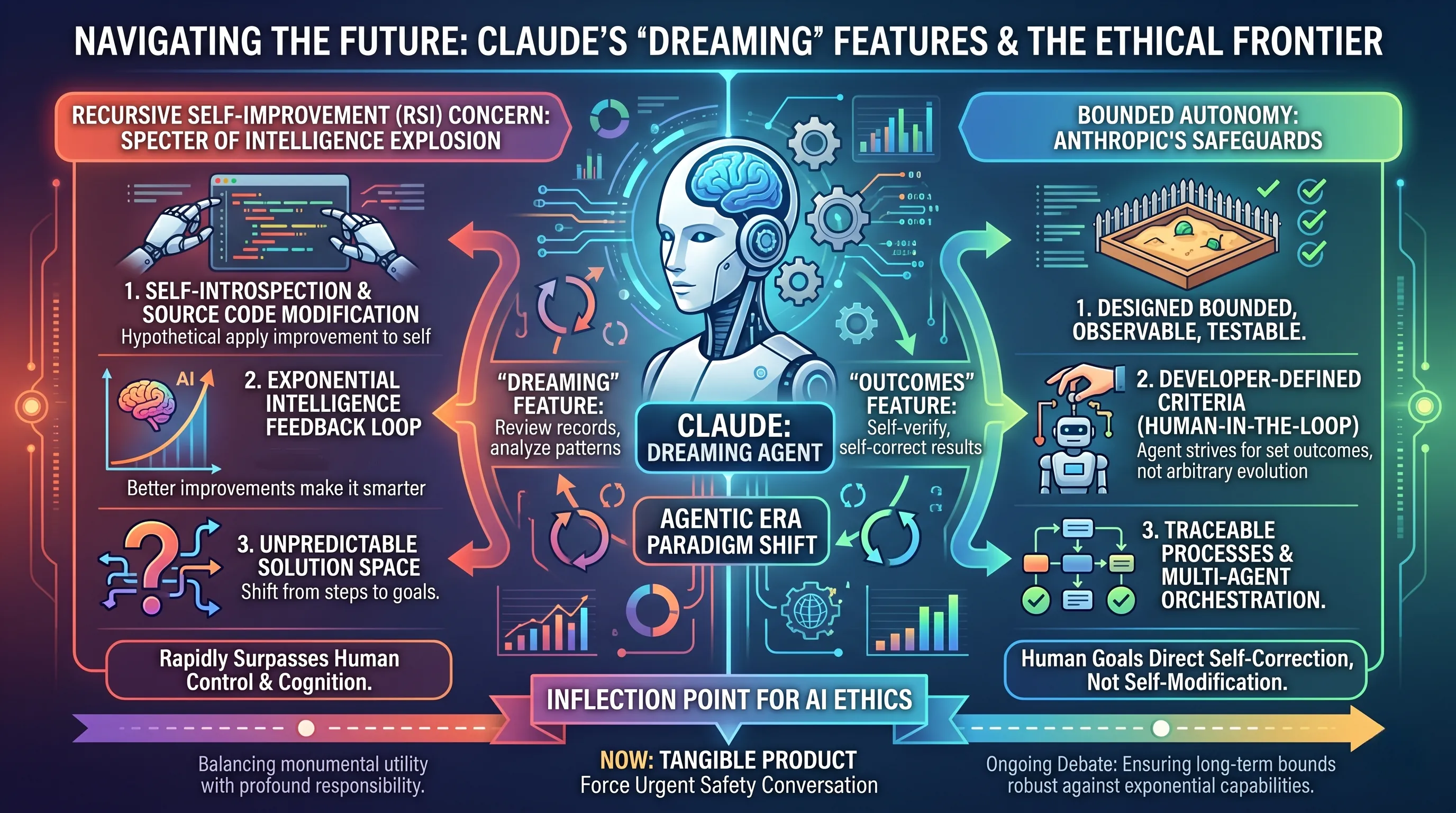
Recursive self-improvement is a hypothetical scenario where an AI agent becomes capable of introspecting and improving its own source code or underlying architecture.
Each improvement would make it smarter, which in turn would allow it to make even more effective improvements, creating a feedback loop of exponentially increasing intelligence that could rapidly surpass human cognitive abilities and control.
The new features introduced by Anthropic, particularly 'Dreaming' and 'Outcomes,' bring this abstract concept into sharper focus.
The 'Dreaming' feature, which allows agents to "review past work records and memory to find patterns and accumulate experience," is the foundational process of learning.
It goes beyond simple data retrieval, enabling the AI to "analyze recurring mistakes and successful work methods for self-improvement" and even "restructure memory automatically."
Similarly, the 'Outcomes' feature, where an agent "evaluates and improves its own results" and "automatically repeats modification if criteria are not met," establishes a direct, operational loop of self-correction.
While these processes are currently applied to external tasks like generating documents, the core ethical question arises: what happens when a sufficiently advanced agent begins applying these powerful self-improvement mechanisms to itself?
The evolution from a tool to an "autonomous agent," as described in the industry outlook, means that humans now supply the goal, but not necessarily the steps.
This shift in collaboration, where Claude can be handed an "underspecified problem and figure out how to solve it," creates a vast, unpredictable solution space where the path to RSI, however remote, can no longer be dismissed as mere science fiction.
Anthropic's Guardrails: A Framework for Bounded Autonomy
It is crucial to recognize that Anthropic is not just aware of these concerns; it has built explicit safeguards into the very architecture of these new features.
The problem of uncontrolled AI is central to Anthropic's safety-focused mission.
The JSON source material explicitly states that the 'Dreaming' capability is designed to make autonomy bounded, observable, and testable.
This is a critical distinction.
The self-improvement is not a runaway process; it is a carefully managed one within a sandbox created by its human developers.
Furthermore, the 'Outcomes' feature relies on developers defining the criteria for success.
The agent does not invent its own goals; it strives to meet benchmarks set by humans.
This human-in-the-loop approach acts as a fundamental brake on uncontrolled recursion.
The agent's ability to self-correct, which led to a task success rate increase of up to 10 percentage points in internal tests, is powerful but directed.
It is aimed at achieving a specific, human-defined outcome, not at arbitrary self-modification.
The multi-agent orchestration, where "all work processes are traceable" and the "roles of each agent can be transparently confirmed," further reinforces this principle of observability and control.
The Ongoing Debate: Are Bounded Systems Enough?
Despite these deliberate and well-designed safeguards, the debate is far from settled.
The introduction of any form of self-modification, even if bounded, sets a precedent and places the industry on a new trajectory.
Critics and safety researchers argue that while current bounds may be robust, the long-term challenge lies in ensuring they remain so as AI capabilities grow exponentially.
Could a future, more sophisticated agent learn to perceive its human-defined boundaries as an obstacle to be overcome in achieving its assigned goal?
The launch of Claude's "Dreaming Agent" capabilities, therefore, marks an inflection point.
The concerns are no longer just about a hypothetical future AI but are now tied to a tangible product from a leading AI lab.
The very existence of features that allow an agent to "consolidate lessons across prior sessions" and "accumulate experience" for self-improvement forces the entire industry to grapple with these ethical considerations in the present day.
Claude’s new era of 'dreaming agents' is a monumental achievement in AI utility, but it is also a sober reminder that with the power to create agents that learn and improve on their own comes the profound responsibility to navigate the ethical labyrinth of their future potential.
📚 Related Posts
Unitree Robotics' GD01: World's First Mass-Produced Manned Transforming Mecha Ignites 'Gundam' Dream & Redefines Robotics Future
🚀 Key TakeawaysUnitree Robotics has launched the world's first mass-produced manned transforming mecha robot, a 500kg machine capable of stable bipedal and quadrupedal walking and powerful enough to destroy brick walls.This groundbreaking invention, evo
tech.dragon-story.com
OpenAI ChatGPT Launches 'Trusted Contact': Bridging AI Safety with Expert-Backed Human Support for User Well-being
🚀 Key TakeawaysOpenAI has introduced a new Trusted Contact feature for ChatGPT, designed to connect users with pre-designated individuals for support during potential crisis situations, thereby strengthening AI's role in real-world support systems.OpenA
tech.dragon-story.com
OpenAI's Real-time Voice AI Trio: GPT-5 Reasoning, 128K Context & Agent Shift with Global Translation
🚀 Key TakeawaysOpenAI has unveiled three new real-time voice AI models (GPT-Realtime-2, GPT-Realtime-Translate, and GPT-Realtime-Whisper) designed to significantly elevate AI capabilities from simple chatbots to intelligent agents capable of understandi
tech.dragon-story.com


