🚀 Key Takeaways
- The partnership between Anthropic and SpaceXAI secures a massive compute boost for Claude, leveraging SpaceX's Colossus 1 data center with over 300 megawatts and 220,000 NVIDIA GPUs.
- This strategic collaboration immediately enhances Claude's user experience by doubling usage limits and abolishing peak-time restrictions for Pro and Max users, while significantly raising API limits for Opus models.
- The deal represents a lucrative venture for SpaceX, projected to generate $3-4 billion in annual revenue, and positions both companies at the forefront of the AI compute race, exploring potential gigawatt-scale space-based AI infrastructure.
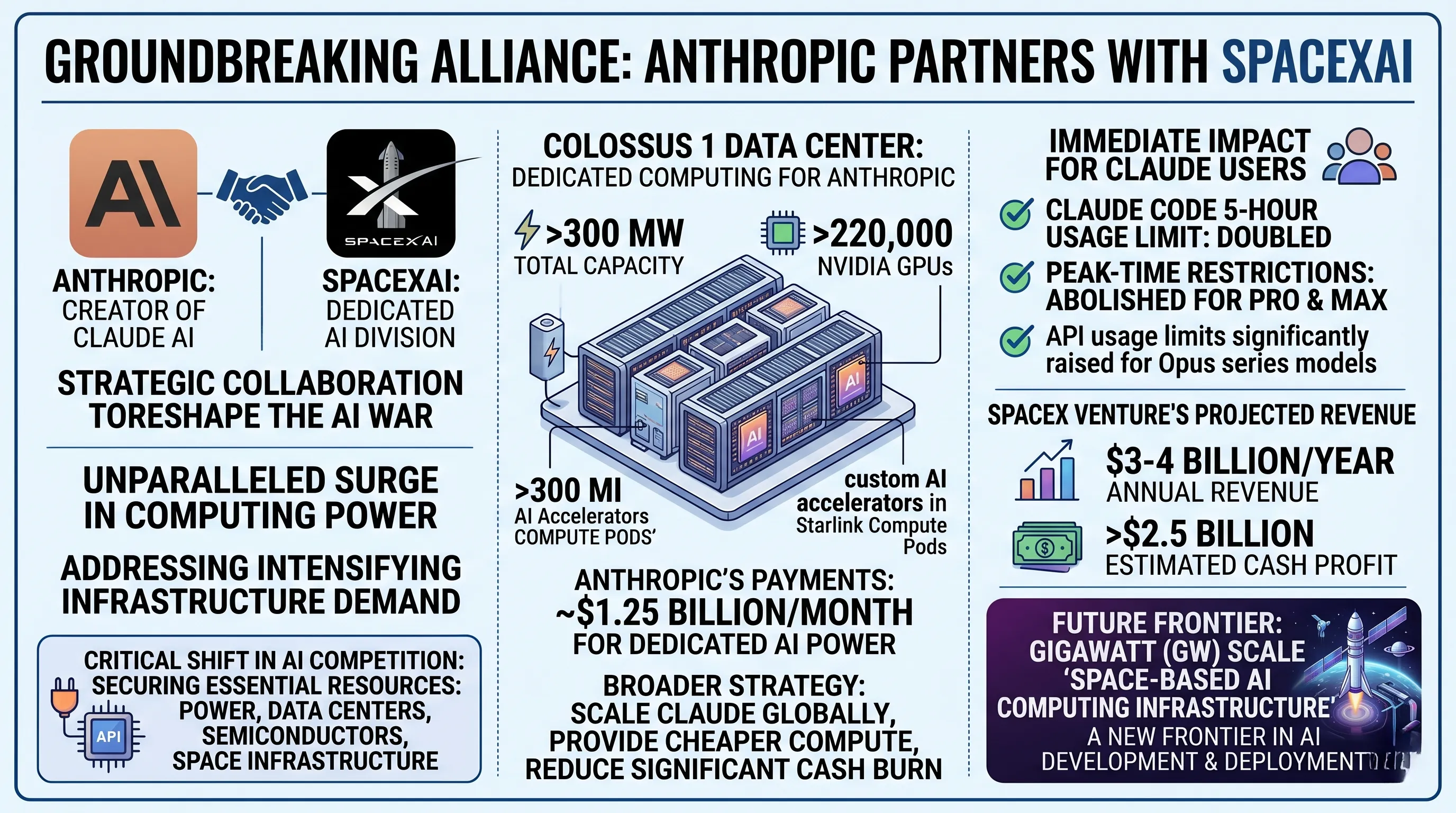
A groundbreaking alliance has been forged as Anthropic, the creator of the advanced AI model Claude, partners with SpaceX's dedicated AI division, SpaceXAI.
This strategic collaboration is set to dramatically reshape the landscape of the AI war by providing Anthropic with an unparalleled surge in computing power, directly addressing the industry's intensifying demand for robust infrastructure.
The move underscores the critical shift in AI competition, where securing not just software, but also essential resources like power, data centers, semiconductors, and even space infrastructure, is paramount for leadership.
At the core of this partnership is SpaceX's Colossus 1 data center, which will dedicate its entire computing resources to Anthropic.
This includes an astounding capacity of over 300 megawatts (MW) and more than 220,000 NVIDIA GPUs, all housed within custom AI accelerators in rugged 'Starlink Compute Pods'.
Anthropic's commitment involves payments of approximately $1.25 billion per month to SpaceX for this dedicated AI computing power.
This substantial investment is part of Anthropic's broader strategy to scale Claude globally, aiming to provide cheaper compute while reducing its significant cash burn on terrestrial compute solutions.
The immediate impact for Claude users is profound: Claude Code's 5-hour usage limit has been doubled, and peak-time restrictions have been abolished for Claude Pro and Max users, effectively immediately. Furthermore, API usage limits for Claude Opus series models have been significantly raised, empowering developers and enterprise customers with greater freedom.
For SpaceX, this venture is projected to generate an estimated $3-4 billion in annual revenue, with over $2.5 billion in estimated cash profit.
Looking ahead, both companies are exploring the ambitious possibility of establishing several gigawatts (GW) scale 'space-based AI computing infrastructure', signaling a new frontier in AI development and deployment.
1. SpaceX's Colossus 1: Unlocking Unprecedented Compute Power for Anthropic
This partnership, centered on the newly revealed Colossus 1 data center, is the very engine room driving the entire premise of our main topic: "Claude, joining hands with SpaceX, changes the game in the AI war."
It is not merely an incremental upgrade; it is the physical manifestation of a strategic pivot, providing Anthropic with the raw computational force required to fundamentally alter the competitive landscape. This section details the hardware, financials, and strategic implications of the deal that gives Claude its new arsenal.
The Scale of Colossus 1: A Nation-State Level Supercomputer
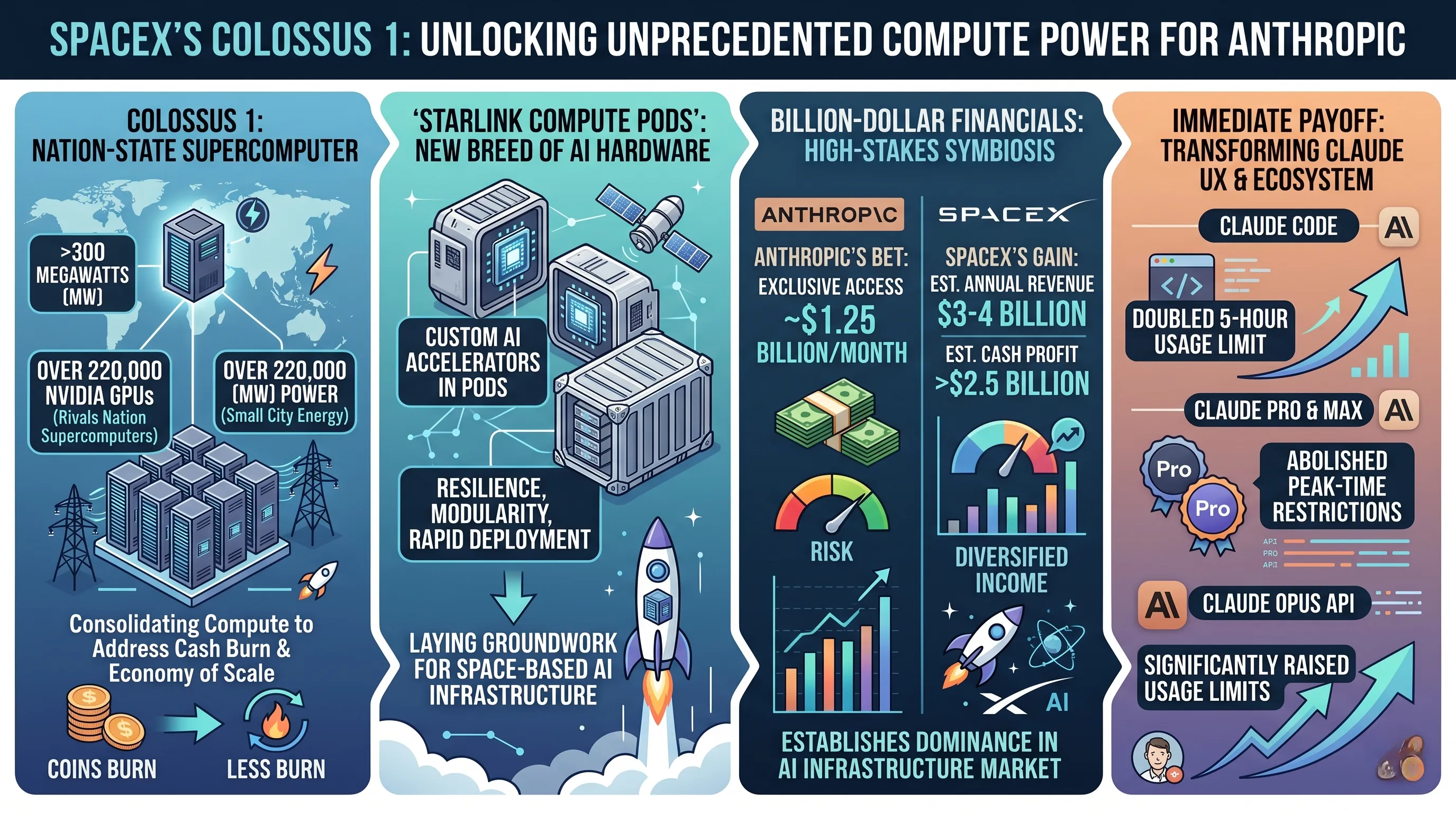
The agreement between Anthropic and the SpaceXAI division is breathtaking in its scope, granting Anthropic exclusive access to the entire computing resources of SpaceX's Colossus 1 data center.
This commitment immediately catapults Anthropic into the highest echelon of AI infrastructure ownership.
The raw specifications underscore the sheer magnitude of this leap: the facility provides over 300 megawatts (MW) of power, fueling a staggering array of over 220,000 NVIDIA GPUs.
To put this into perspective, 300 MW is enough energy to power a small city, and a cluster of over 220,000 of the latest GPUs constitutes a supercomputer that rivals the capabilities of entire nations.
This is the critical resource that directly addresses one of Anthropic's biggest challenges: its significant cash burn on less efficient terrestrial compute.
By consolidating its needs into this massive, purpose-built facility, Anthropic aims to achieve an economy of scale that makes its computational spending more effective, even at an astronomical price point.
The 'Starlink Compute Pods': A New Breed of AI Hardware
This immense power is not housed in a conventional data center architecture.
SpaceX is leveraging its unique engineering ethos by deploying custom AI accelerators within ruggedized 'Starlink Compute Pods.'
This design choice is telling.
It suggests a system built for resilience, rapid deployment, and modularity—hallmarks of SpaceX's approach to rocketry and satellite technology.
These pods are not just servers; they are industrial-grade compute units designed for extreme efficiency and robustness.
This hardware innovation is a key enabler of the partnership's future ambitions, laying the groundwork for a potential expansion beyond terrestrial limits and into the very "space-based AI computing infrastructure" the partners are exploring.
The Billion-Dollar Financials: A High-Stakes Symbiosis
The financial terms of this deal are as monumental as the hardware itself, revealing a deep, symbiotic relationship.
For its exclusive access to Colossus 1, Anthropic is paying SpaceX approximately $1.25 billion per month.
This expenditure is a clear signal of Anthropic's all-in strategy; it is a bet-the-company level investment that demonstrates how the AI war has shifted from a battle of algorithms to a war of securing fundamental resources like power and silicon.
For SpaceX, this arrangement is transformative.
According to estimates from New Street Research, this single deal is projected to generate $3-4 billion in annual revenue for SpaceX, with an estimated cash profit of over $2.5 billion.
This instantly establishes SpaceXAI as a dominant force in the AI infrastructure market, creating a massively profitable new business vertical that diversifies its income beyond launch services and Starlink subscriptions.
The high profit margin suggests SpaceX possesses a formidable competitive advantage in constructing and operating these hyper-scale facilities, turning its engineering prowess into a lucrative new service.
From Infrastructure to User Experience: The Immediate Payoff
This massive influx of compute power is not a theoretical, long-term benefit; it is already delivering tangible improvements to the entire Claude ecosystem.
The partnership has enabled Anthropic to immediately address user pain points and unlock new potential for its models.
The changes are significant and immediate:
- The 5-hour usage limit for Claude Code has been doubled, empowering developers to work on more complex, time-intensive projects without interruption.
- Peak-time restrictions for Claude Pro and Max users have been completely abolished, transforming the service into a reliable, always-on utility.
- API usage limits for the powerful Claude Opus series models have been significantly raised, which is perhaps the most crucial update for the developer and enterprise community.
These enhancements directly enable developers and enterprise customers to utilize AI services more freely and build more ambitious applications on the Claude platform. This is a strategic move to not only improve the user experience but also to accelerate the growth of the entire ecosystem built around Anthropic's models, further solidifying its position in the ongoing AI war.
2. Claude Unleashed: Doubled Limits and Abolished Restrictions for Users and Enterprises
The monumental partnership between Anthropic and SpaceX is not a distant, abstract corporate strategy; it is the direct engine fueling immediate and tangible benefits for every user of the Claude ecosystem.
This alliance directly addresses one of the most significant bottlenecks in the AI industry: computational capacity.
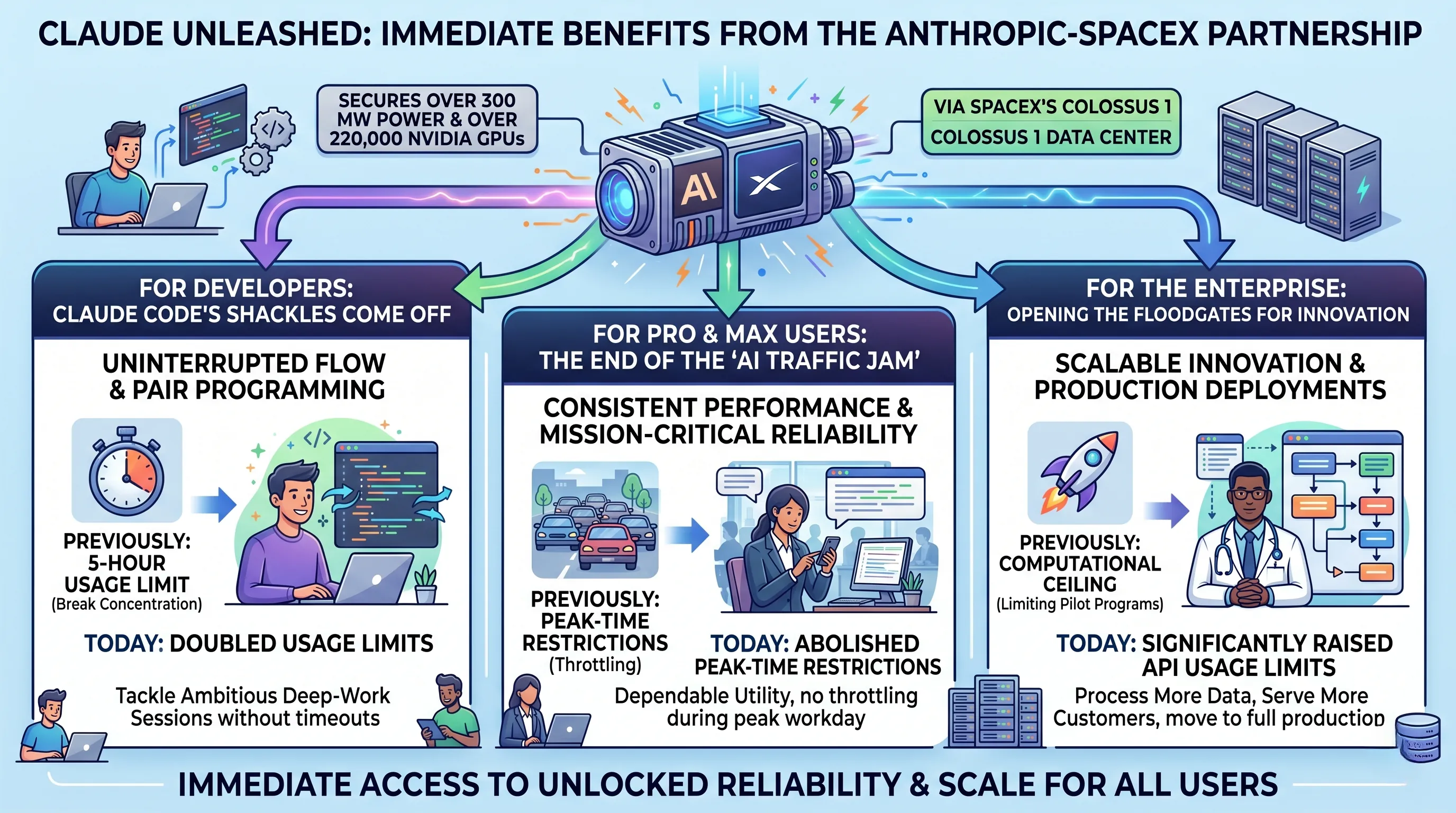
By securing over 300 megawatts of power and access to over 220,000 NVIDIA GPUs via SpaceX's Colossus 1 data center, Anthropic has effectively unlocked a new tier of service reliability and scale.
This is how the "game-changing" nature of the deal manifests for developers, professionals, and large-scale enterprises—not in future promises, but in concrete service enhancements available today.
For the Developers: Claude Code's Shackles Come Off
For developers, maintaining a state of "flow" is paramount to productivity.
Previously, the 5-hour usage limit on Claude Code acted as an unavoidable interruption, a hard stop that could break concentration during complex debugging sessions or the development of intricate algorithms.
The partnership's first dividend is the immediate doubling of Claude Code's 5-hour usage limit.
This isn't just a quantitative increase; it's a qualitative transformation of the development experience.
It represents the difference between a helpful assistant and a true, uninterrupted pair-programming partner.
A developer can now confidently embark on a deep-work session, tackling substantial refactoring projects or building out entire features from scratch without the looming threat of a forced timeout.
This change empowers developers to use Claude Code for more ambitious tasks, fostering a more seamless and productive human-AI collaboration right in the IDE.
For Pro and Max Users: The End of the 'AI Traffic Jam'
One of the most common frustrations for paid subscribers of any popular service is performance degradation during peak usage hours.
For Claude Pro and Max users, this often meant encountering throttling or restrictions precisely when they needed the AI most—during the busiest parts of the workday.
The massive infusion of computing power from SpaceX has allowed Anthropic to completely abolish peak-time restrictions for Claude Pro and Max users.
This move elevates Claude from a powerful-but-sometimes-unavailable tool to a mission-critical, consistently reliable professional utility.
Users no longer have to second-guess if their subscription will deliver the performance they paid for at 2 PM on a Tuesday.
This newfound reliability is crucial for professionals who depend on Claude for drafting reports, analyzing data, and generating time-sensitive content.
It builds a foundation of trust and transforms the service into a dependable fixture of their daily workflow.
For the Enterprise: Opening the Floodgates for Innovation
While individual user enhancements are significant, the most profound impact of the SpaceX partnership is felt at the enterprise level.
Businesses building applications and services on Anthropic's platform are now supercharged by a significant increase in API usage limits for the Claude Opus series models.
This is the green light that enterprises have been waiting for to scale their AI-driven operations aggressively.
Higher API limits mean a company can serve more customers, process more data, and run more complex, multi-step AI workflows without fear of hitting a computational ceiling.
For a fintech company, it means processing a higher volume of financial document analyses.
For a healthcare provider, it allows for the scaling of AI-powered patient communication tools.
This change directly enables and encourages businesses to move their AI projects from pilot programs to full-scale production deployments.
It is a direct consequence of Anthropic's broader strategy to invest in large-scale infrastructure, ensuring that its most powerful models are not just a technological marvel, but a commercially viable and scalable foundation for the next generation of enterprise AI.
3. Reshaping the AI War: Strategic Advantages and the Vision for Space-Based Compute
This section directly addresses the core thesis of the main topic, "Claude partners with SpaceX, changing the game in the AI war," by dissecting the strategic underpinnings of this alliance. It moves beyond the simple announcement to explain *how* this partnership fundamentally alters the competitive landscape. It reveals that the AI war is no longer just about algorithms and model size, but has decisively shifted to a battle for raw, physical infrastructure—power, data centers, and now, even space—and how this specific deal gives Anthropic a powerful new arsenal in this evolving conflict.
The New Battlefield: A War for Physical Infrastructure
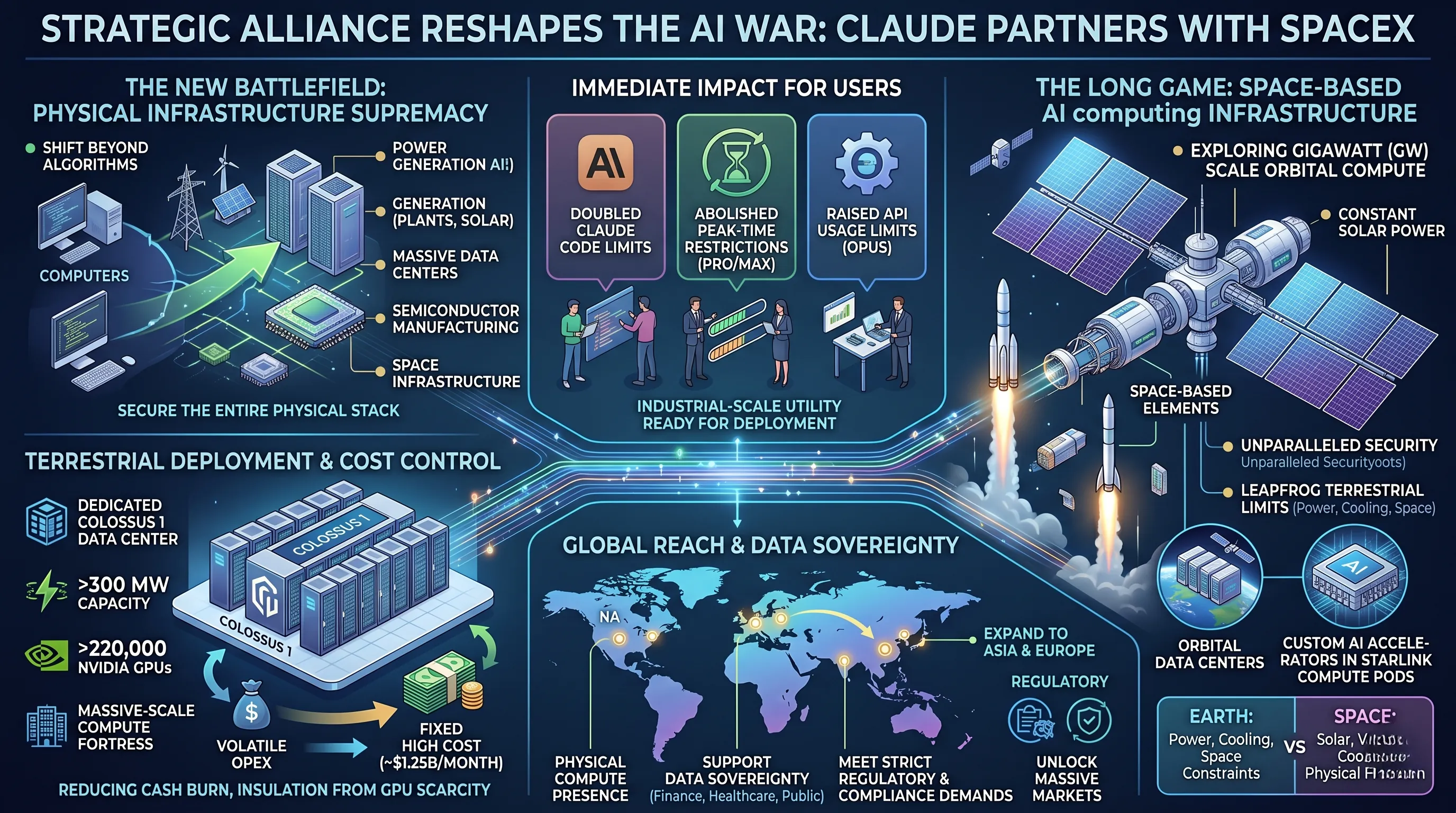
The competition among leading AI firms has reached a critical inflection point. As the JSON facts highlight, the battle for supremacy is rapidly "shifting towards securing computing resources." An innovative model is no longer enough; victory now belongs to those who can secure the underlying physical stack: the power to run the systems, the data centers to house them, the semiconductors to process the data, and in this groundbreaking case, even space infrastructure. Anthropic's partnership with SpaceX is the most aggressive and tangible acknowledgment of this new reality.
This alliance is a direct counter-offensive to Anthropic's immense operational challenge: the company has been "burning significant cash on terrestrial compute." By securing the *entirety* of SpaceXAI's Colossus 1 data center, Anthropic is not just buying more server time; it is acquiring a dedicated, massive-scale compute fortress. The specifications are staggering: a capacity of over 300 megawatts (MW) powering over 220,000 NVIDIA GPUs. This move insulates Anthropic from the volatile and fiercely competitive market for GPU resources, providing a stable and predictable foundation for its development and scaling efforts. While the price tag of approximately $1.25 billion per month is colossal, it represents a strategic decision to trade unpredictable, fluctuating operational expenses for a fixed, albeit high, cost that guarantees access to world-class infrastructure. This is how Anthropic aims to provide "cheaper compute" in the long run, not by absolute dollar amount, but by escaping the premium costs and scarcity of the open market, thereby reducing its relative cash burn and gaining a significant competitive edge.
The immediate impact of this raw power infusion is felt directly by users, making the abstract concept of compute capacity tangible. The partnership has enabled Anthropic to instantly double Claude Code's 5-hour usage limit and completely abolish peak-time restrictions for Claude Pro and Max users. Furthermore, the significantly raised API usage limits for Claude Opus series models are a clear signal to the market. It tells developers and enterprise customers that Claude is no longer a resource-constrained platform but a robust, industrial-scale utility ready for heavy deployment, empowering them to "utilize AI services more freely."
The Long Game: From Terrestrial Dominance to a Space-Based Future
This partnership is not merely a solution to today's compute shortage; it is a foundational element of an audacious, long-term vision. The fact that this is part of Anthropic's "broader large-scale infrastructure investment plan" signals a permanent strategic shift. The most visionary and disruptive element of this plan is the exploration of a "several gigawatts (GW) scale 'space-based AI computing infrastructure'" with SpaceX.
This concept moves the AI war into an entirely new dimension. By leveraging SpaceX's expertise, Anthropic is positioning itself to leapfrog terrestrial limitations of power generation, cooling, and physical space. The mention of custom AI accelerators housed in rugged "Starlink Compute Pods" indicates this is not just a theoretical ambition but an area of active engineering and development. Building data centers in orbit could provide unparalleled security and access to constant solar power, completely redefining the economics and logistics of large-scale AI training and inference.
Simultaneously, the alliance provides a clear roadmap for global terrestrial expansion. The plan to expand infrastructure to Asia and Europe is a crucial strategic play to support data sovereignty. For enterprise customers in highly regulated sectors like finance, healthcare, and public institutions, the physical location of data processing is a non-negotiable legal requirement. By establishing a physical compute presence in these regions, Anthropic can meet strict regulatory and compliance demands, unlocking massive markets that remain challenging for competitors with a more centralized infrastructure. This proactive approach to global, regulation-aware expansion positions Anthropic not just as a technology provider, but as a trusted global partner for sensitive, mission-critical AI applications.
📚 Related Posts
OpenAI ChatGPT Launches 'Trusted Contact': Bridging AI Safety with Expert-Backed Human Support for User Well-being
🚀 Key TakeawaysOpenAI has introduced a new Trusted Contact feature for ChatGPT, designed to connect users with pre-designated individuals for support during potential crisis situations, thereby strengthening AI's role in real-world support systems.OpenA
tech.dragon-story.com
OpenAI's Real-time Voice AI Trio: GPT-5 Reasoning, 128K Context & Agent Shift with Global Translation
🚀 Key TakeawaysOpenAI has unveiled three new real-time voice AI models (GPT-Realtime-2, GPT-Realtime-Translate, and GPT-Realtime-Whisper) designed to significantly elevate AI capabilities from simple chatbots to intelligent agents capable of understandi
tech.dragon-story.com
GPT-5.5 Instant: OpenAI's Dramatic AI Upgrade | 52.5% Less Hallucinations, Personal Memory & 400K Codex
🚀 Key TakeawaysGPT-5.5 Instant represents a massive leap in AI capability, offering drastically reduced hallucinations (52.5% in high-risk fields) and significantly enhanced factuality, propelling the vision of a truly reliable personal AI assistant for
tech.dragon-story.com


