🚀 Key Takeaways
- Hyundai Motor Group is making a colossal $26 billion investment in the U.S. to establish a robotics hub (RMAC), targeting the mass production of advanced humanoid robots like Atlas by 2028, with an ambitious annual capacity of 30,000 units.
- This strategic initiative integrates a "Robot by Robot" production concept, a sophisticated two-AI Brains strategy with Boston Dynamics for physical AI and Google DeepMind for cognitive AI, and a shift towards self-learning robots, signaling a rapid transition from R&D to large-scale commercialization in robotics.
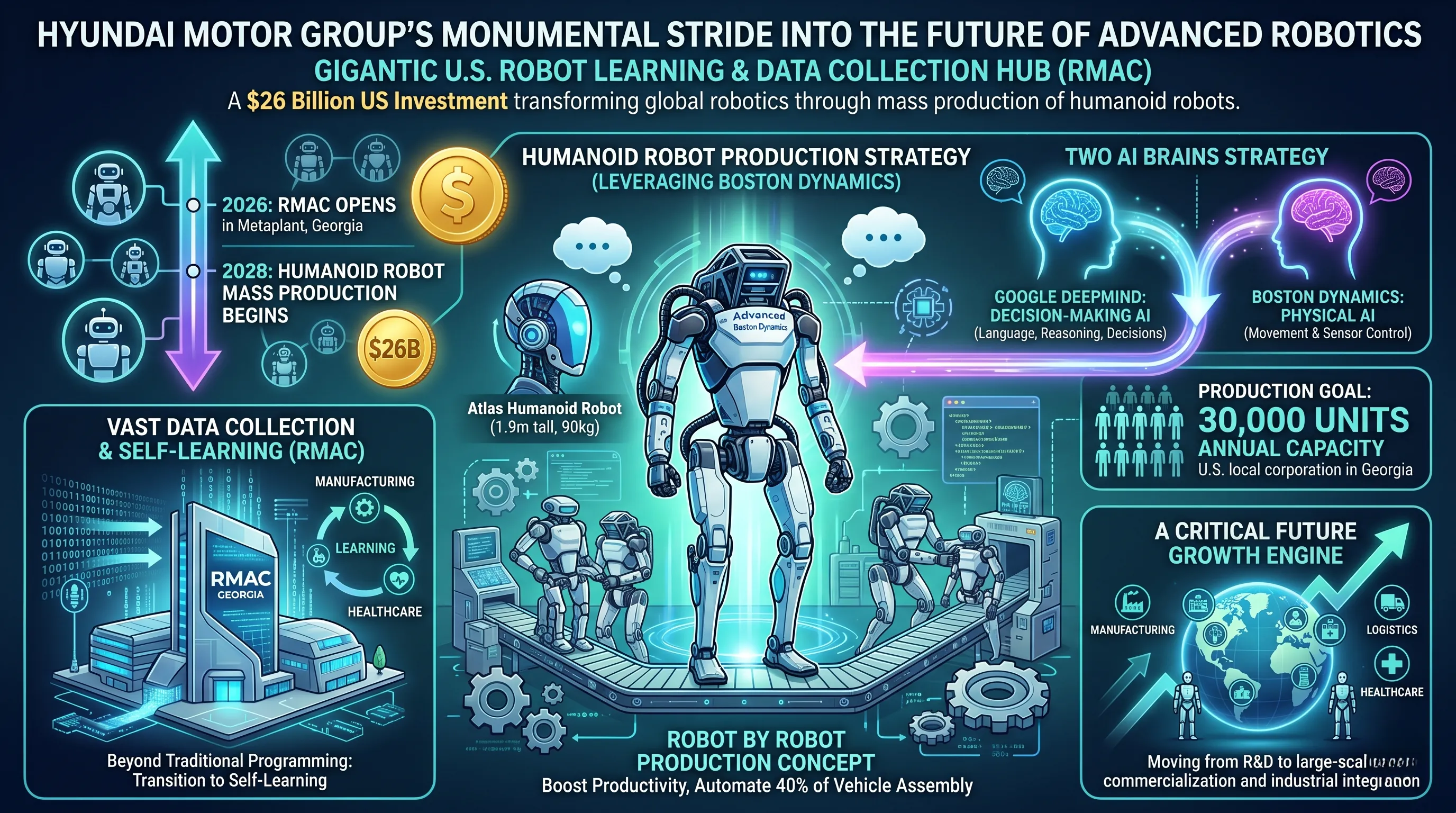
Hyundai Motor Group is making a monumental stride into the future of advanced robotics by establishing a gigantic robot learning and data collection hub (RMAC) in the United States.
This strategic move, part of a substantial $26 billion U.S. investment by 2028, signals the company's commitment to transforming the global robotics landscape, particularly through the mass production of humanoid robots.
Located within their Metaplant in Bryan County, Georgia, this facility is poised to become a pivotal center for robotics innovation, set to open its doors in 2026.
At the core of this initiative is the ambitious plan to begin humanoid robot mass production by 2028, targeting an impressive annual capacity of 30,000 units at a U.S. local production corporation in Georgia.
Hyundai's strategy involves leveraging cutting-edge technology from Boston Dynamics, utilizing the formidable Atlas humanoid robot (1.9m tall, 90kg) as key personnel to boost industrial productivity and automate operations, including a projected 40% of vehicle assembly work at its Georgia factory.
The vision embraces a unique "Robot by Robot" production concept, where robots will produce other robots, maximizing efficiency and scalability.
This groundbreaking endeavor is powered by a sophisticated two-AI Brains strategy: collaborating with Google DeepMind for language, reasoning, and decision-making AI, and entrusting Boston Dynamics with the development of physical AI for movement and sensor control.
Moving beyond traditional programming, robots will transition to self-learning through vast data collection, enabling adaptability across diverse applications from manufacturing and logistics to healthcare.
Hyundai Motor Group's bold investment and clear roadmap firmly position robotics as a critical future growth engine, moving rapidly from research and development to large-scale commercialization and integration across various industries.
1. U.S. Robotics Hub: Mass Production & Strategic Investment
Hyundai Motor Group's grand vision of establishing a giant robotics hub in the U.S. is not a speculative dream; it is a meticulously planned industrial strategy backed by a colossal financial commitment and a concrete production roadmap.
This section details the tangible investments and manufacturing plans that form the bedrock of this American robotics hub, transforming the abstract concept into a physical and operational reality.
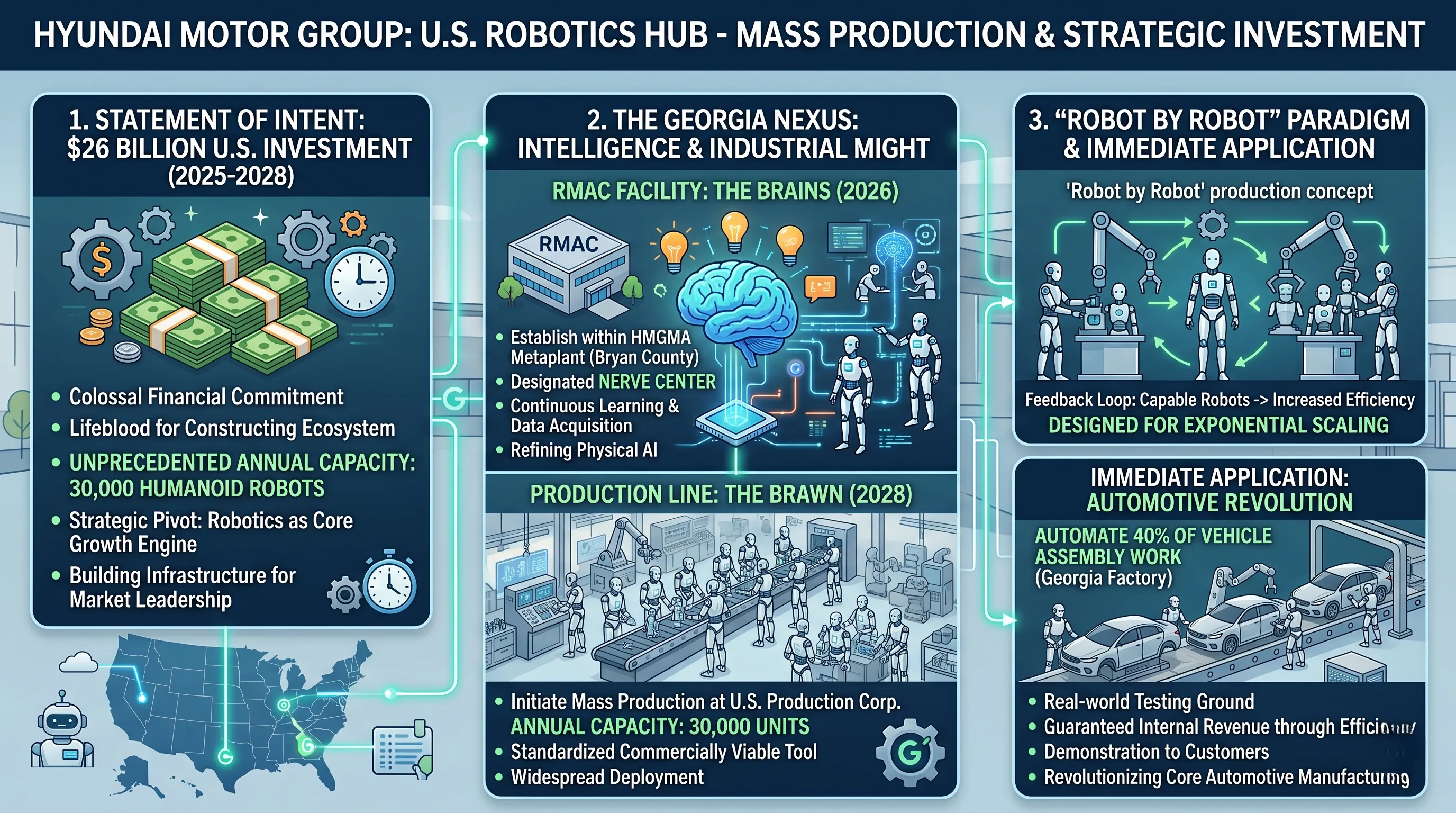
A Statement of Intent: The $26 Billion U.S. Investment
The scale of Hyundai's ambition is most clearly articulated by its financial allocation.
Between 2025 and 2028, the group has earmarked a staggering USD 26 billion for investment in the United States.
This is not merely a budget for research and development; this capital injection is the lifeblood for constructing the entire ecosystem, including the physical plant designed to achieve an unprecedented annual production capacity of 30,000 humanoid robots.
This level of investment signals Hyundai's strategic pivot, viewing robotics not as an auxiliary business but as a core future growth engine on par with its automotive division.
It represents a decisive move to seize leadership in the nascent commercial humanoid robot market by building the necessary infrastructure long before competitors can mobilize.
The Georgia Nexus: From Data Hub to Mass Production
The state of Georgia is positioned as the epicenter of Hyundai's U.S. robotics operations, hosting a two-stage rollout that combines intelligence with industrial might.
The RMAC Facility: The Brains of the Operation (2026)
The first critical milestone is the establishment of the RMAC (Robot Learning & Data Collection Hub) facility within the Hyundai Motor Group Metaplant America (HMGMA) in Bryan County.
Scheduled to open in 2026, the RMAC is the designated nerve center for the entire robotics initiative.
It is not a traditional factory but a specialized hub where robots will undergo continuous learning and data acquisition, refining their "Physical AI" through real-world interaction and simulation.
This facility ensures that the robots rolling off the production line two years later will be equipped with a constantly evolving and improving software foundation.
The Production Line: The Brawn of the Operation (2028)
Following the groundwork laid by the RMAC, Hyundai will initiate the mass production of humanoid robots in 2028 at its U.S. local production corporation, also located in Georgia.
The stated goal is an annual capacity of 30,000 units, a figure that aims to completely redefine the industry's scale.
Achieving this volume will transition humanoid robots from bespoke, expensive prototypes into a standardized, commercially viable industrial tool, ready for widespread deployment.
The 'Robot by Robot' Paradigm and Immediate Application
Hyundai's manufacturing strategy is as innovative as the products themselves.
The company plans to implement a 'Robot by Robot' production concept, where robots are integral to the manufacturing and assembly of other robots.
This creates a powerful feedback loop: as the robots become more capable, the efficiency and quality of the production line inherently increase.
It is a strategy designed for exponential scaling, allowing Hyundai to meet its ambitious 30,000-unit target by leveraging the very technology it is creating.
This vast robotic workforce will have an immediate and impactful first customer: Hyundai itself.
The group has set a clear internal objective to automate 40% of vehicle assembly work at the same U.S. Georgia factory.
This provides a real-world testing ground, a guaranteed revenue stream through internal efficiency gains, and a powerful demonstration of the robots' capabilities to potential external customers.
The robotics hub is therefore not just building robots for the world; it is fundamentally designed to revolutionize Hyundai's core automotive manufacturing from the inside out.
2. Atlas Humanoid: Cutting-Edge AI and Industrial Integration
The Atlas humanoid robot is not merely a component of Hyundai's new U.S. robotics hub; it is the physical embodiment of the entire strategy. The capabilities, intelligence, and industrial applications of Atlas are the very reason for the existence of the RMAC (Robot Learning & Data Collection Hub) in Georgia, which will serve as the nerve center for refining and scaling this technology for mass production starting in 2028.
This section delves into the specific attributes of Atlas that make it the linchpin of Hyundai's ambitious "Hyundai to Build a Giant Robot Hub in the U.S." initiative.
Physical Prowess and Environmental Resilience
To function as a key personnel asset in demanding industrial environments, Atlas has been engineered with specifications that far exceed those of a laboratory prototype.
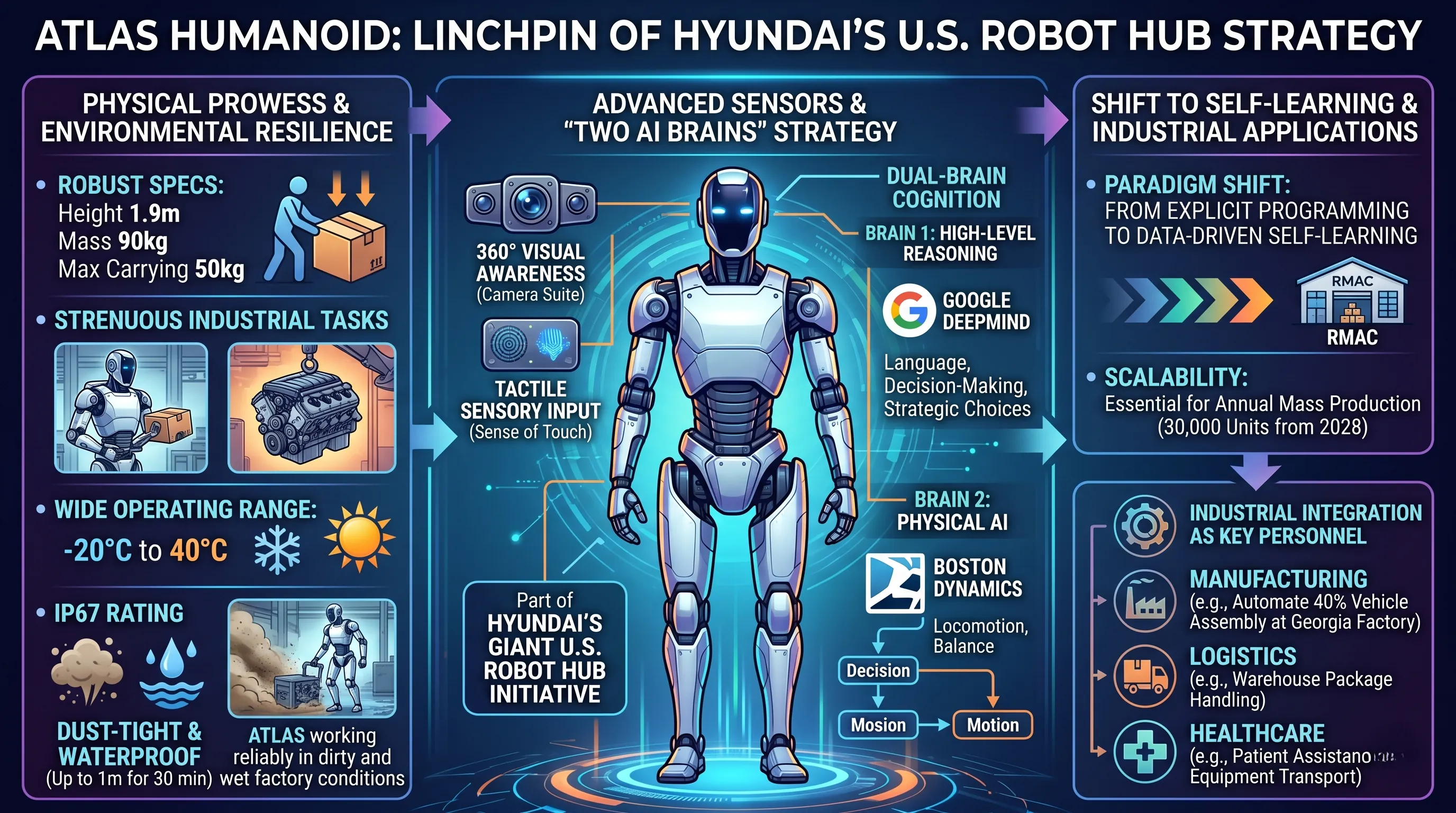
It stands at an imposing height of 1.9m and has a mass of 90kg, giving it the physical presence to interact with machinery and environments built for humans.
Crucially, it boasts a maximum carrying capacity of 50kg, enabling it to perform genuinely strenuous tasks like lifting and moving heavy automotive components, which is central to its planned role in Hyundai's own factories.
The robot's operational readiness is further underscored by its robust environmental tolerances.
It can function effectively in a wide temperature range, from a frigid -20°C to a sweltering 40°C, making it suitable for deployment in facilities without climate control or in varied global locations.
Perhaps most significantly for industrial use, Atlas possesses an IP67 rating.
This is not a trivial feature; it signifies that the robot is completely dust-tight and can withstand immersion in water up to 1 meter for 30 minutes.
Experientially, this means Atlas can operate reliably in environments prone to dust, debris, sprays, and spills—common conditions in manufacturing plants—without succumbing to damage, ensuring uptime and operational reliability.
Advanced Sensory Input and the 'Two AI Brains' Strategy
A robot's physical capabilities are only as good as its ability to perceive and understand its surroundings.
Atlas is equipped with a sophisticated sensor suite, including a 360-degree camera for comprehensive visual awareness and an array of tactile sensors that allow it to interact with objects with a sense of touch.
This sensory data feeds into a revolutionary "Two AI Brains Strategy," a collaborative approach that splits the cognitive load.
The first "brain," responsible for high-level language, reasoning, and decision-making, is being developed in collaboration with Google DeepMind.
This partnership provides Atlas with the cognitive engine to understand complex commands, reason through problems, and make strategic choices.
The second "brain" is the proprietary domain of Boston Dynamics, focusing on the intricate challenges of Movement and Sensor Control, also known as Physical AI.
This is the system that translates a decision—like "pick up that box"—into a flawlessly executed sequence of balance, motion, and grip, leveraging Boston Dynamics' world-renowned expertise in dynamic locomotion.
This dual-brain architecture is a core element that Hyundai will refine at its new U.S. hub, creating a robot that can both 'think' and 'do' with unparalleled sophistication.
A Paradigm Shift to Self-Learning and Industrial Integration
Historically, robots like Atlas were programmed with explicit instructions for every movement.
Hyundai and Boston Dynamics are spearheading a crucial transition away from this rigid method towards a more fluid, data-driven self-learning approach.
This new paradigm, which will be accelerated by the data collection efforts at the RMAC facility, allows Atlas to learn and improve from experience, much like a human worker.
This scalability of learning is essential for achieving the planned mass production of 30,000 units annually.
The ultimate goal of this technological fusion is clear: Boston Dynamics' strategy is to position Atlas as key personnel to increase industrial productivity across multiple sectors.
While manufacturing is the immediate focus—with Hyundai aiming to automate 40% of vehicle assembly work at its U.S. Georgia factory—the applications extend to logistics (e.g., warehouse package handling) and healthcare (e.g., patient assistance and equipment transport).
By integrating Atlas into these workflows, Hyundai's massive investment in its U.S. robotics hub becomes a strategic move to not only revolutionize its own production lines but also to capture the nascent global market for humanoid robots as it shifts from R&D to full-scale commercialization.
3. Hyundai's Global Robotics Blueprint & Ecosystem Synergy
The construction of a massive robot hub in the United States is not an isolated venture but the most visible and ambitious manifestation of Hyundai Motor Group's meticulously crafted global robotics blueprint.
This strategy moves beyond mere research and development, aiming to establish an end-to-end, self-sustaining ecosystem that leverages every facet of the Hyundai empire to dominate the emerging humanoid robot market.
The US hub, therefore, serves as the critical beachhead for a much larger global commercialization and expansion plan, fueled by a synergy of internal resources, strategic partnerships, and colossal domestic investments.
The 'Built-in' Market: Leveraging a Colossal Internal Ecosystem
Hyundai’s most formidable, and perhaps underestimated, advantage is its own sheer scale.
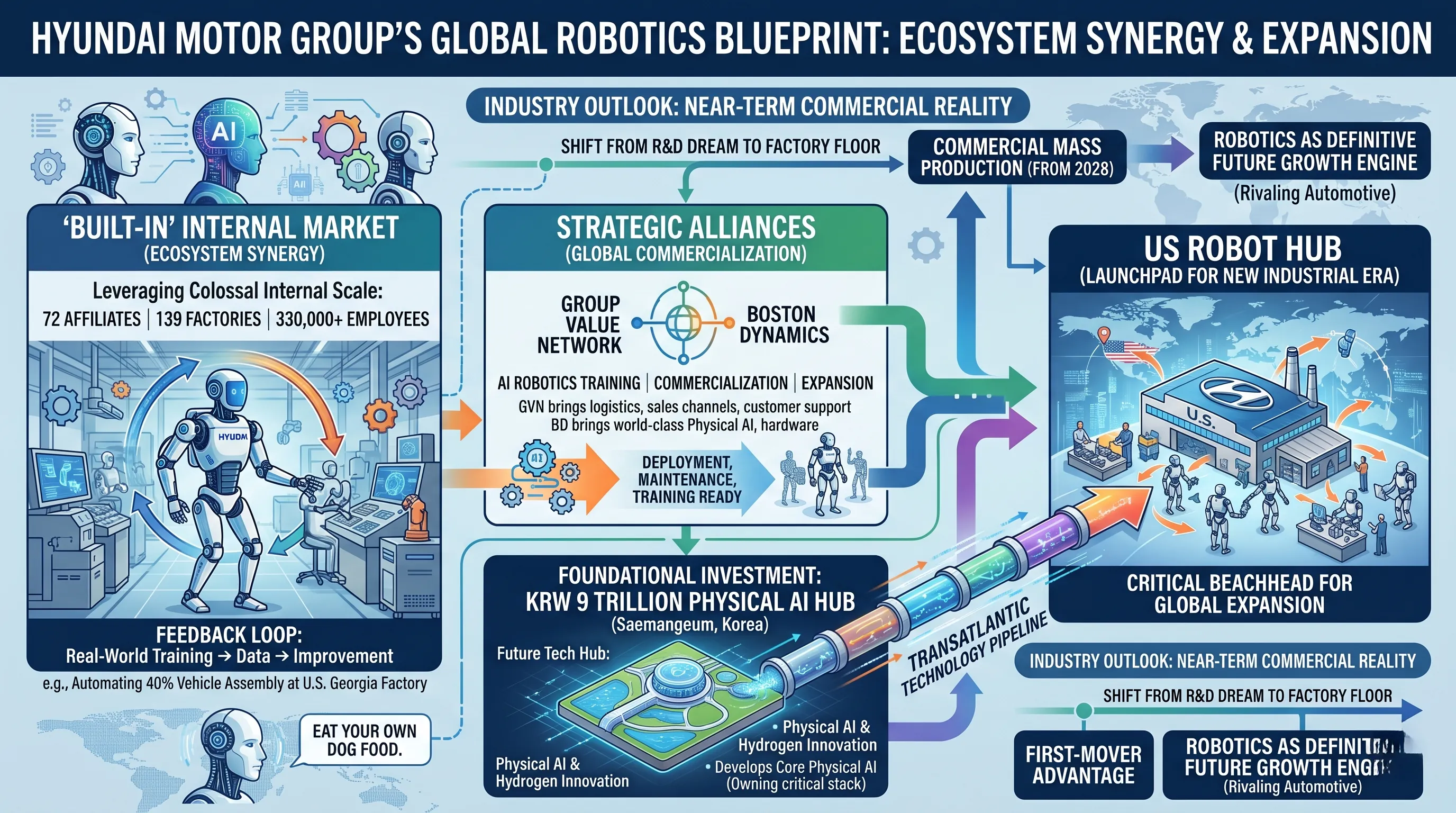
The Group is not a single company but a sprawling conglomerate of 72 affiliates, operating 139 factories worldwide, and employing over 330,000 people.
This internal structure provides an unparalleled, low-risk testbed and an immediate, captive market for its humanoid robots.
Instead of cold-calling potential clients with an unproven product, Hyundai can deploy thousands of Atlas units within its own manufacturing plants, logistics centers, and shipyards.
This creates a powerful feedback loop: robots are trained on real-world, complex Hyundai tasks, data is gathered, and improvements are made in a controlled environment.
This internal demand de-risks the colossal investment in mass production and allows the technology to mature and prove its value before being offered to the wider market.
The goal to automate 40% of vehicle assembly at the U.S. Georgia factory is a prime example of this "eat your own dog food" strategy, turning its own facilities into the first and most demanding customers.
Strategic Alliances for Global Commercialization
Hyundai understands that technological excellence alone does not guarantee market leadership.
To bridge the gap between a functional robot and a commercially viable product, the company is forging a crucial strategic partnership between its Group Value Network and Boston Dynamics.
This collaboration is purpose-built for three key objectives: AI Robotics training, commercialization, and expansion.
Boston Dynamics brings the world-class Physical AI and hardware, while Hyundai’s Group Value Network provides the global logistical prowess, sales channels, and customer support infrastructure honed over decades in the automotive industry.
This synergy ensures that when the Atlas robot is ready for external customers, a comprehensive system for sales, deployment, training, and maintenance is already in place, dramatically lowering the barrier to adoption for other industrial giants.
Foundational Investment: The KRW 9 Trillion Physical AI Hub
While the US hub represents the frontline of commercial production, the strategic brain of the operation is being fortified back home in Korea.
Hyundai Motor Group's staggering KRW 9 trillion investment in Saemangeum is dedicated to creating a future technology hub focused on Physical AI and hydrogen innovation.
This investment is not separate from the US robotics plan; it is the foundational pillar supporting it.
By developing core Physical AI capabilities—the intelligence that allows a robot to move and interact with the physical world—in Saemangeum, Hyundai ensures it owns the most critical part of the technology stack.
This domestic R&D powerhouse will feed innovations directly to the production lines in Georgia, creating a transatlantic technology pipeline that fuels the entire global robotics business.
Industry Outlook: From R&D Lab to Factory Floor
Hyundai's entire strategy is predicated on a fundamental shift in the robotics industry.
The humanoid robot business is decisively moving from a long-term R&D dream to a near-term commercial reality.
By establishing a mass production timeline starting in 2028 and building the infrastructure now, Hyundai is positioning itself to capture the first-mover advantage in this transition.
The company views robotics not as a side project but as a definitive future growth engine, a new pillar of the business with the potential to one day rival its core automotive manufacturing operations.
The blueprint is clear: leverage internal scale for testing and initial demand, build strategic partnerships for global reach, and secure technological leadership through massive investment, all culminating in the US robot hub as the launchpad for a new industrial era.
📚 Related Posts
Unitree Robotics' GD01: World's First Mass-Produced Manned Transforming Mecha Ignites 'Gundam' Dream & Redefines Robotics Future
🚀 Key TakeawaysUnitree Robotics has launched the world's first mass-produced manned transforming mecha robot, a 500kg machine capable of stable bipedal and quadrupedal walking and powerful enough to destroy brick walls.This groundbreaking invention, evo
tech.dragon-story.com
OpenAI ChatGPT Launches 'Trusted Contact': Bridging AI Safety with Expert-Backed Human Support for User Well-being
🚀 Key TakeawaysOpenAI has introduced a new Trusted Contact feature for ChatGPT, designed to connect users with pre-designated individuals for support during potential crisis situations, thereby strengthening AI's role in real-world support systems.OpenA
tech.dragon-story.com
OpenAI's Real-time Voice AI Trio: GPT-5 Reasoning, 128K Context & Agent Shift with Global Translation
🚀 Key TakeawaysOpenAI has unveiled three new real-time voice AI models (GPT-Realtime-2, GPT-Realtime-Translate, and GPT-Realtime-Whisper) designed to significantly elevate AI capabilities from simple chatbots to intelligent agents capable of understandi
tech.dragon-story.com


