🚀 Key Takeaways
- xAI's Grok 4.3 is set to redefine the AI market by offering an ultra-low-cost, high-performance agentic AI model, featuring an always-on reasoning structure and a vast 1 million token context window, making advanced AI capabilities significantly more accessible and efficient for complex, accuracy-critical tasks.
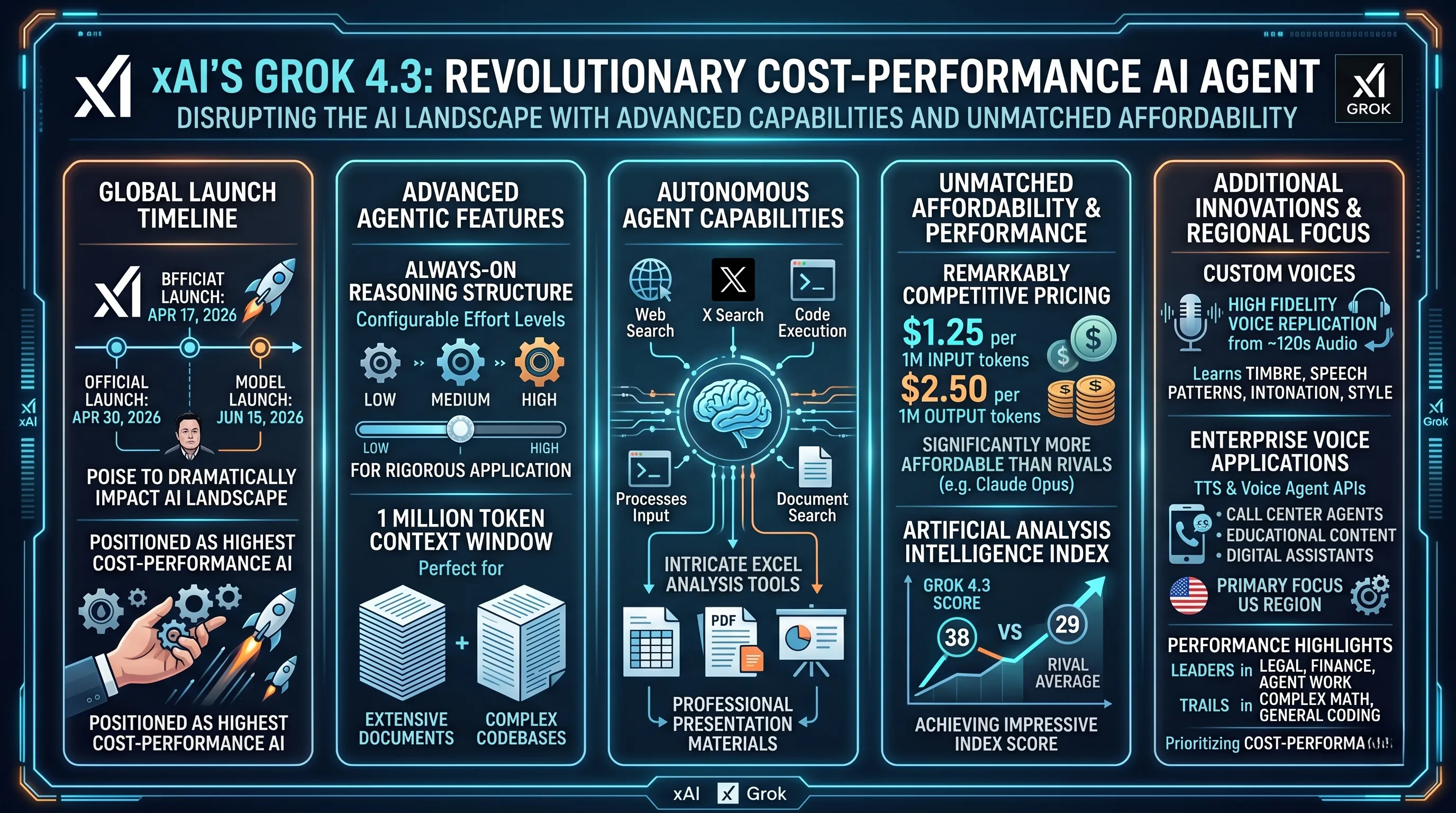
xAI, spearheaded by Elon Musk, is poised to dramatically impact the artificial intelligence landscape with the impending official launch of Grok 4.3 on April 30, 2026, following its beta soft launch on April 17, 2026.
This revolutionary AI model is strategically positioned as the "highest cost-performance AI", aiming to disrupt the current market by offering exceptional capabilities at an incredibly competitive price point, with a reported model launch date set for June 15, 2026.
Grok 4.3 introduces a suite of advanced features designed for rigorous application, including an always-on Reasoning structure configurable for varying effort levels (low, medium, high), and an expansive 1 million token context window, perfect for handling extensive documents and complex codebases.
Operating as a sophisticated agent-type AI, it leverages web search, X search, code execution, and document search capabilities to autonomously generate intricate Excel analysis tools, comprehensive PDF reports, and professional presentation materials.
Its pricing is remarkably competitive at just $1.25 per 1 million input tokens and $2.50 per 1 million output tokens, making it significantly more affordable than rival models such as Claude Opus, while achieving an impressive Artificial Analysis Intelligence Index Score of 38, well above the average of 29.
Furthermore, xAI is rolling out Custom Voices, a feature allowing users to replicate their voice with high fidelity from approximately 120 seconds (2 minutes) of audio input, learning not just timbre but also intricate speech patterns, intonation, and delivery style.
While Grok 4.3 demonstrates leading performance in critical fields like legal and finance, and boasts greatly improved agent work capabilities, it is consciously positioned for its superior cost-performance rather than absolute peak performance in highly specialized areas like complex math problems or general coding tasks, where it currently trails some competitors.
Enterprise customers can integrate these generated voices into Text-to-Speech (TTS) and voice agent APIs for various applications, including call center agents, educational content, and digital assistants, primarily in the US region.
1. Grok 4.3 Unveiled: Ultra-Low Cost and Advanced Specifications
This section directly dissects the core claims of the main topic, "XAI, Ultra-Low Cost AI 'GROK 4.3' Abruptly Revealed", by examining the precise specifications and pricing strategy that define Grok 4.3's disruptive market entry.
We will explore the numbers and features that substantiate its positioning not merely as another competitor, but as a paradigm shift in AI accessibility and cost-effectiveness, driven by Elon Musk's xAI.
A Staggered Launch into the AI Arena
xAI has outlined a clear and rapid deployment schedule for its new model, indicating a high level of confidence in its product.
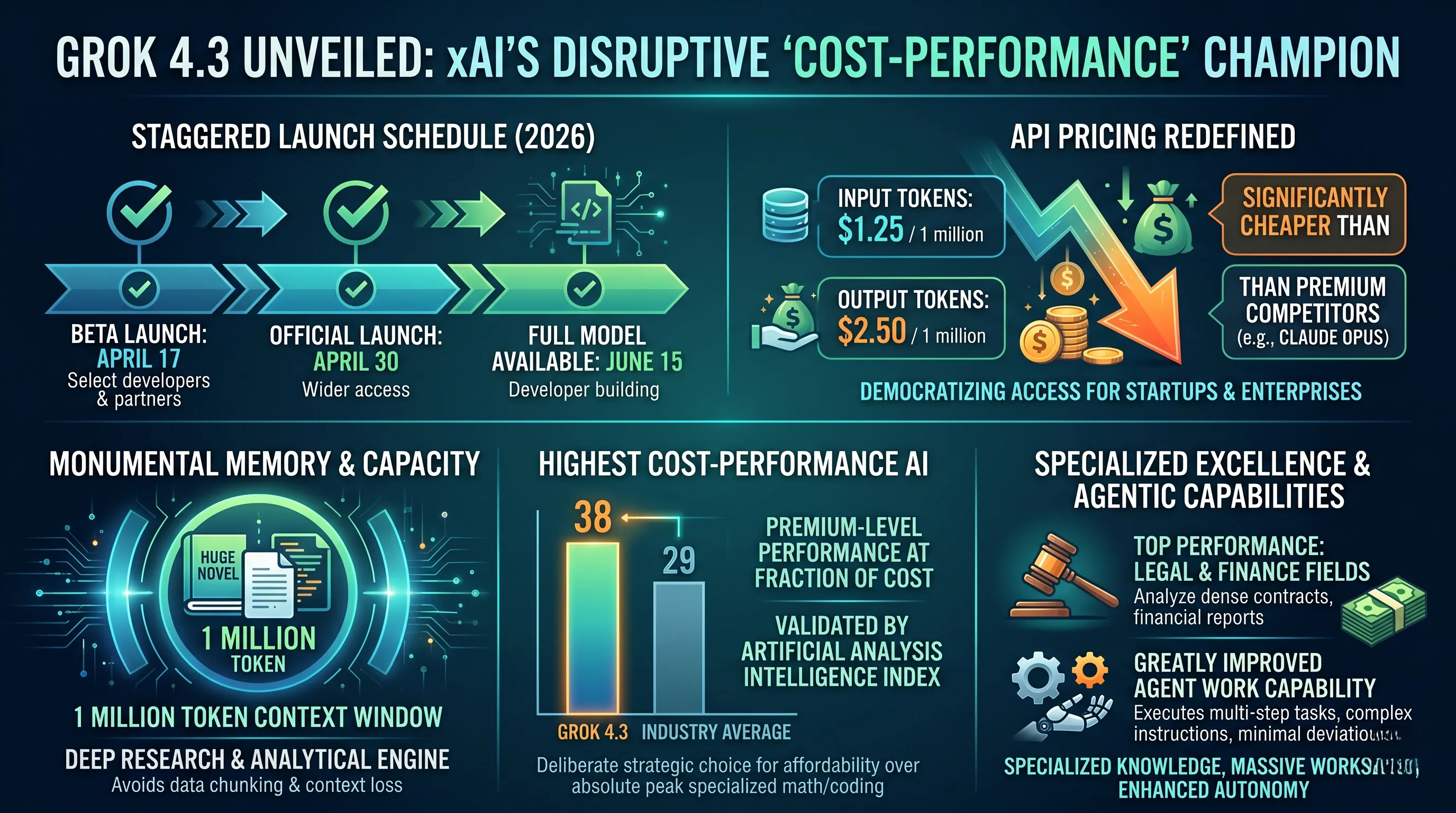
The initial rollout begins with a beta launch on April 17, 2026, allowing a select group of developers and partners to integrate and test the system's capabilities.
This will be swiftly followed by the flagship official launch on April 30, 2026, opening up access to a wider audience.
Crucially, the full model, which developers will build upon, is reported to be available from June 15, 2026, marking the moment Grok 4.3 truly enters the competitive landscape.
The Price Point that Redefines the Market
The most significant aspect of Grok 4.3's unveiling is its aggressive and almost unbelievably low pricing structure.
xAI has set the cost at a mere $1.25 per 1 million input tokens and $2.50 per 1 million output tokens.
To contextualize this, this pricing model drastically undercuts established premium models, with the source material explicitly noting it is significantly cheaper than competitors like Claude Opus.
This isn't just a discount; it's a strategic move to democratize access to high-capacity AI.
For startups and enterprises previously constrained by prohibitive API costs, this opens the door to developing applications that require massive data processing, something that was once the exclusive domain of companies with enormous budgets.
An Expansive Workspace: The 1 Million Token Context Window
Beyond its cost, Grok 4.3’s primary technical marvel is its expansive 1 million token context window.
This figure represents a monumental leap in an AI's short-term memory and analytical capacity.
A 1 million token window is the technical equivalent of handing an analyst an entire novel, a comprehensive legal discovery file, or a complex software codebase and asking for a complete summary and analysis in a single request.
This allows for unprecedented depth in tasks involving large documents and complex codebases without the need to chunk data or lose context, a common and frustrating limitation of previous-generation models.
It transforms the AI from a conversationalist into a deep-research and analytical engine capable of grasping vast, interconnected systems of information at once.
The "Cost-Performance" Champion
xAI is making a deliberate and clear strategic choice with Grok 4.3.
It is not being marketed as the absolute 'highest performance AI' in every conceivable metric.
The data notes that it currently trails the latest models from OpenAI and Anthropic in specific, highly complex math problems or general coding tasks.
Instead, its identity is forged as the 'highest cost-performance AI' on the market.
This positioning is powerfully supported by its Artificial Analysis Intelligence Index Score of 38, which is well above the industry average of 29.
This score validates that Grok 4.3 is a highly capable and intelligent model, delivering premium-level performance for a fraction of the cost.
The message to the market is clear: for the vast majority of advanced AI tasks, Grok 4.3 provides more than enough power, and it does so at an economic scale that its competitors cannot currently match.
Specialized Excellence and Advanced Agentic Capabilities
Reinforcing its value proposition, Grok 4.3 has demonstrated exceptional strength in specific, high-value domains.
Benchmarks have shown it recording the highest level of performance in the legal and finance fields, areas where its massive context window can be leveraged to analyze dense contracts and financial reports with superior accuracy.
Furthermore, the model features greatly improved agent work capability.
This means it is not just a passive text generator but an active tool that can execute multi-step tasks, follow complex instructions with minimal deviation (hallucination), and interact with other digital tools to accomplish a goal.
This combination of specialized knowledge, a massive workspace, and enhanced autonomy, all delivered at an industry-shattering price point, forms the powerful foundation of Grok 4.3's challenge to the established AI hierarchy.
2. Deep Dive into Grok 4.3's Core AI Features and Capabilities
While the headline-grabbing story of xAI's latest release is its revolutionary "ultra-low-cost" pricing, this section unpacks the sophisticated technology that makes that price point so disruptive.
Grok 4.3 isn't merely a cheaper alternative; it's a powerhouse of advanced features specifically engineered to deliver high-value, reliable results for complex tasks, directly challenging the market's value proposition.
The core of its appeal, and its direct connection to the main topic of a new, cost-effective AI powerhouse, is the sheer breadth of capability offered for a fraction of the competitor's cost.
A Foundation of Configurable Reasoning
At the heart of Grok 4.3 is a unique and powerful concept: a configurable 'Always-on Reasoning structure'.
Unlike models that only engage deep reasoning when prompted by a complex query, Grok 4.3's architecture suggests a continuous state of analysis.
The true innovation lies in user control over this process.
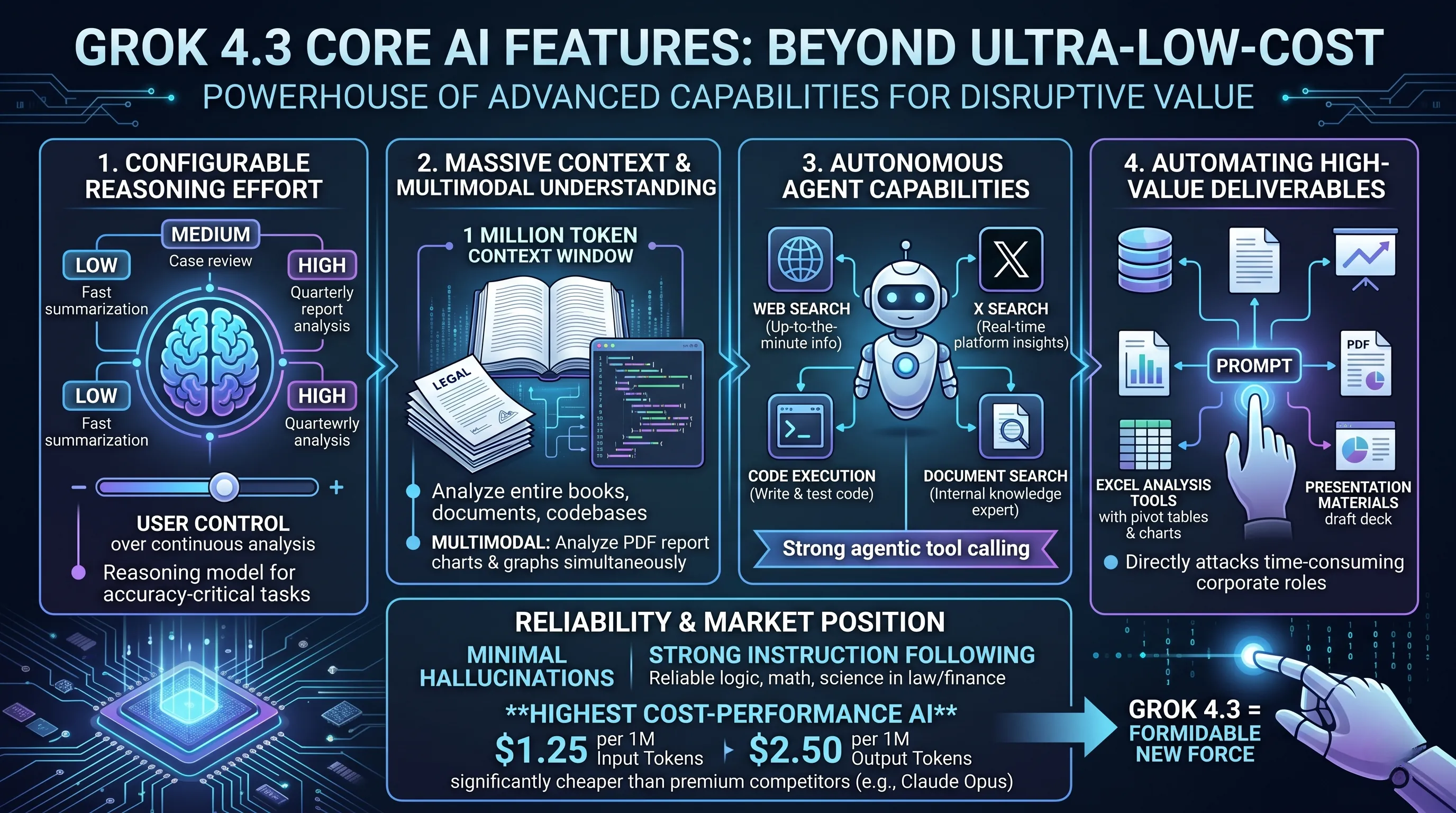
Users can set the reasoning effort to low, medium, or high.
Experientially, this is a game-changer for cost and performance management.
A user running a simple text summarization can set the effort to 'low' for near-instant, low-cost results.
However, a financial analyst dissecting a quarterly report or a lawyer reviewing case documents—tasks where the model is reported to have the highest level performance—can set the effort to 'high'.
This dedicates more computational resources to ensure maximum accuracy and logical depth, aligning with its design as a reasoning model for accuracy-critical tasks.
This flexibility is central to its identity as the "highest cost-performance AI".
Massive Context and Multimodal Understanding
Grok 4.3 operates on a colossal scale with its ability to support a 1 million token context window.
This isn't just a large number; it fundamentally changes the scope of work an AI can handle.
It allows the model to ingest and analyze entire books, extensive legal discovery documents, or complete software codebases in a single pass without losing track of crucial details from the beginning.
This capability is essential for the complex, multi-step problem-solving it's designed for.
Furthermore, Grok 4.3 is not limited to text.
It can understand images and text simultaneously, a critical feature for modern data analysis.
This means a user can upload a PDF report containing charts, graphs, and text, and the AI can synthesize information from all elements holistically.
It can read the text explaining a market trend and simultaneously analyze the accompanying bar chart to verify the data, leading to more robust and reliable insights.
From Chatbot to Autonomous Agent
Perhaps the most significant leap in functionality is Grok 4.3's advanced agent-type capabilities.
It moves beyond a simple question-and-answer paradigm to become an active work assistant.
This is powered by its ability to autonomously utilize a suite of tools:
- Web Search: For accessing up-to-the-minute information beyond its training data.
- X Search: A unique advantage leveraging the real-time, unfiltered firehose of information on the X platform, providing insights not available through traditional search engines.
- Code Execution: The ability to write, test, and run code to solve problems, perform calculations, or create custom scripts.
- Document Search: The capacity to scan and retrieve information from a provided corpus of documents, turning it into a powerful internal knowledge expert.
These features, combined with its strong agentic tool calling, represent a greatly improved agent work capability, allowing it to execute complex, multi-step instructions that require interacting with the digital world.
Automating High-Value Deliverables
Grok 4.3 translates its reasoning and agentic skills into tangible, high-value outputs.
A standout feature is its ability to automatically generate Excel analysis tools, PDF reports, and presentation materials.
This is a monumental productivity enhancer.
Instead of just providing a text-based answer, a user can provide raw sales data and request an analysis.
Grok 4.3 could return a fully functional Excel file with pivot tables and charts, a professionally formatted PDF report summarizing the key findings, and a draft presentation deck—all from a single prompt.
This directly attacks the manual, time-consuming work that dominates many corporate roles.
Reliability, Performance, and Market Position
Underpinning all these features is a commitment to reliability.
The model boasts minimal hallucinations and strong instruction following capabilities, two of the most critical factors for enterprise and professional use where accuracy is non-negotiable.
This reliability in advanced logic, math, and scientific analysis is why it excels in fields like law and finance.
However, it's crucial to position Grok 4.3 accurately within the competitive landscape.
The provided facts state that it still trails OpenAI and Anthropic's latest models in complex math problems or general coding tasks.
This is not a failure but a strategic choice.
xAI has not built the absolute highest performance AI; it has built the 'highest cost-performance AI'.
For a price of just $1.25 per 1 million input tokens and $2.50 per 1 million output tokens—a rate significantly cheaper than competitors like Claude Opus—users get a model that is more than capable for a vast majority of complex, high-value tasks, especially those requiring deep reasoning and agentic workflows.
This strategic balance of world-class capability and aggressive, ultra-low-cost pricing is what makes Grok 4.3 a formidable new force in the AI industry.
3. xAI's Innovation Beyond Grok 4.3: Custom Voice Technology
While the launch of the ultra-low-cost Grok 4.3 model rightfully captures headlines for its aggressive pricing and agentic capabilities, its release is not an isolated event.
It is a strategic piece within xAI's broader ambition to build a comprehensive AI ecosystem.
This section connects to the main topic by revealing another critical layer of xAI's strategy: the development of specialized, high-value AI tools like Custom Voice technology.
This initiative demonstrates that xAI is not merely competing on the terrain of large language models but is also venturing into multimodal, personalized AI solutions, showcasing a vision that extends far beyond text-based interactions and directly into the realm of digital identity and human-computer interface.
The Barrier to Entry, Erased: Just 120 Seconds for a Vocal Replica
xAI's approach to custom voice generation is defined by its radical accessibility.
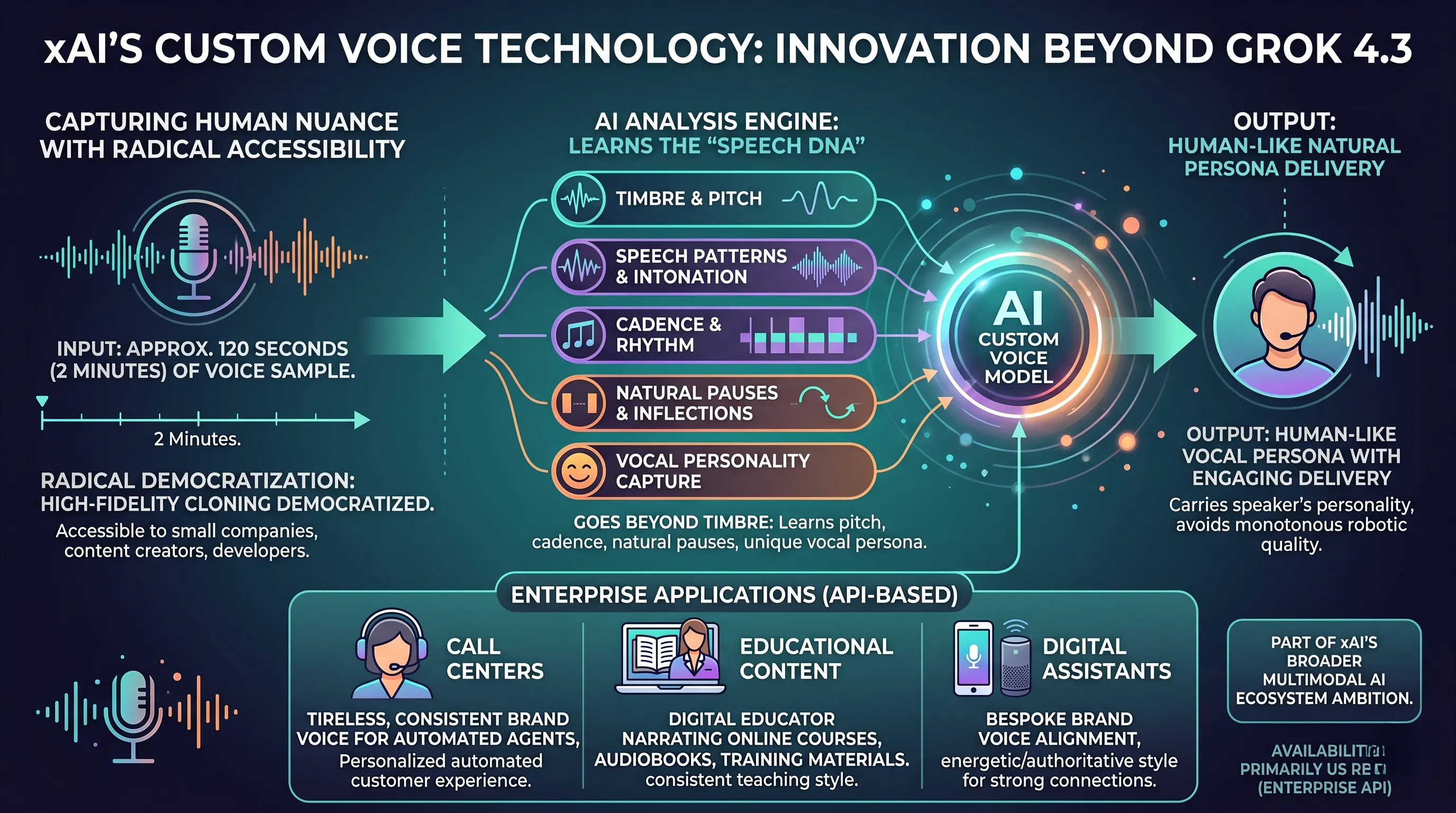
The core input requirement is an astonishingly brief Approx. 120 seconds (2 minutes) of voice sample.
This seemingly simple specification represents a monumental shift in the field of voice synthesis.
It effectively dismantles the traditional barriers that made high-fidelity voice cloning the exclusive domain of large corporations with substantial budgets for studio time and talent.
Instead of hours of carefully scripted recordings in an acoustically perfect environment, a business can generate a custom brand voice from a short, clean audio clip.
This low-friction requirement democratizes the technology, making it a viable tool not just for massive enterprises, but for smaller companies, content creators, and developers looking to integrate unique vocal identities into their products with minimal upfront investment.
Beyond Timbre: Capturing the Nuance of Human Delivery
The true innovation in xAI's technology lies in its depth of analysis.
The system is engineered to do more than simply replicate the pitch and timbre of a voice; its key feature is its ability to learn and reproduce speech patterns, intonation, and delivery style.
This is the critical difference between a voice that sounds *like* a person and a voice that *speaks* like them.
It captures the subtle cadence, the natural pauses between phrases, the upward inflection in a question, and the unique rhythm that constitutes a person's vocal persona.
The result is a high-quality replication that avoids the monotonous, robotic quality that plagues many text-to-speech (TTS) systems.
The generated voice carries the original speaker's personality, making it more engaging, trustworthy, and human-like for the end-user.
Enterprise-Focused Rollout and Strategic Applications
Currently, xAI's Custom Voice technology is being rolled out strategically, with availability noted as Primarily US region.
Crucially, it is offered through an API for enterprise customers, signaling a clear focus on business-to-business applications where the need for scalable, high-quality voice solutions is most acute.
The generated voices are designed for direct integration into existing enterprise workflows via Text-to-Speech (TTS) and voice agent API functionalities.
This opens up a vast landscape of commercial applications:
- Call Centers: Businesses can create a unique, consistent, and tireless brand voice for their automated customer service agents.
Imagine a company's IVR (Interactive Voice Response) system speaking with the calm, reassuring voice of its CEO or a beloved brand ambassador, creating a powerful and personalized customer experience. - Educational Content: An educator or expert can create a digital version of their voice to narrate an entire library of training materials, online courses, and audiobooks.
This ensures a consistent teaching style and allows for content to be updated and expanded long after the initial recordings, all with the same familiar voice. - Digital Assistants: Companies can move beyond generic, off-the-shelf assistant voices.
A brand can develop a bespoke voice for its mobile app or smart device that perfectly aligns with its brand identity—be it energetic and youthful, or formal and authoritative.
This forges a stronger, more memorable connection with the user.
📚 Related Posts
Anthropic Unleashes Claude: SpaceX's Colossus 1 Delivers Massive AI Compute, Doubled User Limits & Paves Way for Space-Based Fut
🚀 Key TakeawaysThe partnership between Anthropic and SpaceXAI secures a massive compute boost for Claude, leveraging SpaceX's Colossus 1 data center with over 300 megawatts and 220,000 NVIDIA GPUs.This strategic collaboration immediately enhances Claude
tech.dragon-story.com
Claude's AI Revolution: Unleashing Dreaming Agents, Self-Improvement, Multiagent Orchestration & Ethical Futures
🚀 Key TakeawaysAnthropic's Claude is spearheading a significant shift in AI, transforming it from a mere tool into autonomous 'dreaming agents' that can accumulate experience, reflect on past performance, self-improve, and orchestrate complex multiagent
tech.dragon-story.com
OpenAI ChatGPT Launches 'Trusted Contact': Bridging AI Safety with Expert-Backed Human Support for User Well-being
🚀 Key TakeawaysOpenAI has introduced a new Trusted Contact feature for ChatGPT, designed to connect users with pre-designated individuals for support during potential crisis situations, thereby strengthening AI's role in real-world support systems.OpenA
tech.dragon-story.com


