Today, we're looking at a significant update in the fight against financial crime: the Optimized Explainable Boosting Machine (OEBM).
A new research paper, arXiv:2602.06955v1, published on 2026-02-11, details how OEBM is poised to improve Credit Card Fraud Detection (CCFD) through its unique hybrid sampling approach and built-in explainability.
Let's dive into what OEBM brings to the table right now, and why it matters for financial institutions.
Key Takeaways for OEBM in CCFD
- Hybrid Sampling Advantage: OEBM leverages ADASYN and random undersampling to effectively train on highly imbalanced credit card fraud data.
- Proven Performance Boost: The model shows superior recall and G-mean compared to XGBoost and standard EBMs, directly reducing fraud losses.
- Native Explainability: Provides both high-level global insights for strategy and precise local breakdowns for individual transaction decisions.
- Streamlined Operations: Detailed explanations empower fraud analysts to make faster, more confident decisions and reduce false positives.
- Compliance & Trust: OEBM's transparency aids regulatory compliance, bias auditing, and fosters greater customer trust.
OEBM's Core Innovations: Hybrid Sampling and ADASYN
The Optimized Explainable Boosting Machine (OEBM) builds upon the foundation of standard Explainable Boosting Machines (EBMs), retaining their crucial 'glass-box' interpretability.
However, its real differentiator lies in how it directly confronts a major hurdle in Credit Card Fraud Detection (CCFD): the extreme imbalance of fraud data.
Fraudulent transactions are incredibly rare, often making up less than 0.1% of all data.
This scarcity leaves many machine learning models struggling to learn fraud patterns effectively, leading to poor fraud detection rates (low recall).
OEBM tackles this head-on with a sophisticated hybrid sampling strategy during its training phase.
This strategy combines two powerful techniques:
- ADASYN (Adaptive Synthetic Sampling):
Instead of simply replicating existing fraud examples, ADASYN intelligently generates new, synthetic fraud samples.
Crucially, it focuses on the 'hardest-to-learn' cases—fraudulent transactions that a simple k-Nearest Neighbors model frequently misclassifies.
This approach forces OEBM to concentrate on the nuanced and often ambiguous line between legitimate and fraudulent behavior, strengthening its ability to identify complex fraud patterns. - Random Undersampling:
After ADASYN boosts the minority (fraud) class, OEBM then reduces the size of the majority (non-fraudulent) class by randomly removing samples.
This balances the dataset without overrepresenting the majority class.
This combined, hybrid approach of generating targeted synthetic fraud data and reducing legitimate transaction data is OEBM's key innovation.
It creates a far more balanced and informative dataset for training, enabling the model to learn fraud characteristics much more effectively than standard models trained on raw, imbalanced data.

Real-World Performance Validation: OEBM's Impact on Fraud Loss
The academic metrics from the arXiv:2602.06955v1 paper have direct and compelling implications for financial institutions grappling with fraud.
The research indicates that OEBM consistently outperforms established fraud detection models, including XGBoost, LightGBM, and even standard EBMs, particularly on metrics vital for minimizing financial losses.
When assessing fraud detection, the focus isn't just on raw accuracy; it's about metrics that directly translate to financial outcomes:
- Recall (Sensitivity):
This metric measures the percentage of actual fraudulent transactions that the model successfully identifies.
A higher recall directly equates to a reduction in gross fraud losses.
OEBM's reported superior recall suggests it can prevent more fraudulent events from succeeding, directly saving financial institutions money. - G-mean (Geometric Mean):
This metric offers a balanced view of performance across both the majority (non-fraud) and minority (fraud) classes.
A high G-mean indicates that the model is adept at approving legitimate transactions while simultaneously being highly effective at flagging fraudulent ones.
This minimizes the common trade-off between robust security and potential customer friction from false positives.
While specific financial figures remain proprietary, the performance gains detailed in the paper strongly imply a significant potential for loss reduction within a production environment.

Conceptual Performance Comparison
Based on the findings, here’s a qualitative comparison highlighting OEBM's key advantages:
| Model | Recall (Fraud Capture) | G-mean (Balanced Performance) | Explainability | Data Imbalance Handling |
|---|---|---|---|---|
| OEBM | Highest | Highest | Native (Glass-box) | Built-in (Hybrid Sampling) |
| XGBoost / LightGBM | High | Moderate | Post-hoc (e.g., SHAP) | Requires manual tuning/sampling |
| Standard EBM | Moderate-High | Moderate-High | Native (Glass-box) | Requires manual tuning/sampling |
Unpacking Explainability: Local vs. Global Insights for Fraud Analysts
OEBM's inherent explainability stands out as a major advantage, eliminating the need for often approximate and sometimes unreliable post-hoc interpretation tools like SHAP.
This transparency provides two distinct, actionable tiers of insight for fraud prevention teams.
- Global Explanations:
These offer a high-level, panoramic understanding of the overarching fraud risk factors across the entire system.
Analysts can clearly identify the top features that contribute most significantly to fraud risk—for instance,transaction_amount,merchant_category, ortime_since_last_login—and understand the shape of their risk curves.
This capability is invaluable for strategic rule-writing, proactively identifying systemic vulnerabilities, and clear reporting to stakeholders and management. - Local Explanations:
This is a powerful feature for daily operations.
For every single transaction flagged by OEBM, an analyst receives a precise, additive breakdown explaining why it was flagged.
For example, a transaction might score high risk due to specific factors:
Transaction Score: 85 (High Risk)
    +0.45 from Transaction Amount = $2,500 (unusually high for this cardholder)
    +0.35 from Merchant Location = Overseas (atypical geography)
    +0.15 from Time of Day = 3:15 AM (uncommon transaction time)
    -0.10 from AVS Check = Match (a mitigating factor)
This granular level of detail allows analysts to make faster, more confident, and ultimately more justifiable decisions.
It significantly reduces the time previously spent investigating false positives, streamlining workflows and boosting team efficiency.

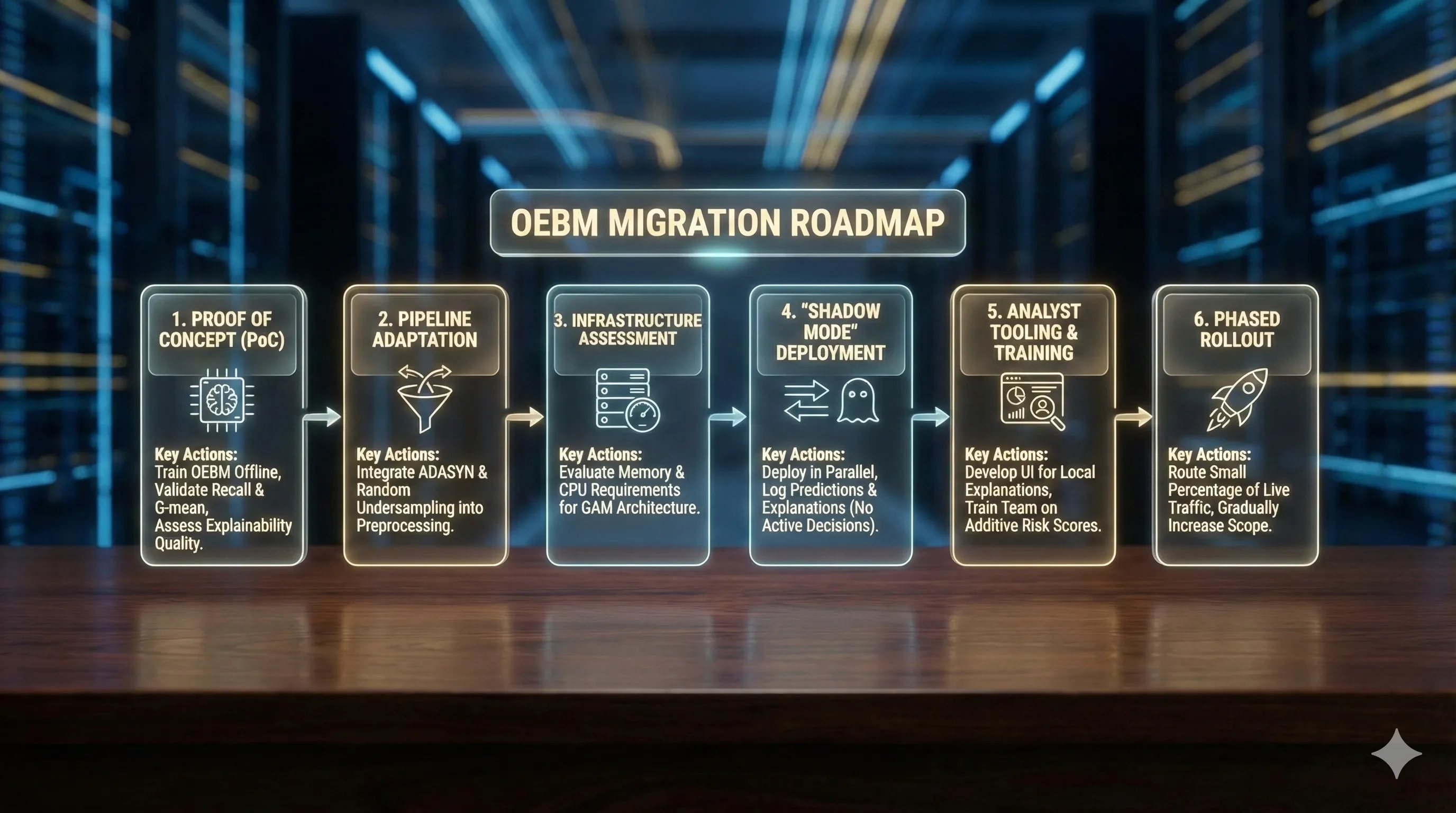
Migration Roadmap: Transitioning from Traditional ML to OEBM
Integrating OEBM into an existing Credit Card Fraud Detection (CCFD) pipeline, particularly if you're currently using models like XGBoost or LightGBM, requires a methodical approach.
Here’s a structured roadmap for a smooth transition:
- Proof of Concept (PoC):
Start by training an OEBM model offline using your historical data.
Carefully validate its performance against your current model, paying close attention to recall, G-mean, and the quality of its generated explanations. - Pipeline Adaptation:
The most crucial modification will be to your data preprocessing stage.
You must adapt it to incorporate the ADASYN and random undersampling steps.
This is a significant addition that typically isn't part of standard machine learning pipelines. - Infrastructure Assessment:
EBMs and their underlying Generalized Additive Model (GAM) architecture can have different computational profiles compared to tree-based models.
Thoroughly assess the memory and CPU requirements for both training and real-time inference to confirm that your production systems can comfortably handle the new load. - 'Shadow Mode' Deployment:
Deploy the OEBM model in parallel with your existing system.
Allow it to score live transactions without taking any direct action, simply logging its predictions and explanations.
This "shadow mode" offers a risk-free way to compare its real-world performance against your incumbent system. - Analyst Tooling & Training:
Develop a user interface or a dedicated dashboard that allows your fraud analysts to easily consume and interpret the local explanations provided by OEBM.
Crucially, provide comprehensive training to your team on how to understand and leverage these additive risk scores to optimize their investigation workflow. - Phased Rollout:
Once OEBM has been thoroughly validated in shadow mode, begin a phased rollout.
Perhaps route a small percentage of your live traffic to OEBM for active decisioning, gradually increasing its scope as confidence grows.
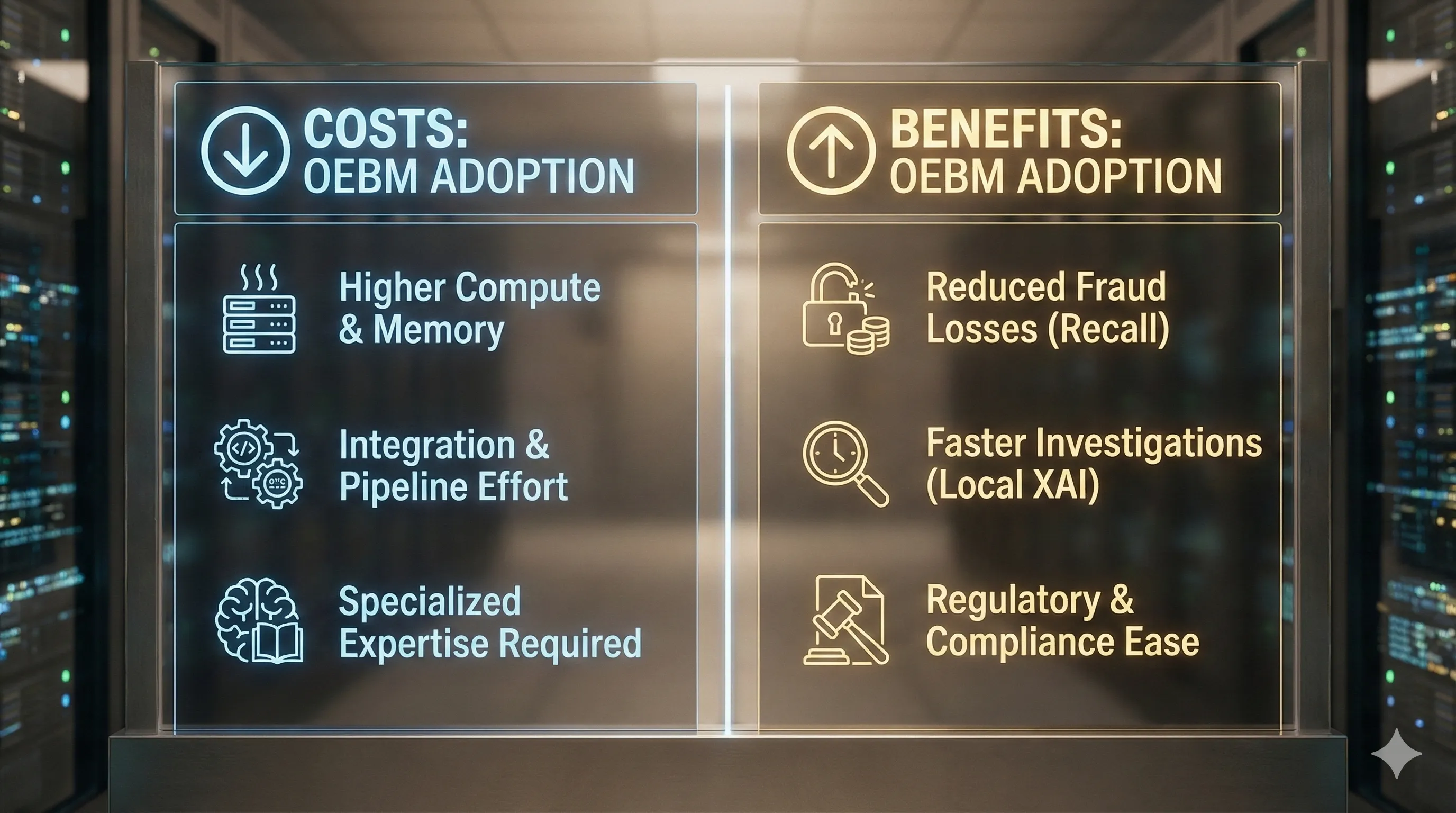
The Cost-Benefit Analysis: Is OEBM's Explainability Worth the Computational Overhead?
Adopting OEBM, while offering significant advantages, does involve a trade-off between its advanced capabilities and the potential implementation costs.
It's important to weigh both sides carefully.
Potential Costs:
- Computational Resources:
The hybrid sampling process, combined with the architecture of Generalized Additive Models (GAMs), may result in longer training times and potentially higher memory consumption compared to highly optimized gradient boosting libraries like XGBoost. - Implementation Effort:
Modifying existing MLOps pipelines to include new sampling steps, and building or integrating new UIs for explainability, will require dedicated engineering resources and effort. - Expertise:
Your team may need to acquire or deepen their understanding of the nuances of GAMs and their interpretation to fully leverage OEBM's capabilities.
Tangible Benefits:
- Direct Loss Reduction:
OEBM's superior recall performance directly translates to a significant reduction in the financial impact of successful fraud attacks. - Operational Efficiency:
The clear, local explanations enable fraud analysts to resolve alerts considerably faster, leading to reduced operational costs and increased productivity. - Reduced False Positives:
Improved model accuracy often leads to fewer legitimate transactions being incorrectly declined.
This enhances customer satisfaction and prevents lost revenue from unnecessary rejections. - Regulatory & Compliance Ease:
OEBM provides a built-in audit trail for its decisions.
Explaining a specific transaction decision to a regulator or a customer becomes straightforward by presenting the model's clear output.
This is a stark contrast to the complexity of justifying decisions made by black-box models.
For most large financial institutions, the substantial financial benefits derived from reduced fraud losses and enhanced operational efficiencies, coupled with the immense value of regulatory compliance, are highly likely to outweigh the initial implementation and computational costs.
Community & Ethical Considerations: Building Trust with Explainable Fraud Detection
OEBM's inherent transparency has profound implications extending beyond just model performance, impacting how financial institutions interact with regulators and customers.
- Regulatory Compliance:
With the global landscape seeing increasing regulation around AI—such as the EU AI Act—having inherently explainable models is transitioning from a 'nice-to-have' to a legal and ethical necessity.
OEBM is exceptionally well-positioned to meet these stringent requirements for high-stakes decision-making in finance. - Bias and Fairness Audits:
The global explanations provided by OEBM make it significantly easier to audit the model for potential biases.
If a feature that could be related to a protected class or a demographic proxy (e.g., certain geographic postcodes) shows an unexpectedly high-risk contribution, it can be promptly investigated and mitigated.
This proactive approach helps ensure fairness in decision-making. - Customer Trust:
While detailed model explanations might not be shared directly with customers, the ability for customer service agents to understand precisely why a transaction was blocked or flagged allows them to provide clearer, more satisfying support.
This transparency helps reduce customer friction, resolves issues faster, and builds long-term trust in the institution's fraud prevention systems.

Future Directions: Expanding OEBM's Capabilities and Addressing Limitations
While OEBM marks a significant advancement in Credit Card Fraud Detection, the research also clearly outlines avenues for future development and addresses existing limitations.
Current Limitations & Open Questions:
- Extreme Scalability:
The paper validates OEBM's performance on a large dataset, but further research is necessary to rigorously benchmark its training and inference speed on systems that process billions of transactions daily, common in major financial networks. - Automated Interaction Detection:
While EBMs can incorporate pairwise interaction terms, the process of efficiently selecting and modeling these complex, multi-feature fraud patterns can be computationally intensive.
Future work could explore more automated and efficient methods for identifying and integrating these interactions without excessive overhead.
Future Research Directions:
- Dynamic Adaptation:
Developing enhanced versions of OEBM that can dynamically adapt their hybrid sampling strategy as new fraud patterns emerge and evolve in real-time, ensuring continuous effectiveness. - Unsupervised Applications:
Exploring how OEBM's powerful explainability features could be leveraged within unsupervised anomaly detection frameworks, helping analysts not just detect, but also understand novel and emerging fraud attacks. - Federated Learning:
Investigating the application of OEBM within a federated learning context.
This would allow multiple banks to collaboratively train a highly powerful and explainable fraud model without needing to directly share sensitive customer transaction data, fostering broader industry collaboration.
OEBM is a compelling step forward, and its ongoing development promises even greater resilience and transparency in the fight against financial fraud.


