- Workflow Transformation: Claude AI has introduced new stages like 'Pre-Review Triage' and 'AI Oversight' roles, shifting human tasks from primary review to validation and exception handling.
- Nuanced Performance: While Claude achieves 99%+ accuracy on structured data, its interpretation of novel financial jargon requires significant human intervention, making a 'human-in-the-loop' essential for nuanced risk detection.
- Strategic Reskilling: Goldman Sachs is mitigating job displacement fears with a 'Digital Vanguard' program, focusing on AI collaboration, data analytics, and ethical AI governance for its employees.
- Complex Integration & Security: Merging Claude with legacy systems required extensive ETL pipelines, network upgrades, and a 'data clean room' for privacy. Data security is paramount, with VPC deployment, zero data retention, and end-to-end encryption.
- Regulatory Frontier: The firm is developing an 'AI Audit Trail' for explainability, logging AI reasoning, confidence scores, and human approvals to address regulatory concerns over AI-driven compliance decisions.
Goldman Sachs Embraces Claude AI: A Critical Look at Enterprise Integration in Finance
The financial sector is closely watching as Goldman Sachs implements Anthropic's Claude AI to streamline its critical accounting and compliance operations.
Following the February 6, 2026, announcement, the industry is buzzing about the real-world impact of this integration, moving beyond official press releases to analyze the practical workflow shifts and performance realities.
This isn't just about automation; it's about fundamentally altering how a global financial giant manages risk and efficiency.
Goldman's AI Rollout: Undocumented Workflow Changes
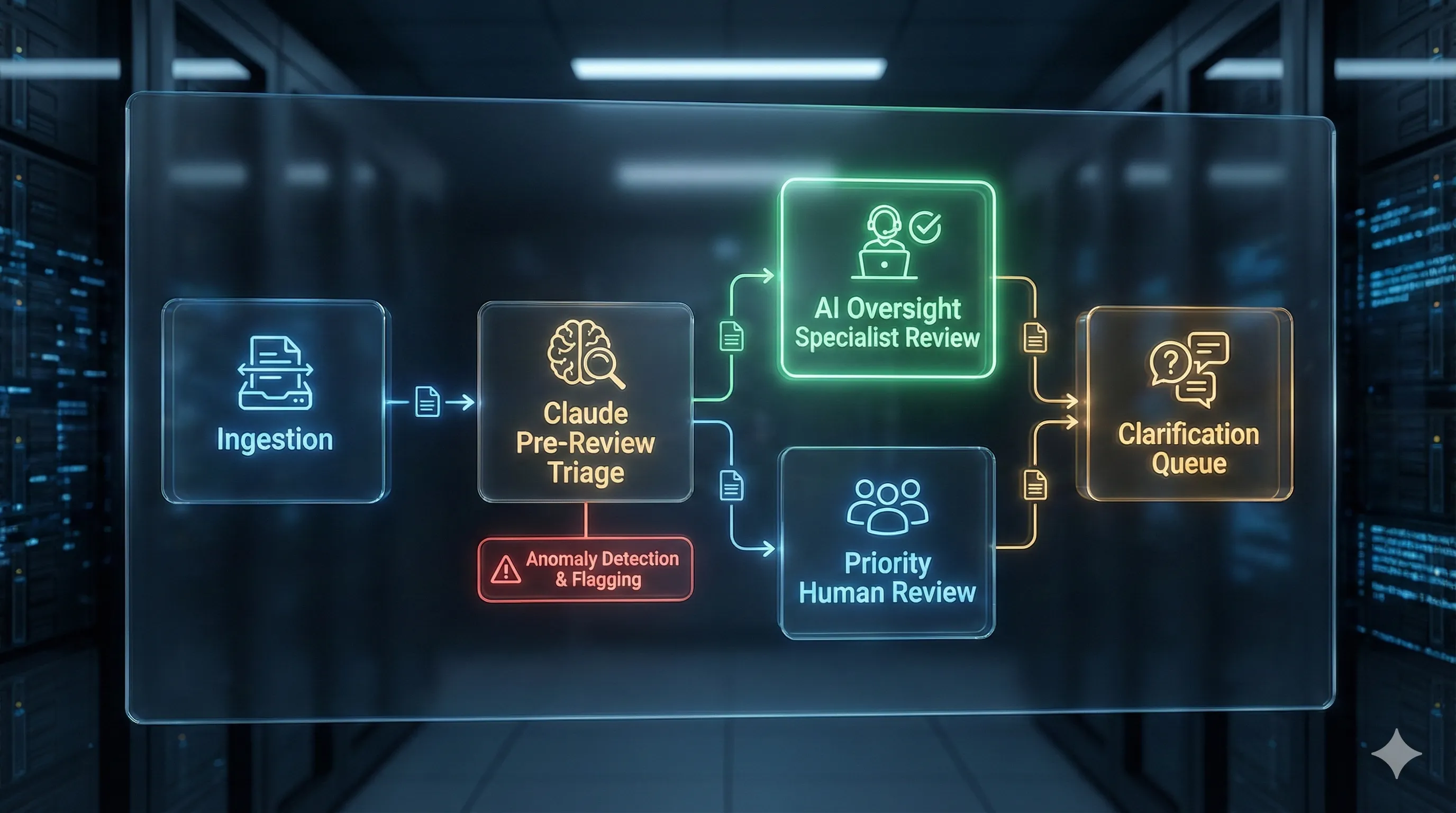
The integration of Claude AI at Goldman Sachs has gone beyond simple task automation, creating entirely new operational stages.
Official statements focused on summarizing reports, but the day-to-day reality involves a more complex, multi-stage workflow.
The 'Pre-Review Triage' System:
Documents no longer go directly to a human analyst.
Instead, they are first processed by a Claude-powered system.
This system performs more than just summarization.
It actively cross-references against internal policies and historical filings, immediately flagging potential anomalies, missing signatures, or deviations from standard contractual language.
Documents with flags are then routed to a priority queue for human review.
New 'AI Oversight' Roles Emerge:
A new position, the 'AI Oversight Specialist,' is becoming standard.
These specialists are not typical data scientists.
They are seasoned accountants and compliance officers trained in prompt engineering and interpreting AI-generated confidence scores.
Their core responsibility is to validate Claude's high-risk findings and conduct spot-checks on its routine approvals.
Unexpected Bottlenecks:
A significant challenge has been Claude's difficulty with ambiguous, institution-specific jargon or novel deal structures not present in its training data.
This issue has led to a new 'clarification queue,' where the AI specifically requests human input, causing temporary delays in the automated process.
Teams are now actively developing internal glossaries to fine-tune the AI's performance and reduce these stalls.
Claude's Performance in Financial Audits: A Reality Check
Marketing often overstates AI accuracy, and Claude's real-world performance at Goldman Sachs offers a more nuanced perspective.
While impressive in some areas, it underscores the continued necessity of human expertise.
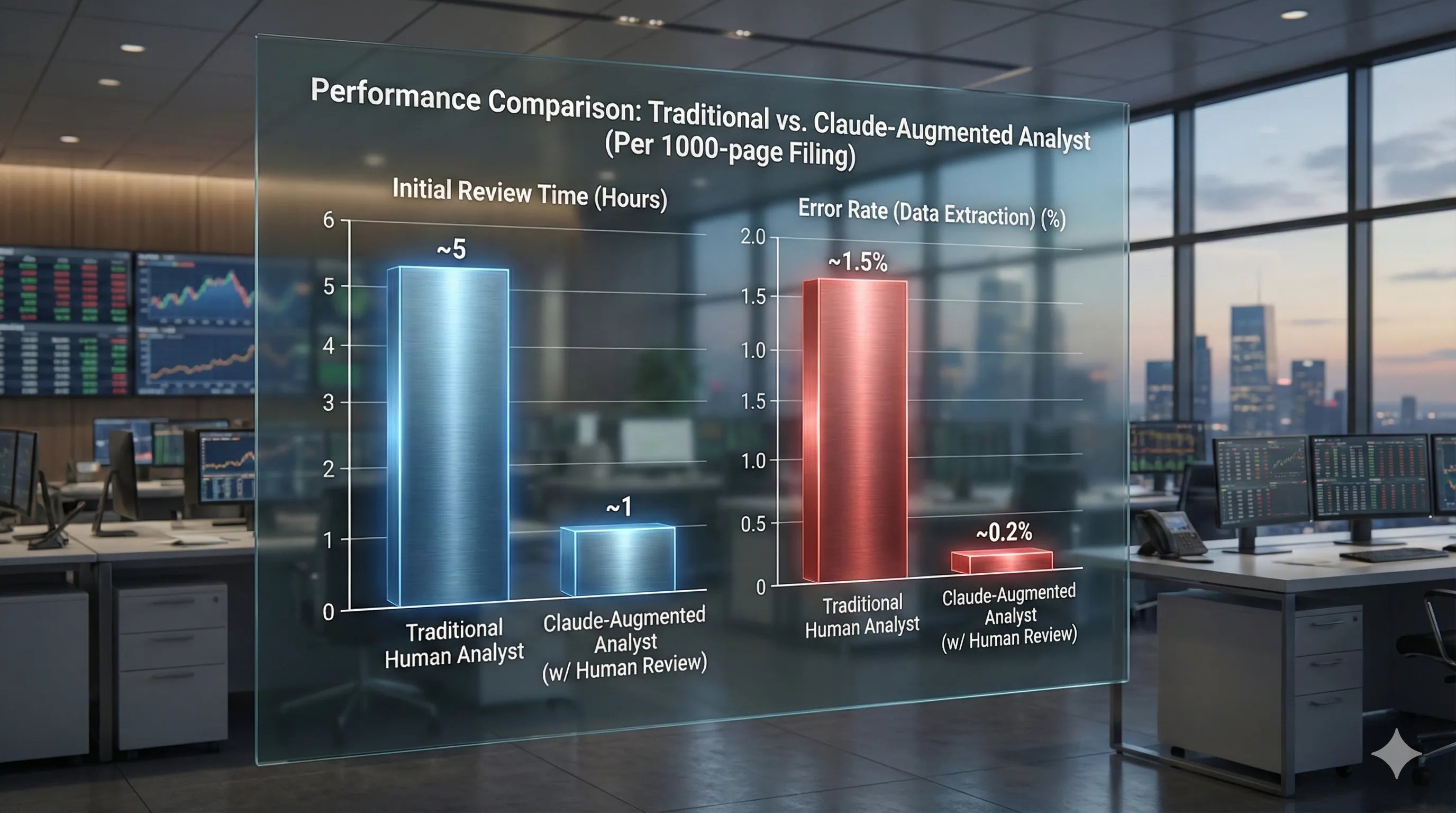
Comparison Table: Human Analyst vs. Claude-Augmented Analyst (Per 1000-page Filing)
| Metric | Traditional Human Analyst | Claude-Augmented Analyst (w/ Human Review) |
|---|---|---|
| Initial Review Time | 4-6 hours | 15-20 minutes (Claude) + 45 minutes (Human) |
| Error Rate (Data Extraction) | ~1.5% | ~0.2% |
| Error Rate (Nuanced Interpretation) | ~2.0% | ~3.5% (Pre-Human Review) / ~1.0% (Post-Human Review) |
| Anomaly Detection Speed | Hours | Minutes |
Sources indicate Claude achieves over 99% accuracy on structured data extraction and routine checks, which is highly impressive.
However, for interpreting novel legal clauses or identifying subtle, context-dependent compliance risks, its unverified accuracy can drop to 90-92%.
This discrepancy highlights why the human-in-the-loop remains essential, shifting the human task from 'doing' to 'verifying' and focusing on complex exceptions.
Employee Impact: Navigating Job Evolution at Goldman Sachs
The internal sentiment among Goldman Sachs employees is a blend of apprehension and relief.
While fears of job displacement, particularly for entry-level data entry roles, are present, many seasoned professionals welcome the offloading of tedious, repetitive work.
Goldman Sachs has responded proactively by launching an internal reskilling initiative called 'Digital Vanguard.'
This program aims to prepare its workforce for an AI-augmented future, focusing on several key areas:
- AI Collaboration:
Training employees on effective prompt engineering for Claude and how to critically validate its outputs. - Data Analytics & Exception Handling:
Shifting the focus from manual review to analyzing the complex cases and exceptions flagged by the AI. - Ethical AI & Model Governance:
Upskilling senior staff to understand and manage the risks and regulatory implications of integrating AI into their workflows.
This initiative suggests an institutional commitment to evolving roles rather than wholesale replacement, aiming to foster a more highly-skilled workforce.
Integration Hurdles: Merging Claude with Goldman's Legacy Systems
Integrating a modern, cloud-native AI like Claude with Goldman's decades-old, complex IT infrastructure has posed significant technical challenges.
This merger requires overcoming several 'migration pain points'.
Data Silos:
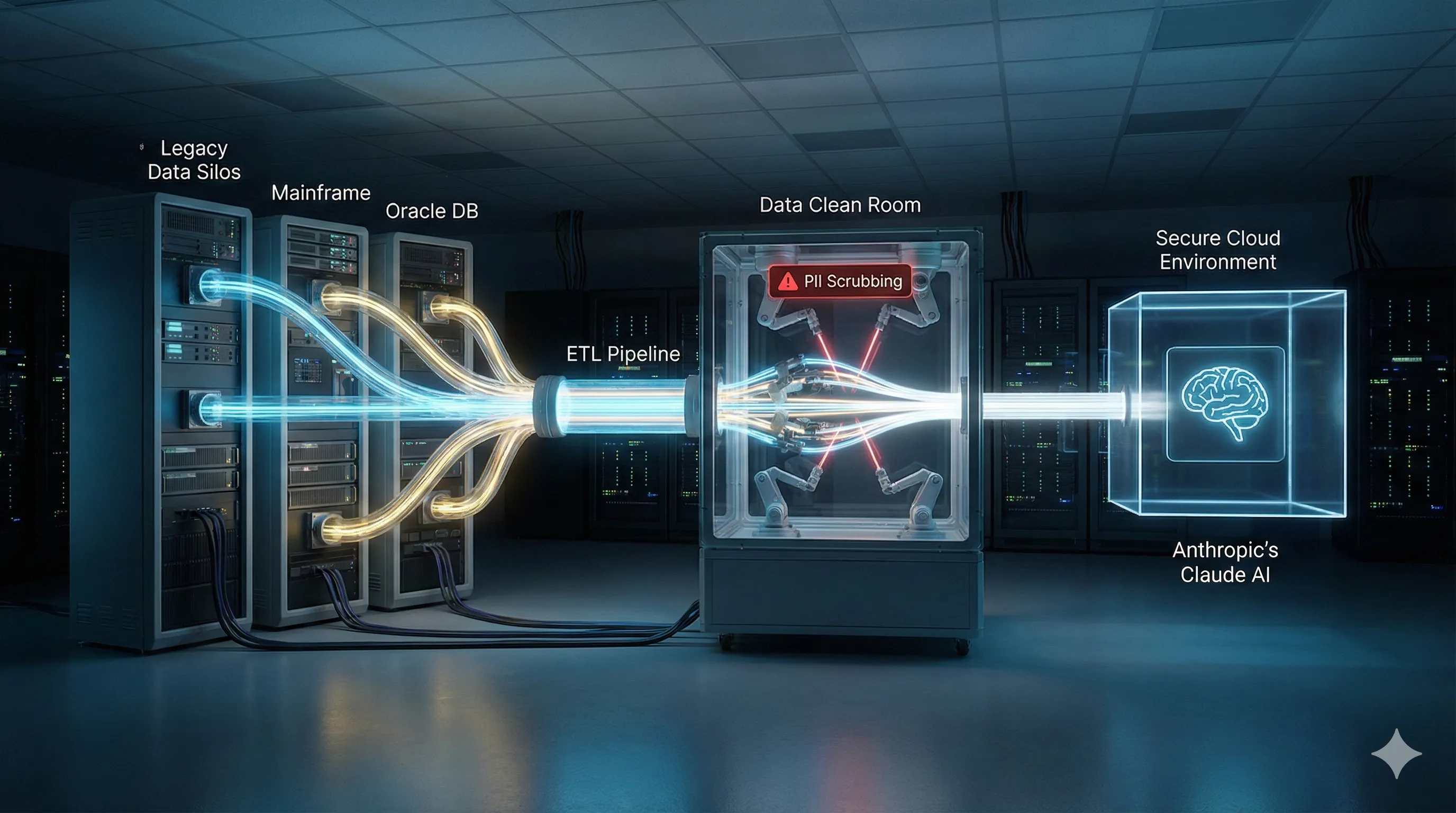
Financial data necessary for compliance checks is often scattered across disparate legacy systems, ranging from mainframes to on-premise Oracle databases.
Creating robust and secure ETL (Extract, Transform, Load) pipelines to feed this vast amount of data to Claude has been a substantial undertaking.
API Latency & Bandwidth:
Processing immense volumes of financial documents demands high-throughput, low-latency connections to Anthropic's models.
This necessity has required significant network infrastructure upgrades at Goldman Sachs.
The 'Data Clean Room':
To uphold stringent data privacy standards, Goldman Sachs developed a sophisticated 'data clean room' environment.
This intermediary system meticulously scrubs or tokenizes all personally identifiable information (PII) and client-sensitive data before it is sent to the AI for processing, even within their secure cloud instance.
This measure is critical for maintaining confidentiality.
Regulatory Compliance & AI: A New Frontier for Financial Services
The adoption of AI by a Global Systemically Important Bank (G-SIB) like Goldman Sachs acts as a crucial stress test for financial regulators such as the SEC and FINRA.
A primary concern for these bodies is 'explainability' (XAI) – the ability to understand how an AI arrived at a specific decision.
Goldman Sachs is reportedly developing a comprehensive 'AI Audit Trail' to address these concerns.
For every significant decision suggested by Claude, this system logs the following critical information:
- The exact data and prompt provided to the AI.
- The specific model version of Claude that was used.
- A summary of the AI's reasoning, where available.
- The confidence score assigned to the AI's output.
- The digital signature of the human employee who reviewed and ultimately approved the action.
This detailed record aims to create a defensible account of AI-assisted decisions.
However, whether regulators will fully accept an AI's reasoning as a valid component of a compliance check remains a pivotal and currently unanswered question for the broader financial industry.

The ROI of AI Automation: Goldman Sachs' Investment in Claude
The immediate return on investment for Goldman Sachs' integration of Claude AI is not primarily driven by headcount reduction.
Instead, the tangible, immediate value lies in enhanced risk mitigation and significant operational efficiency gains.
Cost Savings:
While long-term plans may involve reducing reliance on extensive manual processing, the most immediate savings stem from reducing errors.
Mistakes in compliance and accounting can lead to substantial regulatory fines or costly financial restatements.
By minimizing these, Claude directly contributes to cost avoidance.
Efficiency Gains:
The increased speed at which compliance checks can be performed allows teams to manage higher volumes of work.
This accelerated processing helps close books faster at the end of a quarter, an invaluable benefit in fast-paced financial markets.
Price/Value Shift:
This investment signifies a fundamental shift in the cost structure of financial operations.
The model is evolving from one heavily dominated by labor costs to one where technology licensing, secure cloud computing, and a smaller, more highly-skilled workforce represent the primary expenditures.
Anthropic vs. OpenAI: The Enterprise AI Battleground
Goldman Sachs' choice of Anthropic over competitors like OpenAI sends a strong strategic signal to the market.
This decision was likely influenced by Anthropic's distinct emphasis on AI safety, reliability, and its 'Constitutional AI' approach.
For a risk-averse institution within a highly regulated sector, a partner prioritizing predictable and safe outputs holds more value than one pursuing broader, potentially more volatile, AI capabilities.
This strategic alignment positions Anthropic as a formidable leader for enterprise AI applications in sectors such as finance, healthcare, and law.
Data Security & Trust: Claude's Role with Sensitive Financial Data
For Goldman Sachs, data security is not negotiable; it is paramount.
The implementation of Claude with Anthropic reportedly involves a rigorous, multi-layered security protocol built on a zero-trust architecture.
Key Security Measures:
- VPC Deployment:
Claude is accessed through a private, isolated environment within a major cloud provider (e.g., AWS or Google Cloud).
This ensures no sensitive Goldman Sachs data traverses the public internet. - Zero Data Retention:
Anthropic contractually guarantees that no Goldman Sachs data is stored or utilized to train its foundational models.
Every transaction is ephemeral, meaning data is processed and immediately discarded. - End-to-End Encryption:
All data is meticulously encrypted in transit using TLS 1.3 and at rest using AES-256 encryption standards.
This provides comprehensive protection against unauthorized access.
These stringent measures are crucial for building and maintaining trust, not only internally within Goldman Sachs but also with their clients and regulatory bodies.
For further official information, please refer to press releases on the official websites of Goldman Sachs and Anthropic.


