🚀 Key Takeaways
- SK Hynix has successfully developed the world's first LPDDR6 DRAM, leveraging its cutting-edge 10nm-class (1c) process technology.
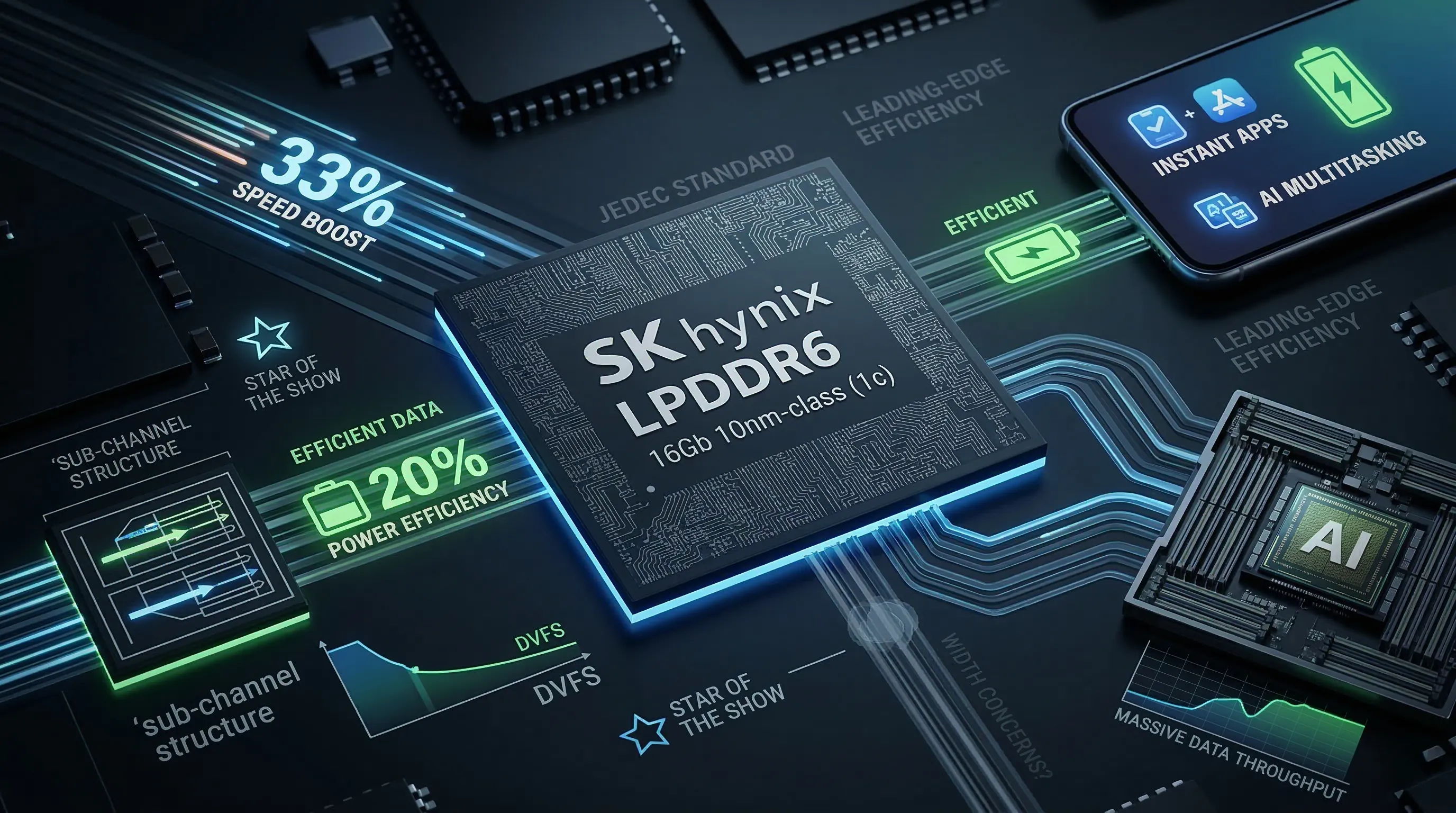
- This new memory boasts a claimed 33% speed increase and 20% better power efficiency compared to LPDDR5X, thanks to innovations like a sub-channel structure and DVFS.
- With speeds exceeding 10.7 Gbps and 16Gb capacity per chip, LPDDR6 is poised to be a game-changer for AI servers, data centers, and high-performance mobile devices.
SK Hynix has just unveiled its groundbreaking LPDDR6 DRAM, marking a significant leap forward in mobile and AI memory technology.
Developed on their cutting-edge 10nm-class (1c) process node, this development positions SK Hynix at the forefront of memory innovation, mere months after the JEDEC standard was finalized.
This new generation promises to redefine performance and power efficiency for a wide array of devices, from our pockets to the most powerful data centers.
The LPDDR6 DRAM boasts impressive upgrades, delivering over 10.7 Gbps base operating speed, translating to a claimed 33% increase in speed and a remarkable 20% improvement in power efficiency compared to its LPDDR5X predecessor.
These advancements are largely thanks to innovative features such as a new sub-channel structure, which only powers active data paths, and DVFS (Dynamic Voltage and Frequency Scaling), optimizing power consumption based on demand.
Each chip offers a robust 16Gb capacity, ensuring ample memory for even the most demanding applications.
While competition is already emerging with announcements from industry peers, SK Hynix's LPDDR6 is set to play a pivotal role in the explosion of AI workloads.
From powering next-generation smartphones and tablets to becoming a critical component in AI servers utilizing modules like SOCAMM/SOCAMM2 for Nvidia's future Grace Blackwell Ultra and Vera Rubin Superchips, its impact will be widespread.
This technology underscores the increasing relevance of high-performance, power-efficient memory across mainstream, server, and client computing landscapes, promising a future of faster, more capable devices.

1. First Impressions & Build
🔹 SK Hynix Enters the LPDDR6 Arena
SK Hynix has officially thrown its hat into the next-generation memory ring with its first LPDDR6 DRAM, a move that feels both aggressive and slightly late to the party.
Arriving eight months after JEDEC finalized the standard, and notably after rival Samsung showcased its own LPDDR6 at CES 2026, SK Hynix is clearly playing catch-up but doing so with some formidable technology.
Built on a leading-edge 10nm-class (1c) process, these 16Gb chips are engineered from the ground up for efficiency.
The real magic lies under the hood with a new sub-channel structure and the implementation of Dynamic Voltage and Frequency Scaling (DVFS).
This isn’t just marketing fluff; it’s a direct engineering assault on power drain, allowing the memory to intelligently power down data paths that aren't in use and dynamically throttle its clock speed and voltage during low-demand moments.
This foundational design choice signals a clear focus on balancing raw power with the practical demands of battery life and thermal management.
🔹 Real-World Performance & Use Cases
The on-paper specs translate into tangible, game-changing benefits across the entire tech landscape.
SK Hynix claims a 33% speed boost and a 20% improvement in power efficiency over the previous LPDDR5X generation, with base speeds already clearing 10.7 Gbps.
For your next flagship smartphone or tablet, this means instantaneous app loading, unbelievably fluid multitasking, and the ability to handle on-device AI processing that would cripple current hardware.
But the real revolution is happening in the data center, where this memory is a critical enabler for systems like Nvidia’s monstrous GB300 Grace Blackwell and future Vera Rubin Superchips.
That raw speed, especially when configured in a dual-channel setup to hit a blistering 256GBps of bandwidth, is precisely what’s needed to feed the insatiable appetite of next-generation AI servers.
The power savings aren't just a bonus; for a massive data center, a 20% reduction in memory power consumption is a huge boon, drastically cutting operational costs and thermal output.
🔹 The Verdict & Community Sentiment
SK Hynix's LPDDR6 is undeniably impressive, offering the speed and efficiency demanded by the impending AI revolution.
The community is buzzing, with users like ‘bit_user’ highlighting its crucial role in everything from future Apple M-series chips to Nvidia’s server roadmap.
However, healthy skepticism remains.
Users like ‘thestryker’ and ‘Notton’ are raising valid concerns online about the potential for manufacturers to use narrower 96-bit interfaces, which could effectively negate some of the bandwidth gains compared to 128-bit LPDDR5X.
There's also apprehension about a "slower" 9600 MT/s standard that some fear will feel "barely better than LPDDR5X" in high-end products.
Conversely, many mobile-focused users, like ‘usertests’, argue that the 20% power efficiency is the "star of the show", making even the slower LPDDR6 variants a massive win for all-day battery life.
Ultimately, SK Hynix has delivered a powerful piece of technology, but its final impact will depend entirely on how device and server manufacturers choose to implement it.
2. Key Features Test
🔹 Blistering Speed Meets Smarter Power
SK Hynix isn't just inching forward; it's leaping ahead with a base operating speed that blasts 'over' 10.7 Gbps.
That’s a claimed 33% greater speed than the previous-gen LPDDR5X, a figure that moves from theoretical to tangible when you’re dealing with massive AI workloads.
But raw speed is only half the story; the real engineering magic lies in its efficiency.
The company implemented a new sub-channel structure, which smartly powers only the specific data paths in use, preventing wasted energy.
Think of it like a highway system that only illuminates the lanes with traffic, dramatically cutting the power bill.
Combined with Dynamic Voltage and Frequency Scaling (DVFS), which dials back the clock speed and voltage during light tasks, SK Hynix claims a stunning 20% improvement in power efficiency over its predecessor.
🔹 Real-World Performance & Use Cases
So, what does all this tech mean for you?
It translates to a calculated peak bandwidth of 256GBps on a dual-channel 192-bit interface running at 10700 MT/s.
This isn't just a number on a spec sheet; it's the data firehose needed to feed the next generation of ravenous AI servers and powerhouse mobile SoCs, from Nvidia's upcoming Vera Rubin Superchip to the next Apple M-series.
For a data scientist or AI developer, this means less time waiting for models to load and faster processing on-device, while for a mobile user, it promises instantaneous app loads and silky-smooth multitasking, all while sipping power.
However, there’s a significant catch that the community, including users like 'thestryker', has been quick to point out.
The standard allows for narrower 96-bit interfaces, which could hamstring this potential, leaving a high-clocked LPDDR6 with bandwidth uncomfortably close to a wider LPDDR5X system.
This has led to valid questions from enthusiasts like 'Notton' about memory controller sizes and the hope that manufacturers don't cripple high-end devices with these narrower configurations.
🔹 The Verdict & Community Sentiment
Ultimately, SK Hynix’s LPDDR6 is a technological triumph, offering a potent combination of game-changing speed and critical power savings.
The pros are undeniable: it's significantly faster and much more power-efficient, making it essential for the future of AI and mobile computing.
The cons, however, are implementation-dependent but worrying; the 'slower' 9600 MT/s standard feels barely better than top-tier LPDDR5X, and the potential for a 96-bit interface could negate the generational leap in bandwidth.
Online, the sentiment is clear: while the speed gains are welcome, many users, such as 'usertests', believe the enhanced power efficiency is the true 'star of the show'.
Our verdict is that this is a phenomenal piece of memory engineering, but its ultimate value will be decided by the SoC designers and device makers.
Buyers will need to watch the spec sheets closer than ever to ensure they're getting the full-fat LPDDR6 experience.

3. Who Should Buy This?
🔹 The Next-Gen AI & Mobile Powerhouse
SK Hynix LPDDR6 DRAM is not built for everyone; it's engineered for the bleeding edge of technology.
Its primary audience consists of two distinct but equally demanding groups: architects of next-generation AI data centers and manufacturers of flagship smartphones and tablets.
This memory represents a critical pivot point, especially for the server market, where its efficiency and speed are desperately needed.
Industry giants are already lining up, with confirmed applications in AI servers utilizing SOCAMM modules, such as Nvidia's groundbreaking GB300 Grace Blackwell and Vera Rubin Superchips.
For these systems, LPDDR6 isn't an optional upgrade; it's the fundamental building block required to handle the unprecedented data throughput of modern AI.
🔹 From Pocket Supercomputers to AI Giants
In the real world, this translates to a tangible leap in capability across the board.
For consumers, the first taste of LPDDR6 will almost certainly be in their next high-end smartphone, just as many users expect.
This will enable powerful on-device AI, console-level gaming, and multitasking that feels instantaneous, all while sipping power to extend battery life.
For the professionals building our AI-powered future, the use case is even more stark.
A system like an Nvidia Vera Rubin or its successors simply cannot function without the massive bandwidth LPDDR6 provides; it is the vital pipeline that feeds the processing cores, preventing catastrophic data bottlenecks.
This is the memory that will train the next wave of large language models and power complex scientific discovery.
🔹 The Verdict: An Inevitable & Essential Upgrade
Ultimately, LPDDR6 is aimed at anyone who cannot afford to compromise on performance or efficiency.
The high interest from the tech community is a clear indicator of its growing importance, with users keenly watching for its integration into beloved platforms like Apple's M-series SoCs, AMD's Ryzen AI, and Nvidia's entire product stack.
It is a foundational technology for the next era of high-performance computing, making it a mandatory consideration for system designers, IT infrastructure planners, and AI developers.
If your work or product demand is at the forefront of mobile performance or data center-scale AI, this memory isn't just a recommendation—it's a requirement.

4. 💡 Tech Talk: Making Sense of the Jargon
- LPDDR6 (Low Power Double Data Rate 6): Think of this as the sixth generation of a super-efficient highway for your device's information. It's specifically built to move data incredibly fast (Double Data Rate) while sipping power (Low Power), like a marathon runner who's both speedy and conserves energy for the long haul.
- 10nm-class (1c) process node: This refers to how tiny the "roads" and "buildings" (transistors) on the memory chip are built. '10nm-class (1c)' means these components are incredibly small, around 10 nanometers wide. Smaller parts mean you can fit more memory into a tiny space and make it work faster and more efficiently, like building a compact, high-rise city instead of sprawling bungalows.
- Sub-channel structure: Imagine your memory chip has many lanes, but you only need a few to carry a small package. A sub-channel structure is like having smart gates that only open the specific lanes you need, keeping the rest of the highway closed. This saves a lot of energy because you're not lighting up or maintaining unused parts of the road.
- DVFS (Dynamic Voltage and Frequency Scaling): This is like your car's cruise control intelligently adjusting engine power. When your device isn't doing much, DVFS automatically lowers the memory's speed and voltage (like idling the engine), saving battery. When you demand high performance (like hitting the gas), it instantly ramps up. It’s about only using as much power as you absolutely need.
📚 Related Posts
Samsung T9 Portable SSD vs SanDisk Extreme Portable SSD – Speed Test & Comparison
🚀 Key TakeawaysUnrivaled Speed: The Samsung T9 and Crucial X10 Pro lead with read/write speeds up to 2,000MB/s and 2,100MB/s respectively, making them ideal for high-bandwidth tasks like 4K/8K video editing and large file transfers.Rugged Durability for
tech.dragon-story.com
Intel Nova Lake Deep Dive: The Core Ultra 400, DDR5-8000, and What It Means for 2026
🚀 Key TakeawaysIntel’s upcoming Nova Lake CPUs, codenamed Core Ultra 400, are projected for a late 2026/early 2027 launch, aiming to challenge and potentially surpass the best CPUs on the market with features like DDR5-8000 memory support and a powerf
tech.dragon-story.com
Google's February AI Blitz: New Gemini Models, Creative Tools, and a Global Vision
🚀 Key TakeawaysGoogle's February AI Blitz unveiled a significant push for more capable and specialized AI, focusing on empowering both advanced problem-solving and creative expression across diverse applications.This included the release of Gemini 3.1 P
tech.dragon-story.com


