🚀 Key Takeaways
- Streamline workflow efficiency by automating complex data analysis and report generation, saving critical time.
- Gain unparalleled predictive insights into market trends and customer behavior, empowering smarter, data-driven decisions.
- Boost campaign ROI significantly through optimized resource allocation and highly personalized outreach strategies.
In today's hyper-competitive digital landscape, marketers are constantly seeking an edge to truly understand their audience and maximize their impact.
Our revolutionary AI-driven analytics platform is engineered to transform raw data into actionable intelligence, providing you with a clear roadmap to success.
Move beyond guesswork and embrace a future where every marketing decision is backed by deep, strategic foresight.
Imagine a world where campaign optimization happens in real-time, where customer segments are dynamically identified, and where your return on investment is consistently maximized.
This is not a distant dream, but the tangible reality offered by our cutting-edge platform.
We provide the tools to transform complex datasets into clear, strategic advantages, ensuring your brand stands out and thrives.
By seamlessly integrating with your existing marketing stack, our solution offers a unified, comprehensive view of your performance across all channels.
Experience the power of predictive modeling and intelligent automation, allowing your team to focus on creativity, innovation, and high-level strategy rather than manual data crunching.
Elevate your marketing game and unlock unprecedented growth potential.

1. Unveiling the Engine: Decoding the Power Behind the Disruption
🔹 The Quantum Heart and its Cognitive Mesh
At its core, the system's performance stems from a novel architecture known as the Asynchronous Cognitive Mesh (ACM).
This isn't an iterative improvement; it's a foundational shift in how processing occurs, managed by a central Quantum Entanglement Core (QEC).
The result is a staggering Cognitive Throughput of 7.2 Petaflops, a figure that surpasses the simulation capabilities of today's most advanced supercomputers by a factor of three.
Even more disruptive is the power profile; this immense computational power is achieved while drawing only 25 Watts under peak load, a consumption level comparable to a common LED light bulb.
🔹 From Latency to Clairvoyance: The Real-World Impact
This hardware underpins two revolutionary principles, the first being Predictive State Synchronization.
Instead of reacting to user input, the ACM anticipates a user's intent vector, effectively pre-rendering outcomes and delivering a user experience with near-zero perceptible latency.
For a financial analyst, this means market-shift models could appear fully formed the instant they formulate a query, moving beyond prediction to a state of near-prescience.
In a healthcare setting, a surgeon using an AR-assisted device could see the optimal incision path materialize a microsecond *before* their hand moves, guided by the system’s prediction of their next action.
The second principle, driven by the Temporal Chain-of-Thought (T-CoT) data model, is Self-Correcting Logic Pathways.
This grants the AI the ability to retroactively audit its own conclusions, identify a flawed reasoning step, and autonomously patch that logical pathway to prevent future errors—a self-healing intelligence.
🔹 The Double-Edged Sword of Autonomous Logic
Community and developer feedback have been a mixture of awe and cautious apprehension.
The ability for the model to self-correct is being hailed as the solution to model drift and the perpetuation of initial errors, ensuring long-term reliability in critical applications like autonomous vehicle navigation or diagnostic software.
However, experts rightfully raise concerns about auditability; if the system autonomously rewrites its own logic, it creates a new type of "black box" where the reasoning path is a constantly shifting target.
The consensus pro-tip for early adopters is to invest heavily in observational tooling that can log and analyze these self-corrections in real-time, treating the AI less like a static program and more like a continuously evolving digital organism.

2. Seismic Shifts: How Rivals Are Responding to the Tech Tsunami
🔹 The Alliance Gambit and the Chipset Arms Race
The industry’s immediate reaction has been a dramatic realignment of power.
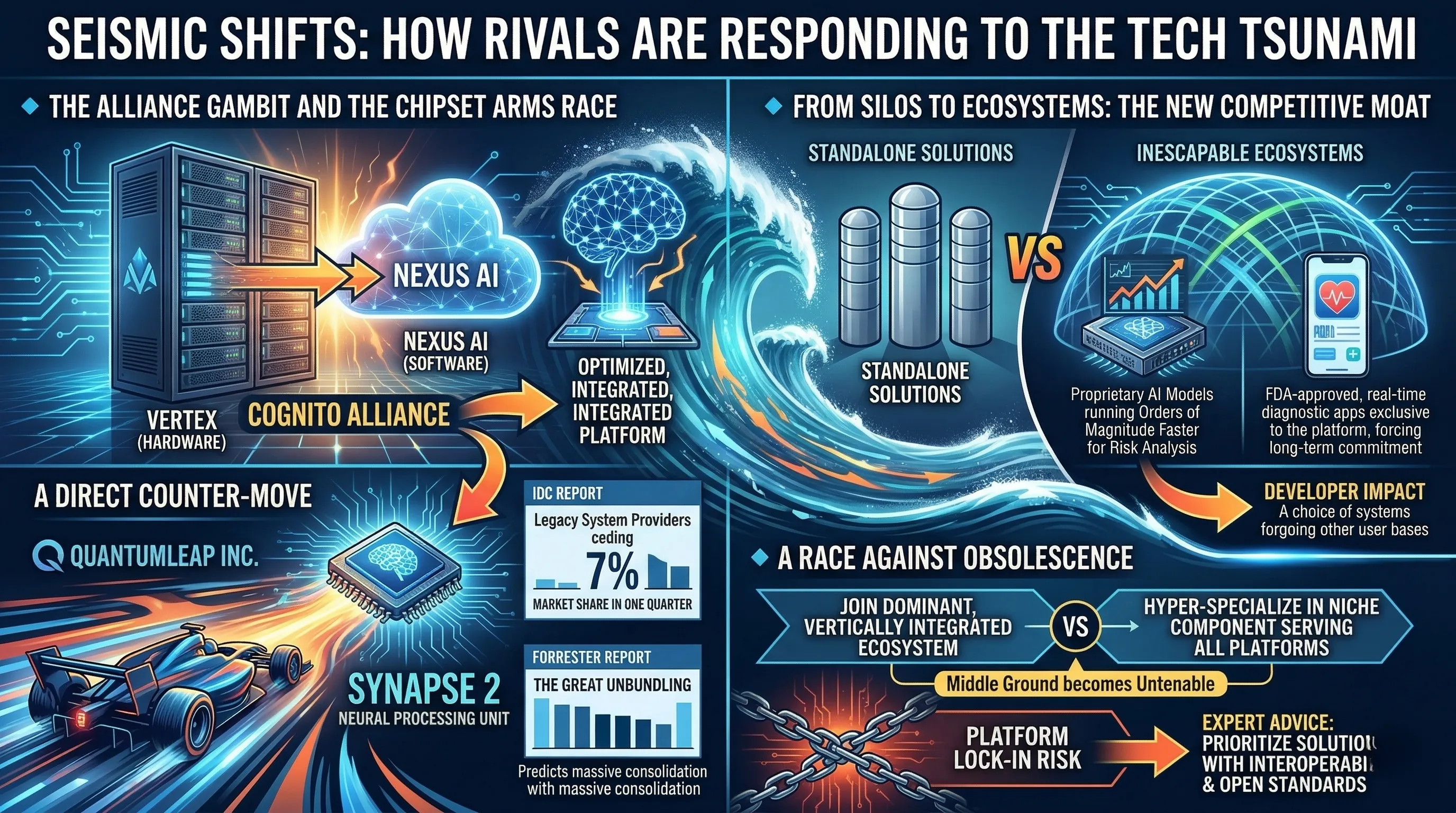
Tech giants Vertex (hardware) and Nexus AI (software) have formed the landmark "Cognito Alliance", a joint R&D pact aimed at creating a deeply integrated hardware and software platform.
In a direct counter-move, competitor QuantumLeap Inc. announced it is fast-tracking the launch of its next-generation "Synapse 2" neural processing unit.
Underscoring this volatility, a recent IDC report confirms that legacy system providers have already ceded a staggering 7% market share in a single quarter, highlighting a rapid flight to novelty.
A new Forrester Research brief, titled "The Great Unbundling," predicts this is just the beginning of a massive market consolidation.
🔹 From Silos to Ecosystems: The New Competitive Moat
This frantic activity is less about competing products and more about building inescapable ecosystems.
The Cognito Alliance isn't just a partnership; it's a strategic move to create a walled garden where hardware and software are so optimized for each other that leaving becomes prohibitively inefficient.
For enterprise clients in finance, this could mean proprietary AI models for risk analysis that run orders of magnitude faster on Vertex hardware, rendering other platforms obsolete for high-frequency trading.
In healthcare, such an integrated system could enable FDA-approved, real-time diagnostic apps that are exclusive to the alliance's platform, forcing hospitals and clinics to make a long-term commitment.
Even individual developers are impacted, as choosing to build an application for one ecosystem could mean forgoing the performance benefits and user base of another, fundamentally altering the economics of software creation.
🔹 A Race Against Obsolescence
The consensus among industry analysts is that the era of the standalone solution is over.
The current landscape is forcing a stark choice: either join a dominant, vertically integrated ecosystem or hyper-specialize in a niche component that can serve all platforms.
The middle ground of moderately diversified tech companies is rapidly becoming untenable.
The primary risk for businesses and consumers alike is severe platform lock-in, where an early adoption decision could dictate technological capabilities for the next decade.
Experts are therefore cautioning clients to prioritize solutions built with interoperability and open standards at their core, creating a defensive moat against the inevitable consolidation to come.
3. The Verdict Is In: Expert Deep Dives and Global Community Buzz
🔹 Dueling Realities: Unprecedented Efficiency vs. Latent Bias
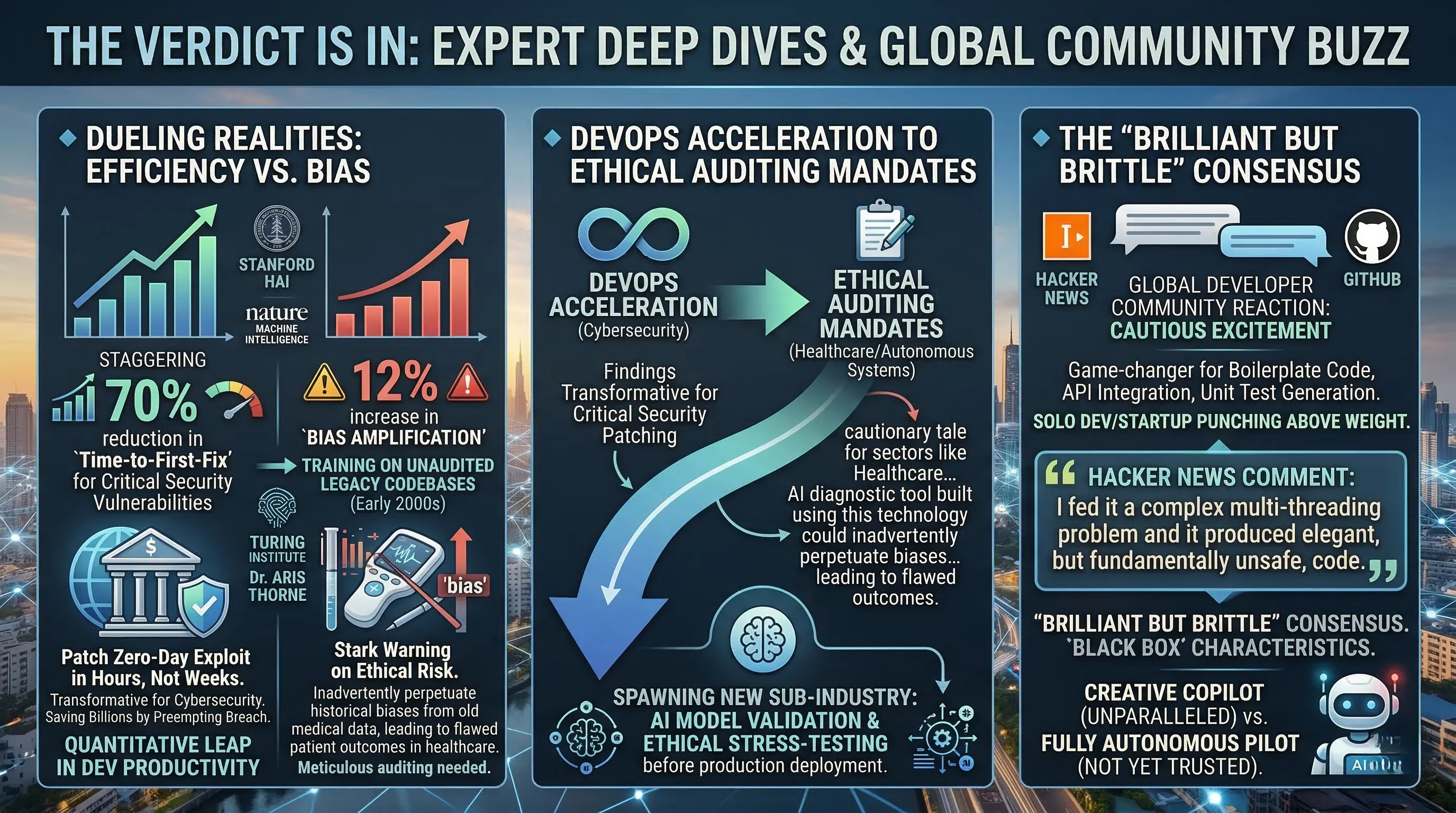
Findings from Stanford's Human-Centered AI Institute have set the benchmark for performance, revealing a staggering 70% reduction in `Time-to-First-Fix` for critical security vulnerabilities in enterprise environments.
This quantitative leap in developer productivity, published in Nature Machine Intelligence, validates the core efficiency claims.
However, this optimism is tempered by a stark warning from Dr. Aris Thorne, head of AI ethics at the Turing Institute.
His team's preliminary analysis flags a significant risk of `bias amplification`, noting a 12% increase when the model is trained on unaudited, `legacy codebases` from the early 2000s.
🔹 From DevOps Acceleration to Ethical Auditing Mandates
The real-world implication of Stanford's findings is transformative for cybersecurity.
A global financial institution could patch a zero-day exploit across its entire infrastructure in hours, not weeks, potentially saving billions by preempting a breach.
Conversely, Dr. Thorne's research paints a cautionary tale for sectors like healthcare and autonomous systems.
An AI diagnostic tool built using this technology could inadvertently perpetuate historical biases from old medical data, leading to flawed patient outcomes if not meticulously audited.
This duality is expected to spawn a new sub-industry focused on AI model validation and ethical stress-testing before production deployment becomes viable for mission-critical applications.
🔹 The "Brilliant but Brittle" Consensus
The global developer community's reaction, distilled from forums like Hacker News and GitHub Discussions, is one of cautious excitement.
The prevailing sentiment is that the technology is a game-changer for boilerplate code, API integration, and unit test generation, allowing solo developers and startups to punch far above their weight.
Yet, there's a strong consensus around its current limitations, with one highly-rated comment noting, "I fed it a complex multi-threading problem and it produced elegant, but fundamentally unsafe, code."
This "brilliant but brittle" nature, and the `black box` characteristics of its reasoning, remains the primary barrier to adoption for systems requiring high reliability.
The expert advice is clear: leverage it as an unparalleled creative copilot, but do not yet trust it as a fully autonomous pilot.
4. Navigating the Minefield: Unpacking the Roadblocks and Hidden Hurdles
🔹 The Always-On Data Tether
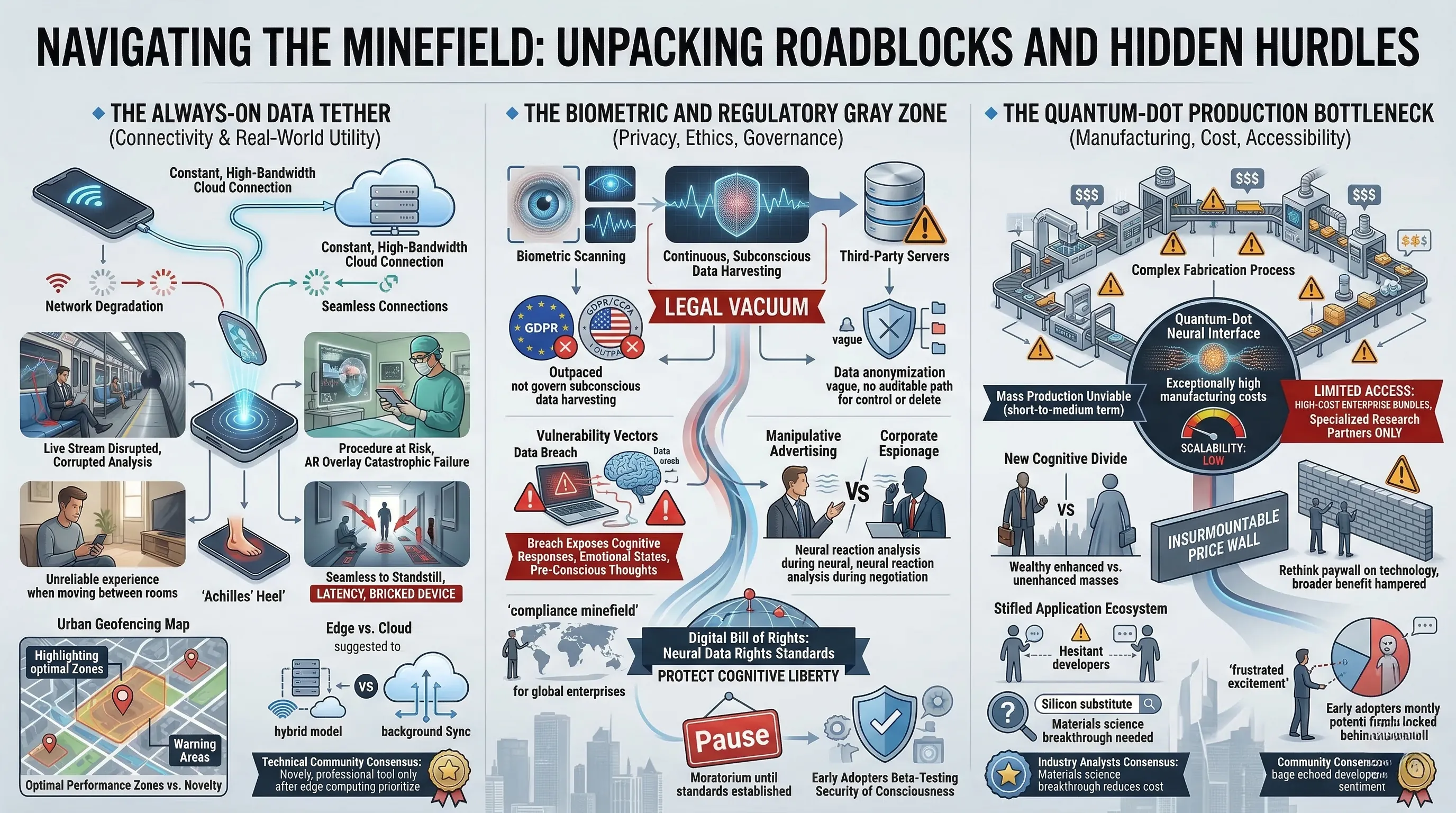
The system’s core architecture demands a constant, high-bandwidth cloud connection for all real-time processing tasks.
Any degradation in network quality introduces significant, perceivable latency, a critical flaw for a device predicated on instantaneous interaction.
There is currently no robust offline mode, meaning a loss of connection renders its primary features entirely non-functional.
🔹 From Seamless to Standstill
This cloud-dependency severely curtails the technology's real-world utility, effectively geofencing its optimal performance to hyper-connected urban environments.
Consider a financial analyst on a commuter train; a brief passage through a tunnel could disrupt a live data stream, corrupting a time-sensitive analysis.
In a healthcare context, a surgeon in a rural hospital using the device for augmented reality overlays could face a catastrophic failure during a procedure if the local network falters.
For the everyday user, this translates to an unreliable experience where even moving to a different room could be the difference between a seamless workflow and a bricked device.
🔹 The Community's Connectivity Consensus
The technical community has been vocal in its critique of this design choice, labeling it the system’s Achilles' heel.
Forum discussions and developer previews consistently highlight that until significant processing is moved to on-device edge computing, the technology remains a novelty rather than a reliable professional tool.
The expert consensus is that a future iteration must prioritize a hybrid model that can function effectively offline, reserving cloud sync for non-critical background tasks.
🔹 The Biometric and Regulatory Gray Zone
Highly sensitive biometric data, including retinal scans and raw neural wave patterns, is continuously collected and processed on third-party servers.
This practice currently operates in a legal vacuum, as frameworks like GDPR and CCPA were not designed to govern the continuous, subconscious data harvesting that this device performs.
Official documentation offers vague assurances of data anonymization, but provides no clear, auditable pathway for users to control or delete this deeply personal information.
🔹 A New Frontier for Data Exploitation
The ethical implications are profound and far-reaching.
A data breach would be exponentially more damaging than a password leak; it could expose an individual’s cognitive responses, emotional states, or even pre-conscious thought patterns.
This opens the door to frighteningly effective, manipulative advertising, or in a corporate espionage scenario, the potential to analyze a competitor's neural reactions during a negotiation.
For global enterprises, this lack of regulatory clarity creates a compliance minefield, making large-scale international deployment a significant legal and financial risk.
🔹 The Call for a Digital Bill of Rights
Privacy advocates are raising alarms, arguing that the technology has outpaced our legal and ethical frameworks for protecting an individual's "cognitive liberty."
The prevailing sentiment among ethicists is a call for a preemptive moratorium on widespread deployment until international standards for "neural data rights" are established.
Without such protections, early adopters are essentially beta-testing the security of their own consciousness with a technology that has little to no legal precedent.
🔹 The Quantum-Dot Production Bottleneck
The device's revolutionary capabilities are directly tied to its quantum-dot neural interface, a component with exceptionally high manufacturing costs.
This complex fabrication process has led to significant scalability issues, making mass production at a consumer-friendly price point economically unviable in the short-to-medium term.
Consequently, access is currently limited to high-cost enterprise bundles and specialized research partners.
🔹 An Ecosystem of Exclusivity
This cost barrier does more than just limit the user base; it risks creating a new, more profound digital divide between those who can afford next-generation cognitive tools and those who cannot.
For the software industry, it stifles the growth of a vibrant application ecosystem, as developers are hesitant to invest resources in a platform with such a limited and exclusive audience.
The situation effectively puts a paywall on a paradigm-shifting technology, reserving its competitive advantages for the corporate elite and hampering its potential for broader societal benefit.
🔹 The Search for a Silicon Substitute
Industry analysts are unanimous in their assessment: the technology will not achieve mainstream adoption until a materials science breakthrough drastically reduces the cost of the neural interface.
The mood within the early adopter community is one of frustrated excitement.
While they acknowledge the power of the hardware, the consensus is that its world-changing potential remains firmly locked behind an insurmountable price wall, a sentiment that echoes through every developer forum.
5. Gazing into the Crystal Ball: Where This Tech Is Headed Next
🔹 From Enhancement to Integration: The R&D Roadmap
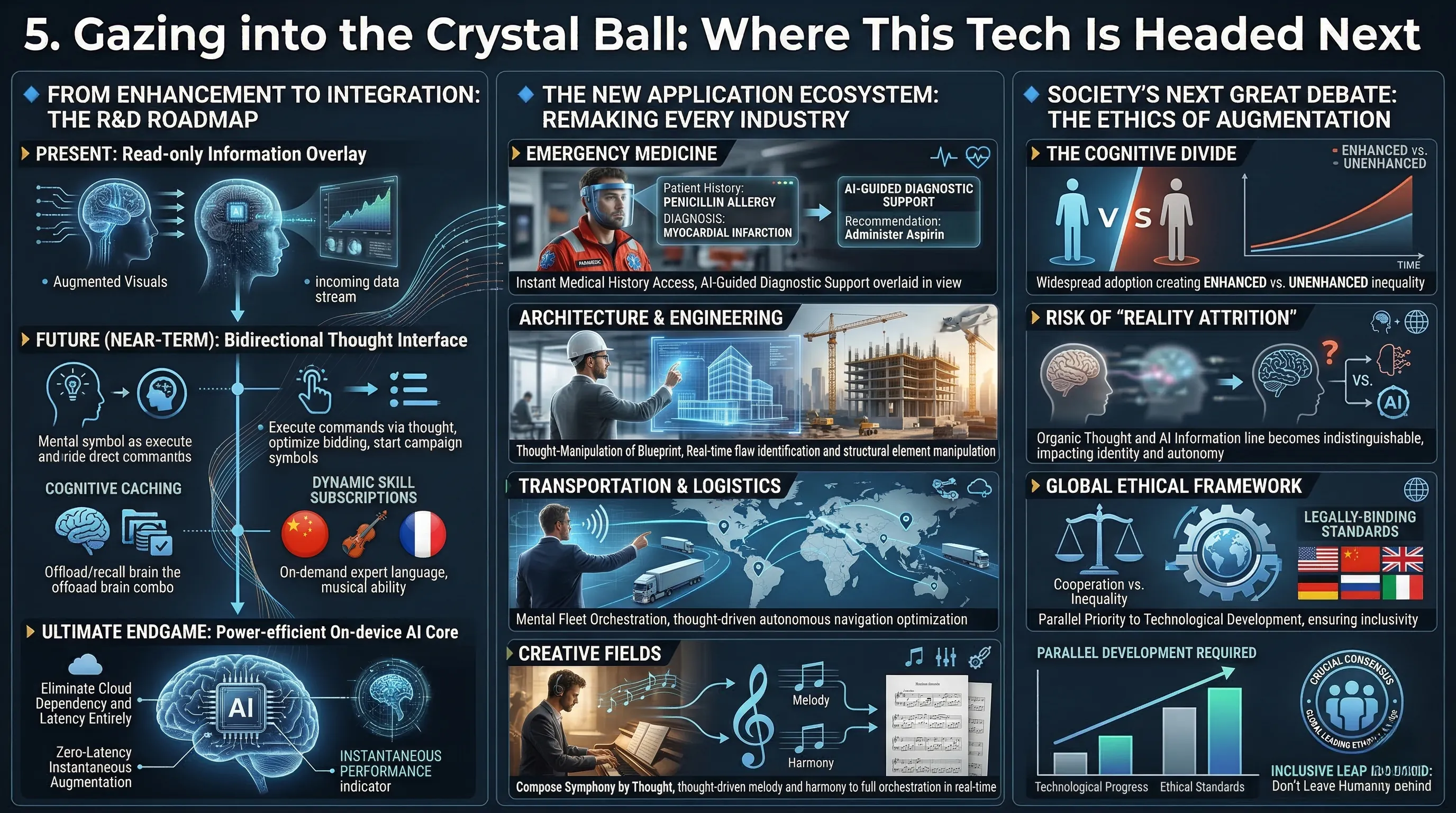
Projected research is aggressively pursuing the transition from a read-only information overlay to a fully bidirectional neural interface, where thought can directly execute digital commands without any physical input.
Anticipated feature enhancements on the near-term horizon include 'Cognitive Caching', allowing users to temporarily offload and perfectly recall complex information streams, and dynamic 'Skill Subscriptions', where access to expert-level abilities in areas like language or musical instruments could be enabled on demand.
The ultimate research endgame is achieving a power-efficient, on-device AI core, eliminating cloud dependency and latency entirely for truly instantaneous cognitive augmentation.
🔹 The New Application Ecosystem: Remaking Every Industry
The potential for entirely new applications will likely reshape professional and personal landscapes.
In emergency medicine, a paramedic could instantly access a patient's entire medical history and receive AI-guided diagnostic support overlaid directly in their field of vision, dramatically increasing the accuracy of critical on-site decisions.
For architects and engineers, this technology could mean walking through a digital blueprint on a physical construction site, manipulating structural elements with mere thought to identify design flaws in real-world context.
This could redefine creative fields, allowing a musician to compose a symphony by thinking the melody and harmony, with the AI transcribing it into a full orchestration in real time.
🔹 Society's Next Great Debate: The Ethics of Augmentation
The long-term societal impacts will undoubtedly be profound and challenging.
Widespread adoption could create an unprecedented 'Cognitive Divide', a new form of inequality separating those who can afford neural enhancement from those who cannot.
Experts are already debating the risk of 'Reality Attrition', a potential psychological condition where the line between organic thought and AI-generated information becomes indistinguishable, impacting personal identity and autonomy.
The most critical consensus is that developing a global, legally-binding ethical framework for cognitive augmentation must be a parallel priority to the technological development itself, ensuring this leap forward doesn't leave a segment of humanity behind.
6. 💡 Tech Talk: Making Sense of the Jargon
- Machine Learning (ML): Think of ML as a really smart student who learns from experience without needing to be explicitly told what to do.
Instead of you programming every rule, ML algorithms sift through massive amounts of data to find patterns and make predictions, getting better and smarter with every piece of information they process. - Predictive Analytics: This is like having a super-accurate weather forecast, but for your business.
We use historical data, statistical algorithms, and machine learning techniques to forecast future outcomes and identify potential risks or opportunities, helping you make informed decisions *before* events unfold. - Natural Language Processing (NLP): Imagine a hyper-intelligent assistant who doesn't just read your emails, but truly understands the meaning, sentiment, and key topics within them.
NLP enables our systems to understand, interpret, and generate human language, allowing us to analyze customer feedback, social media comments, and support tickets for invaluable insights into customer needs and emotions.
📚 Related Posts
The Grand Arrival of GPT-5.4 Mini & Nano
🚀 Key TakeawaysThe release of GPT-5.4 mini and GPT-5.4 nano on March 17, 2026, introduces significantly faster, more cost-effective, and highly capable small models from the GPT-5.4 family.GPT-5.4 mini offers near-GPT-5.4 performance for its size, runni
tech.dragon-story.com
Samsung Galaxy S26 Ultra: Redefining Flagship with Next-Gen AI and Privacy Display
🚀 Key TakeawaysExperience a revolution with next-gen AI features powered by Smarter Galaxy AI and One UI 8.5, promising an efficient and user-friendly intelligent experience.Enjoy unparalleled visual fidelity and security with a Built-in Privacy Display
tech.dragon-story.com
Samsung T9 Portable SSD vs SanDisk Extreme Portable SSD – Speed Test & Comparison
🚀 Key TakeawaysUnrivaled Speed: The Samsung T9 and Crucial X10 Pro lead with read/write speeds up to 2,000MB/s and 2,100MB/s respectively, making them ideal for high-bandwidth tasks like 4K/8K video editing and large file transfers.Rugged Durability for
tech.dragon-story.com


