🚀 Key Takeaways
- Adobe is transforming static PDFs into dynamic, AI-powered digital experience platforms, enabling conversational interaction, automated content creation, and the innovative concept of experience sharing.
The phrase "PDFs coming alive" heralds a significant evolution in how we interact with documents, spearheaded by Adobe's innovative productivity agents.
This initiative goes far beyond traditional document processing, leveraging a powerful combination of Acrobat's core capabilities with advanced AI to fundamentally redefine the PDF experience.
It aims to automate document understanding, content creation, and seamless sharing, making information more accessible and actionable than ever before.
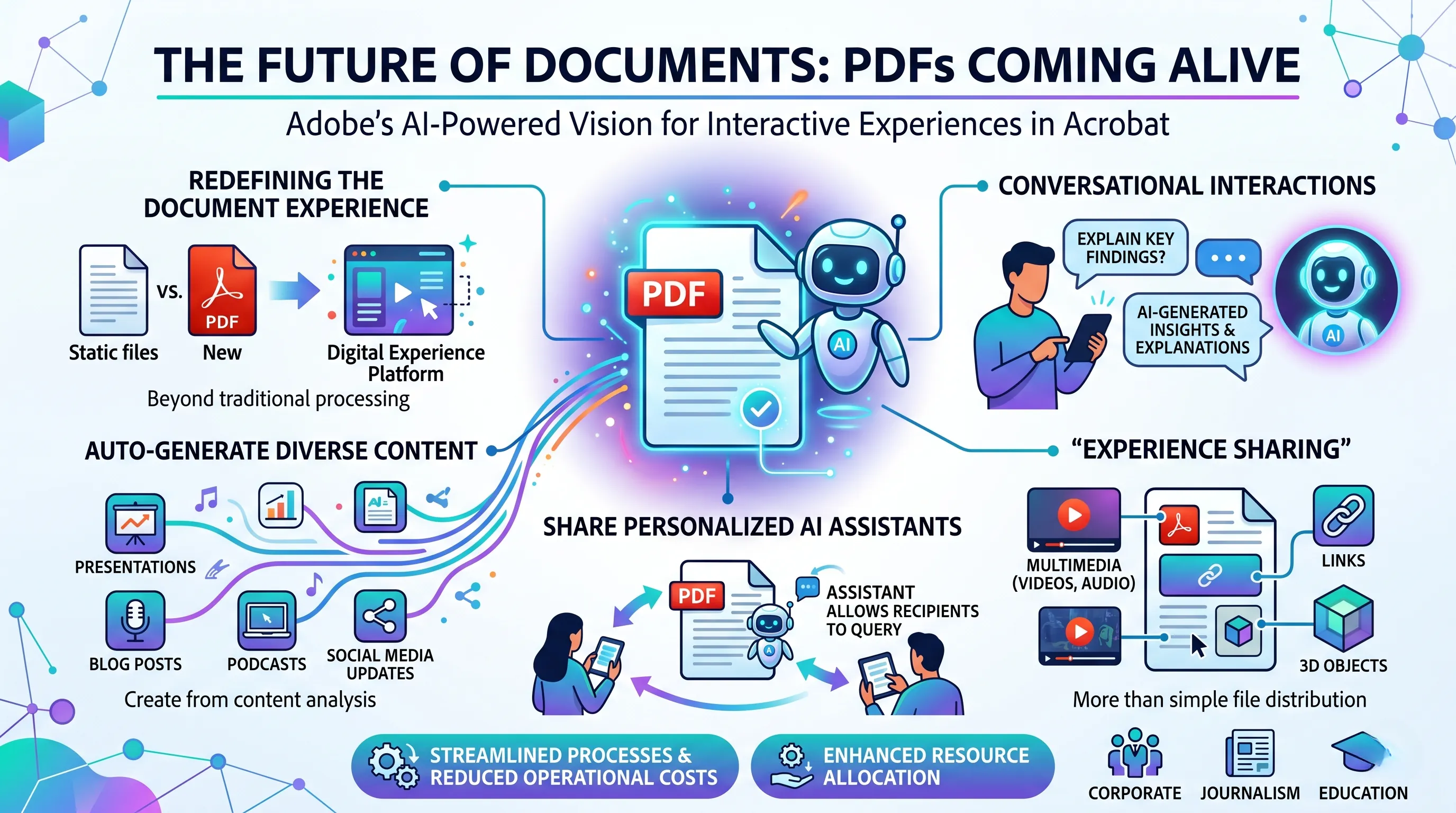
Users can now engage in conversational interactions directly with their PDFs, asking questions and receiving AI-generated insights and explanations.
This groundbreaking approach allows for the auto-generation of diverse content types, from presentations and blog posts to podcasts and social media updates, all derived directly from document analysis.
Furthermore, users can set up and share personalized AI assistants along with their documents, allowing recipients to query the content interactively.
This strategic vision aims to evolve the PDF from a mere file format into a new digital experience platform, adept at connecting people and information in unprecedented ways.
Adobe introduces the concept of 'experience sharing', moving beyond simple file distribution to allow for richly interactive documents with multimedia content, links, and even 3D objects.
This transformation promises to streamline document processes, reduce operational costs, and enhance resource allocation across various sectors, from corporate departments to journalism and education.
1. The Living PDF Blueprint: AI-Powered Core and Strategic Ambition
This section serves as the technical and strategic heart of our main topic, "The PDF Comes Alive".
It deconstructs the fundamental "how"—the architectural blueprint and ambitious vision that transforms the static PDF from a digital piece of paper into a dynamic, interactive, and intelligent entity.
We will explore the core technologies, the redefined goals, and the strategic roadmap Adobe is laying out to make the PDF a truly living platform.
The Hybrid Engine: Fusing Acrobat's Legacy with AI's Future
At the very core of this transformation is a powerful hybrid technology.
The foundation remains Adobe Acrobat's legendary and robust document processing capabilities—the engine that has reliably rendered, secured, and managed PDFs for decades.
However, this stable chassis is now supercharged with a new intelligence layer: AI agents.
This fusion is not merely an add-on; it's a deep integration where the AI doesn't just read the document, it comprehends it using Acrobat's structural understanding.
The AI agents can leverage Acrobat's deep knowledge of text, images, tables, and metadata to perform tasks with a level of accuracy and context that a generic AI could not achieve.
This combination creates a document that is both perfectly preserved in its original format and simultaneously alive with cognitive ability.
From Static Archive to Active Participant: A New Primary Goal
The traditional PDF was a destination—the final, unchangeable archive of a process.
Adobe's new primary goal completely inverts this paradigm.
The ambition is to automate document understanding, content creation, and sharing, turning the PDF into an active participant and a starting point for new work.
It's no longer just about viewing information; it's about the PDF actively helping you process and repurpose that information.
This is a monumental shift from passive consumption to active collaboration with the document itself.
For instance, the AI can analyze a dense financial report within a PDF and automatically generate a concise presentation, a blog post summarizing key trends, or even an audio briefing for an executive on the go.
This automated content creation is a cornerstone of the "living" concept, as the document actively sprouts new forms of communication based on its core data.
The Conversational Leap: Talking to Your Documents
Perhaps the most tangible evidence of the PDF "coming alive" is the shift to conversational interaction.
The familiar 'Ctrl+F' for keyword searching feels archaic in this new model.
Users can now engage in a dialogue with their documents, asking nuanced questions and receiving contextual answers.
Instead of searching for "revenue," a user can ask, "What were the primary drivers of revenue growth in Q3, and how did they differ from Q2?"
The AI agent, understanding the document's content, can synthesize an answer, pulling data from various sections, tables, and charts.
This capability extends beyond the document's creator; when a PDF is shared, recipients can query the embedded AI assistant for clarification or additional explanations, turning a one-way information broadcast into a two-way, interactive Q&A session.
The Ecosystem: 'PDF Spaces' as a Collaborative Hub
A living entity needs an environment to thrive in, and for the new PDF, that environment is 'PDF Spaces'.
This feature moves beyond the simple concept of a folder.
'PDF Spaces' are AI-based workspaces designed for consolidation and collaboration.
A single space can bring together multiple documents, external links, and user notes, creating a unified knowledge hub for a project or team.
Crucially, these shared spaces are alive with updates.
Thanks to document synchronization, the space automatically updates to reflect the latest state of any included document.
This eliminates version control chaos and ensures that every collaborator is always interacting with the most current, living iteration of the information, making the workspace a single source of truth.
Beyond the Attachment: The 'Experience Sharing' Revolution
Adobe is strategically redefining what it means to "share" a file by introducing the concept of 'experience sharing'.
Sending a PDF is no longer about attaching a static file to an email.
It is about delivering a self-contained, intelligent, and customizable experience.
This is powerfully enabled by the ability to personalize the AI assistant embedded within the document.
A company's sales department can transform a generic proposal into a branded interactive experience, complete with its logo and corporate colors.
They can tailor the AI's tone and user intent to act as a virtual sales assistant, ready to answer a potential client's specific questions.
Similarly, HR can turn onboarding materials into a 24/7 guide for new hires, and finance can distribute investment reports that allow stakeholders to query data points conversationally.
This model, already being adopted by organizations from VICE News for investigative reports to Kid Cudi for fan content, turns the document into a bespoke application tailored to its audience.
Adobe's Grand Vision: The PDF as a Digital Experience Platform
Ultimately, these individual features coalesce into a single, overarching strategic vision: to evolve the PDF into a new digital experience platform connecting people and information.
Adobe is not merely adding AI features to a document viewer; it is fundamentally repositioning the PDF as a foundational layer of digital communication and collaboration.
The goal is to create a world where documents are no longer static endpoints but dynamic, intelligent hubs that understand content, facilitate conversation, automate workflows, and deliver rich, customized experiences.
This blueprint reveals an ambition to make the .pdf extension synonymous not just with "document," but with "interactive experience," solidifying its relevance and dominance for decades to come.

2. Unleashing Dynamic Content: AI Features and Industry Applications
This section directly addresses the core theme, "The PDF Comes Alive", by dissecting the specific AI-driven technologies that are breathing life into the once-static document format.
We will explore how these features transform the PDF from a passive container of information into an active, intelligent, and interactive partner in communication and workflow automation.
This is not merely an upgrade; it is a fundamental redefinition of what a document can be and do, making it a living entity that generates content, answers questions, and automates complex tasks.
The AI Engine: Transforming Static Text into Active Intelligence
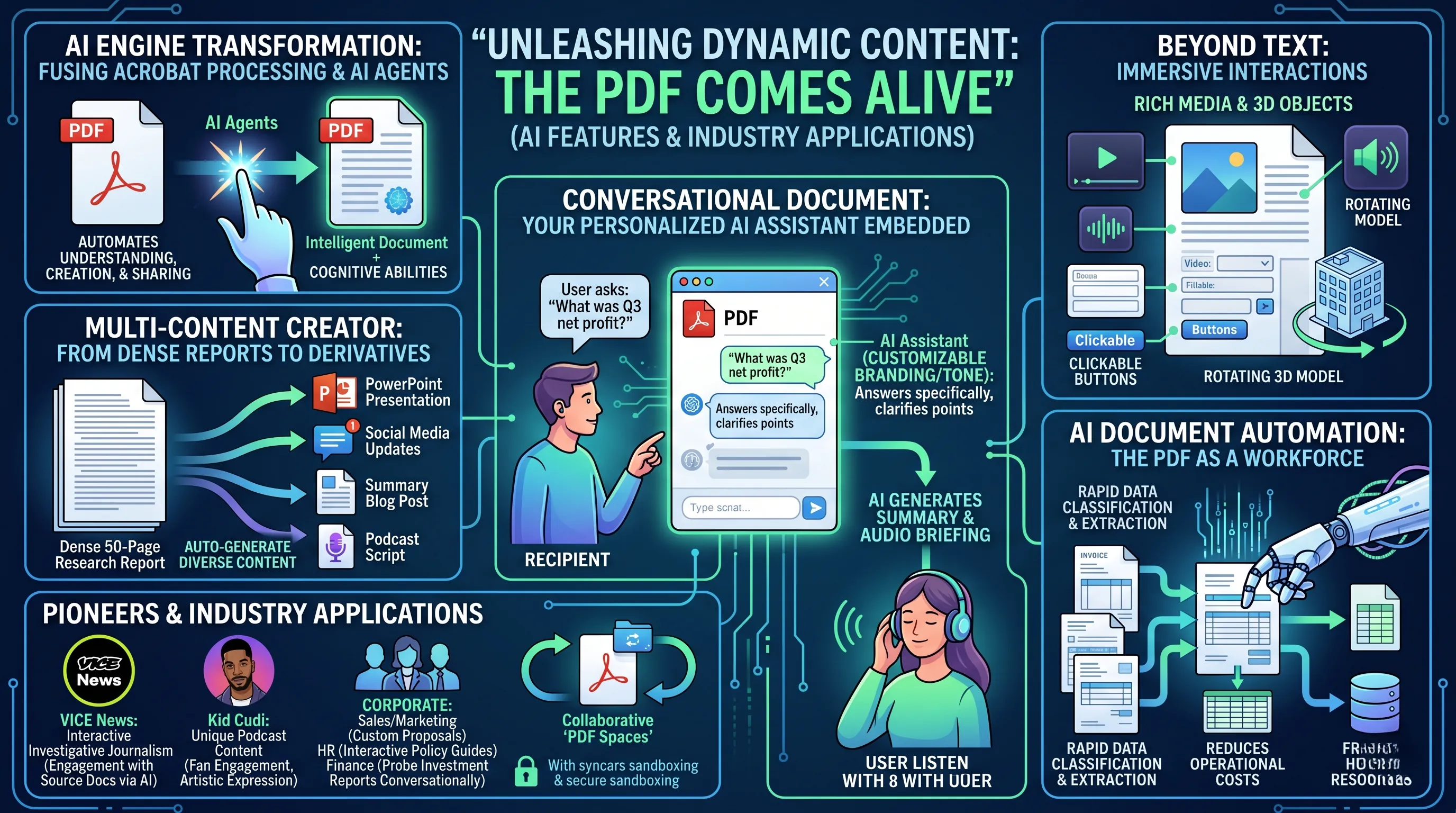
At the heart of this revolution is the fusion of Acrobat's powerful document processing with sophisticated AI agents.
This combination serves a primary goal: to automate the understanding, creation, and sharing of content, effectively giving the document cognitive abilities.
From Reading to Generating: The Multi-Content Creator
The most dramatic evidence of the "living PDF" is its newfound ability to procreate.
An AI-powered engine can now analyze the content of a single PDF and auto-generate a diverse array of new content types.
Imagine a dense, 50-page research report.
Historically, turning this into a PowerPoint presentation, a series of social media posts, or a summary blog post was a manual, time-consuming process.
Now, the PDF itself can spawn these derivatives.
It can distill its own key findings into presentation slides, craft engaging social media updates, and even generate a script for a podcast, all from the source material.
This transforms the document from a destination into a starting point—a wellspring of content tailored for different audiences and platforms.
The Conversational Document: Your Personalized AI Assistant
The concept of a "living" document becomes literal with the introduction of conversational interaction.
Users can now embed and share personalized AI assistants directly within their documents.
This feature shatters the one-way communication model of traditional PDFs.
A recipient doesn't just read the document; they can ask it questions.
For example, when receiving a complex financial report, instead of searching for a specific data point, a user can simply ask the document's AI assistant, "What was the net profit for Q3?" or "Explain the key takeaways from the market analysis section."
This functionality is highly customizable, allowing the creator to set the branding (logos, colors), intent, and even the tone of the AI assistant, ensuring it aligns with a corporate identity or a specific project's voice.
The document is no longer a silent page; it has a voice and the intelligence to respond.
Furthermore, AI can generate concise summaries of key content and even produce audio briefings, allowing users to absorb crucial information on the go, as if the document itself is reading them its executive summary.
Beyond Text: Creating Truly Interactive and Automated Experiences
The transformation extends beyond intelligence to the very fabric of the document, making it a rich, multi-sensory experience that actively participates in business workflows.
Rich Media and Interactive Elements
The modern PDF is a canvas for dynamic content.
It fully supports the creation of interactive experiences by embedding a wide range of rich media.
This includes not just standard hyperlinks, images, and GIFs, but also audio and video files that play directly within the document.
Clickable buttons and fillable forms turn a passive document into an application-like interface.
Perhaps most impressively, the inclusion of interactive 3D objects completely changes the game for technical and design-focused documents.
An architectural blueprint can contain a manipulable 3D model of the building; a product manual can feature a rotatable 3D schematic of the device, allowing for unprecedented clarity and engagement.
AI Document Automation: The PDF as a Workforce
This is where the living PDF truly starts to work for you.
Leveraging Generative AI, the platform provides tools for the rapid classification, extraction, and analysis of data locked within documents.
AI Document Automation can capture and extract data from invoices, forms, and other structured PDFs automatically, eliminating tedious manual entry.
This has profound implications for operational efficiency.
For legal professionals, contracts and briefs can be digitized and analyzed more simply.
For finance departments, it means a drastic reduction in the manual labor required to process invoices, thereby reducing operational costs and freeing up human resources for more strategic tasks.
The PDF is no longer just a record of work; it is an active participant in getting the work done.
The Pioneers: Real-World Applications of the Living PDF
This evolution is not merely theoretical; early adopters are already demonstrating the power of the living PDF, pushing it towards a new strategic vision as a digital experience platform that connects people and information.
VICE News is a prime example in the media industry.
They are using these capabilities to provide readers with interactive investigative reports.
Instead of just reading an article, the audience can engage directly with the original source documents, using the embedded AI assistant to ask questions and explore the data themselves, creating a more transparent and immersive form of journalism.
On the creative front, artist Kid Cudi is using the technology to create unique podcast content for his fans.
This showcases the PDF's potential as a new medium for artistic expression and fan engagement, moving far beyond its corporate origins.
Within the corporate world, the applications are vast.
* Sales and Marketing departments are transforming static proposals and brochures into customized, AI-based experiences that can answer a potential client's specific questions.
* Human Resources can turn lengthy onboarding materials into interactive guides where new employees can query the document about company policies or procedures.
* Finance teams are converting dense investment reports into dynamic tools that allow stakeholders to probe the data conversationally.
This is the manifestation of 'experience sharing' replacing simple 'file sharing.'
When these documents are shared in collaborative 'PDF Spaces,' they automatically sync to the latest version, ensuring everyone is interacting with a single, living source of truth.
While all PDF viewers carry inherent security risks, especially from attack payloads like JavaScript or multimedia, this new generation is designed with enhanced security, such as the strict sandboxing of JavaScript execution, to mitigate these evolving threats.
3. Transformative Advantages & Inherent Security Risks of Living Documents
The very concept behind the main theme, "The PDF Comes Alive", pivots on a fundamental trade-off. As documents shed their static, paper-like nature and evolve into dynamic, interactive platforms through technologies like the Adobe Productivity Agent, they unlock profound business advantages. This evolution, however, simultaneously introduces a new class of security considerations. The ability of a document to execute code, process data, and connect to external resources is precisely what makes it both powerful and potentially perilous. This section explores that critical duality: the revolutionary efficiencies gained and the inherent risks that must be intelligently managed in the age of the living document.
A Revolution in Operational Efficiency and Value
The most immediate impact of a "living" PDF is the radical simplification of complex document-based processes, leading to tangible economic benefits.
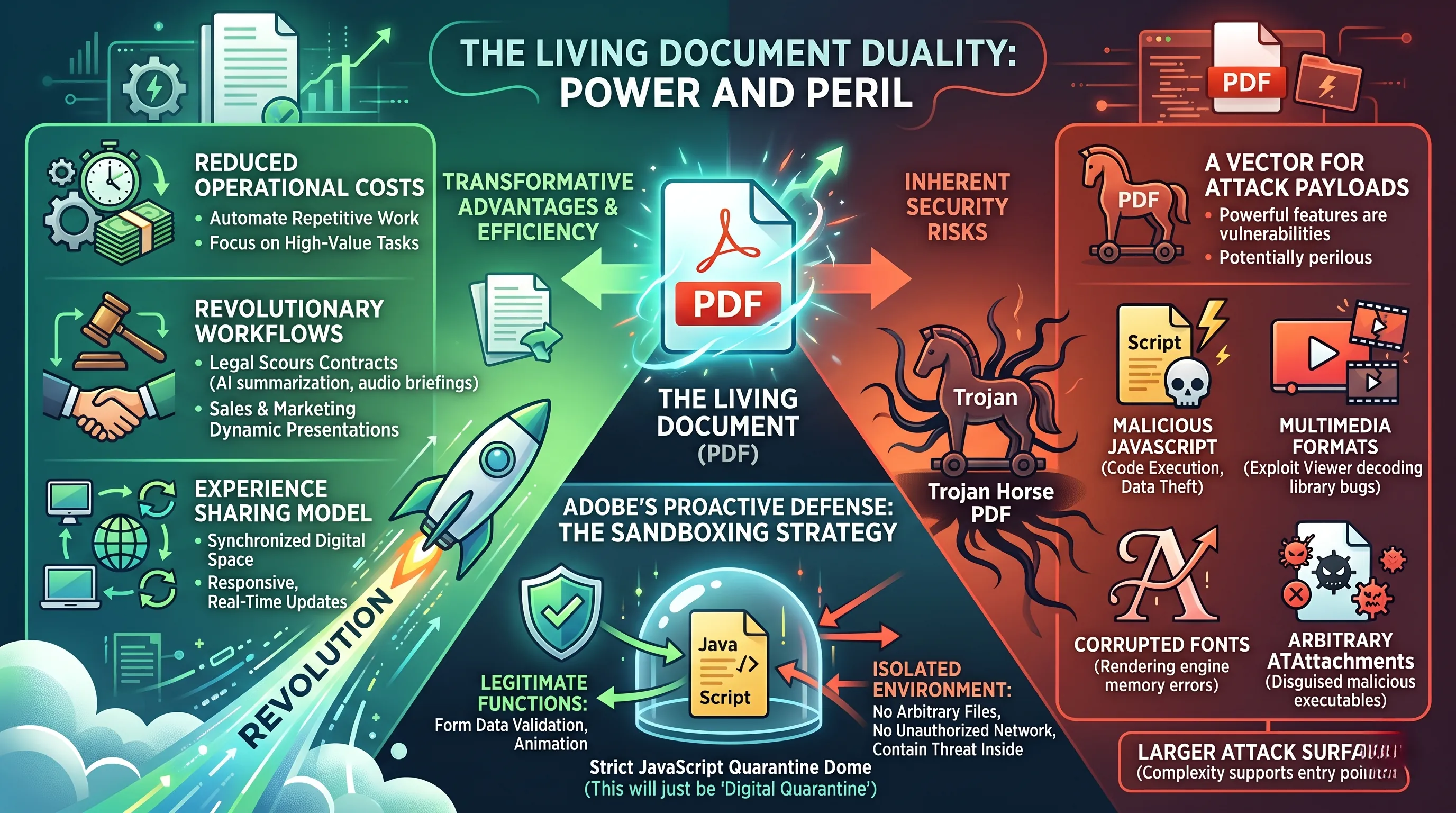
The Adobe Productivity Agent directly targets the high-friction, low-value tasks that consume countless hours in professional settings. According to the facts, a primary benefit is the reduction of operational costs by automating repetitive manual work.
This isn't a minor tweak; it's a strategic overhaul. Consider the legal profession, where professionals can now leverage these tools to simplify the processing of contracts and briefs. Instead of manually scouring hundreds of pages, an AI assistant can summarize key content, generate audio briefings for quick understanding, and allow legal teams to conversationally query the document for specific clauses or definitions. This automation allows for a far more efficient allocation of resources; highly skilled lawyers can focus on legal strategy and negotiation rather than clerical review, dramatically increasing their effective value.
This principle extends across all corporate departments. The agent’s ability to use Generative AI for rapid classification, extraction, and analysis of document data transforms workflows in Sales, Marketing, HR, and Finance. For instance, an investment report is no longer a static file. It becomes an interactive experience where stakeholders can query the embedded AI assistant for clarifications on financial data. A sales proposal can be auto-generated into a branded presentation, and customer onboarding materials can become interactive guides. This is the core of the 'experience sharing' model—moving beyond sending a file to sharing an intelligent, responsive digital space that automatically updates to the latest document state, ensuring all collaborators are always synchronized.
The Inherent Risk: When 'Living' Means Vulnerable
The features that make a modern PDF interactive and "alive" are the very same channels that can be exploited by malicious actors. A document that can execute code is fundamentally different from a static image of text, and this capability carries inherent risks.
The facts are clear: PDFs can inherently serve as a vector for attack payloads. This transforms the document from a simple information vessel into a potential Trojan Horse. Attackers can weaponize several components:
- JavaScript: While essential for interactive forms and dynamic content, malicious JavaScript embedded within a PDF can attempt to exploit vulnerabilities in the viewer to execute arbitrary code, steal sensitive user data, or launch further attacks on the system.
- Multimedia Formats: Interactive PDFs support rich media like audio and video. An attacker can embed a specially crafted media file that targets a bug in the viewer's decoding library, potentially leading to a system compromise when the user tries to play the content.
- Fonts: Even something as seemingly benign as a font can be an attack vector. A corrupted or maliciously designed font file can trigger memory errors in the PDF viewer's font-rendering engine, creating an opening for code execution.
- Arbitrary Attachments: The PDF standard allows for files to be embedded within a document. An attacker can disguise a malicious executable (e.g., malware or ransomware) as a harmless attachment, relying on social engineering to trick the user into opening it.
This culminates in a stark reality: all PDF viewers carry potential security risks. The more complex the software and the more features it supports (3D objects, rich media, scripting), the larger its "attack surface" becomes, providing more potential entry points for attackers to probe for weaknesses.
Adobe's Proactive Defense: The Sandboxing Strategy
Recognizing that the power of a living document is directly tied to its potential risk, Adobe has implemented a critical architectural defense. The facts highlight an enhanced security design through strict sandboxing of JavaScript execution in PDF documents.
Sandboxing is, in essence, a digital quarantine. When a PDF attempts to run JavaScript, the viewer doesn't execute it with full trust. Instead, it runs the code within a heavily restricted, isolated environment—the "sandbox." Inside this secure container, the script can perform its intended, legitimate functions (like validating form data or creating an animation) but is aggressively prevented from accessing sensitive parts of the computer. It cannot read arbitrary files from the hard drive, make unauthorized network connections, or interfere with other running applications. If the script is malicious, the sandbox contains the threat, preventing it from escaping and causing harm to the host system. This proactive security posture is fundamental to safely enabling the rich, interactive experiences that define the next generation of living documents.
📚 Related Posts
xAI Grok 4.3 Unveiled: Elon Musk's Ultra-Low Cost AI with 1M Token Context, Agentic Power & Custom Voices
🚀 Key TakeawaysxAI's Grok 4.3 is set to redefine the AI market by offering an ultra-low-cost, high-performance agentic AI model, featuring an always-on reasoning structure and a vast 1 million token context window, making advanced AI capabilities signif
tech.dragon-story.com
Hyundai's $26B US Robotics Hub: Mass-Producing Atlas Humanoids by 2028
🚀 Key TakeawaysHyundai Motor Group is making a colossal $26 billion investment in the U.S. to establish a robotics hub (RMAC), targeting the mass production of advanced humanoid robots like Atlas by 2028, with an ambitious annual capacity of 30,000 unit
tech.dragon-story.com
Anthropic Unleashes Claude: SpaceX's Colossus 1 Delivers Massive AI Compute, Doubled User Limits & Paves Way for Space-Based Fut
🚀 Key TakeawaysThe partnership between Anthropic and SpaceXAI secures a massive compute boost for Claude, leveraging SpaceX's Colossus 1 data center with over 300 megawatts and 220,000 NVIDIA GPUs.This strategic collaboration immediately enhances Claude
tech.dragon-story.com


