🚀 Key Takeaways
- China's humanoid robot sector is rapidly transitioning into a mass production phase, exemplified by EngineAI launching a state-of-the-art factory capable of producing 10,000 humanoid robots annually, leveraging advanced automation and rigorous quality control processes to meet surging market demand.
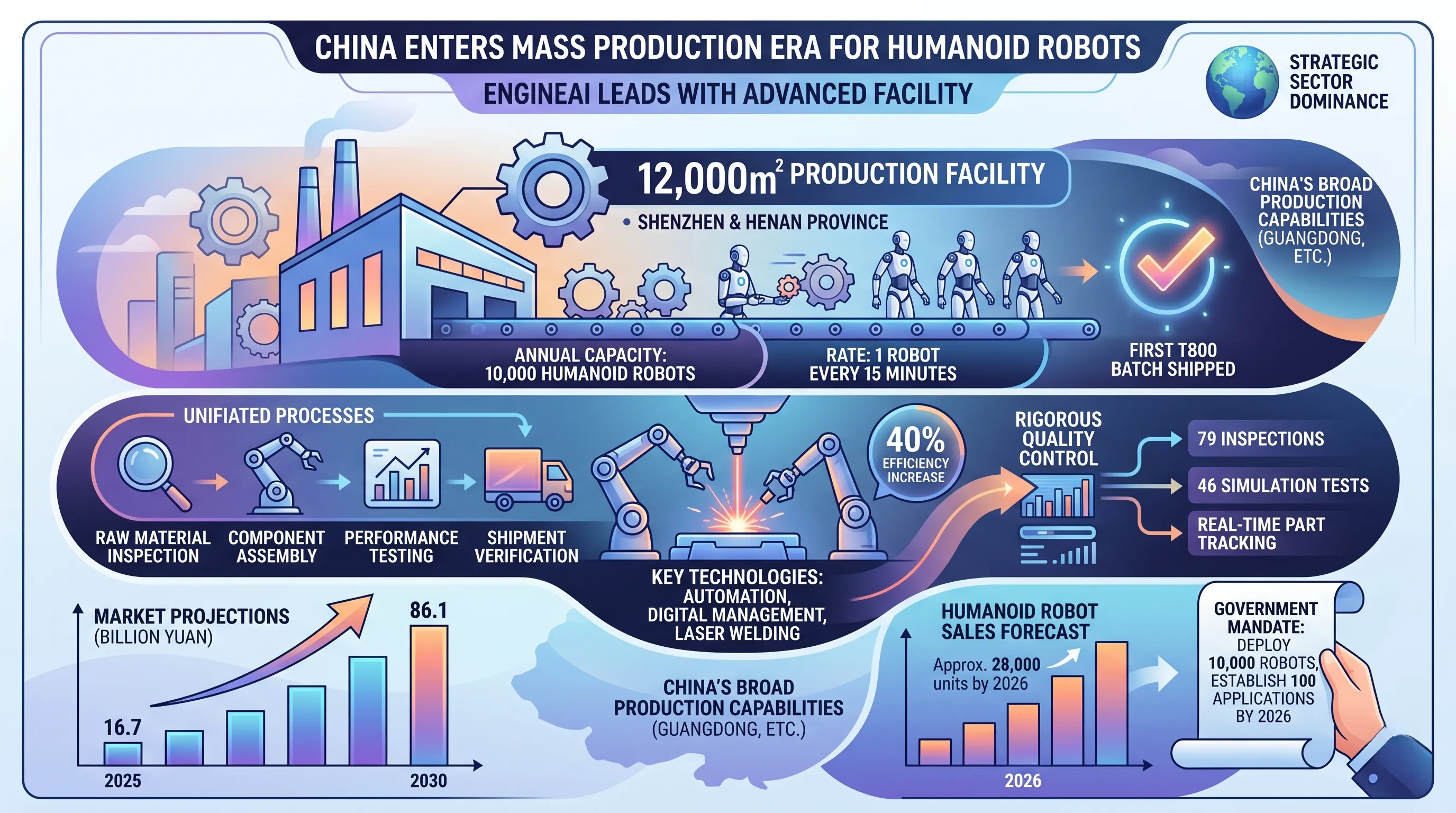
China has officially ushered in a new era of humanoid robot mass production, with EngineAI leading the charge by inaugurating its advanced manufacturing facility. This groundbreaking move signals a significant leap forward in robotics, establishing a production capacity designed to churn out 10,000 humanoid robots annually.
The first batch of its representative model, the 'T800', has already completed shipment, marking a pivotal moment for the company and the industry at large.
Located across production bases in Shenzhen and Henan province, EngineAI's 12,000㎡ production facility boasts an impressive production rate of one humanoid robot every 15 minutes.
The factory integrates all critical processes, from raw material quality inspection and component assembly to performance testing and final shipment verification, all within a unified R&D, production, and testing space.
Utilizing cutting-edge automation technology, digital management systems, and specialized equipment for fastening, bonding, and laser welding, EngineAI has achieved a remarkable 40% increase in production efficiency compared to conventional methods.
This robust system includes real-time tracking of every part and product, ensuring meticulous quality control through 79 quality inspections and 46 simulation tests before each unit is shipped.
This achievement by EngineAI is a strong indicator of China's rapid acceleration into the mass production phase of the humanoid robot industry.
The nation's broader production capabilities, exemplified by factories in Guangdong capable of producing a robot every 30 minutes and achieving similar annual targets, underpin ambitious market growth projections.
Analysts forecast humanoid robot sales to more than double to approximately 28,000 units by 2026, driven by a powerful government mandate to deploy 10,000 humanoid robots and establish over 100 high-value applications across Chinese industries by the end of the same year.
The market is projected to skyrocket from 16.7 billion yuan in 2025 to 86.1 billion yuan by 2030, affirming China's strategic commitment to dominating this transformative technological sector.
1. EngineAI Pioneers 10,000 Humanoid Robots Annually: A Deep Dive into Smart Factory Innovation
EngineAI's recent operational launch of its advanced humanoid robot factory is not merely a corporate milestone; it is a foundational pillar supporting the entire premise of the main topic: "China Opens Era of Mass Producing 10,000 Humanoid Robots."
The company’s smart factory is a tangible, working example of how China is transitioning humanoid robotics from a niche R&D field into a scaled, industrial-grade manufacturing sector.
EngineAI's achievement directly embodies the national push towards mass production, providing a concrete case study of the speed, technology, and ambition driving this new era.
A New Era Begins: Factory Operational, T800 Ships
The theoretical has become practical.
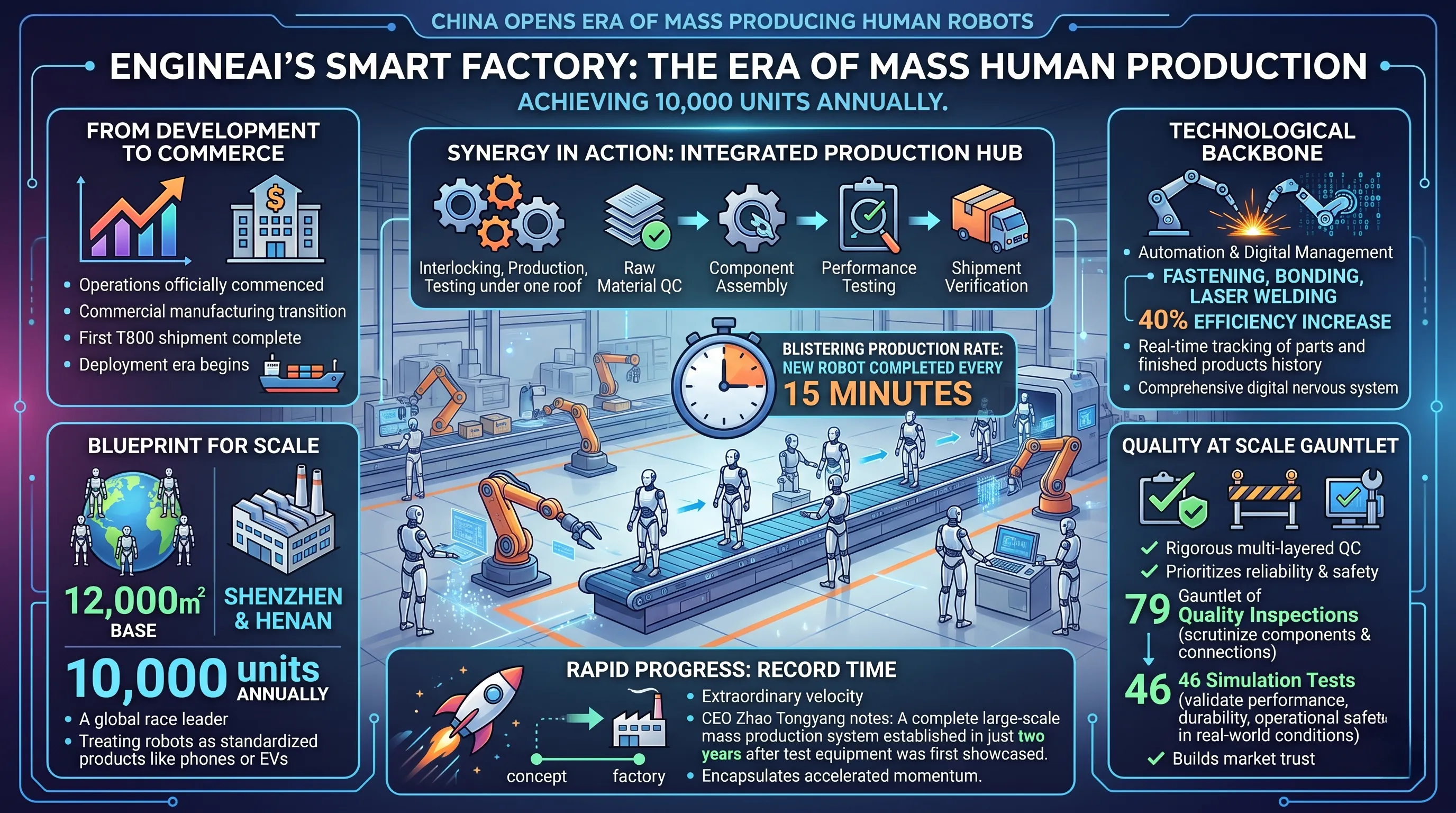
EngineAI has officially commenced operations at its humanoid robot production factory, a landmark event that shifts the company from development to full-scale commercial manufacturing.
Marking this transition, the first shipment of its representative model, the `T800`, has been successfully completed, signaling that the era of waiting is over and the era of deployment has begun.
This launch serves as a powerful proof-of-concept for the entire industry, demonstrating that the complex systems of a humanoid robot can be produced reliably and are ready for market entry.
The Blueprint for Mass Production: Scale, Speed, and Location
EngineAI's ambitions are clearly quantified by its production targets and infrastructure.
The company has set a formidable annual production goal of `10,000 units`, a figure that positions it at the forefront of the global humanoid robotics race.
This capacity is housed within a massive `12,000㎡` production base strategically located across `Shenzhen and Henan province`.
However, the most telling statistic is the production rate: a new humanoid robot is completed every `15 minutes`.
This blistering pace is more than a number; it is a fundamental shift in philosophy, treating humanoid robots not as one-off laboratory projects but as standardized products on a sophisticated assembly line, akin to smartphones or electric vehicles.
Synergy in Action: The Integrated Production Hub
Efficiency at EngineAI is achieved through vertical integration and process synergy.
The factory is designed as an all-in-one hub where `R&D, production, and testing` are conducted in a single, cohesive space.
This model creates an incredibly tight feedback loop, allowing for rapid innovation and immediate implementation of design improvements on the factory floor.
The integrated workflow covers every conceivable stage, from the initial `raw material quality inspection` and intricate `component assembly` to exhaustive `performance testing` and the final `shipment verification`, ensuring end-to-end control over the entire manufacturing process.
The Technological Backbone: Advanced Automation and Digital Management
The factory's impressive output is underpinned by a state-of-the-art technological foundation.
EngineAI has heavily invested in `applied automation technology and digital management systems` to orchestrate the complex assembly of the T800.
The production line is equipped with specialized, high-precision machinery, including `automatic fastening, bonding, and laser welding equipment`.
These automated systems perform critical tasks with a degree of speed and consistency that far surpasses manual methods, resulting in a remarkable `40% increase in production efficiency` compared to existing processes.
Furthermore, a comprehensive digital nervous system allows for the `real-time tracking of production history for all parts and finished products`, creating a transparent and traceable record for every single robot built.
Quality at Scale: A Gauntlet of Inspections and Tests
For EngineAI, speed does not come at the expense of quality.
The company has implemented a rigorous and multi-layered quality control protocol to ensure the reliability and safety of every T800 unit.
Before a robot is cleared for shipment, it must successfully pass a gauntlet of `79 distinct quality inspections` that scrutinize every component and connection.
Beyond these static checks, each unit is subjected to `46 different simulation tests`, which are designed to validate its performance, durability, and operational safety under a wide range of potential real-world conditions.
This obsessive focus on quality is critical for building market trust and ensuring that the robots can be safely and effectively deployed in complex industrial environments.
From Concept to Assembly Line in Record Time
The velocity of EngineAI's progress is, perhaps, its most impressive feat.
CEO `Zhao Tongyang` emphasized the extraordinary speed of their journey, highlighting the company's achievement of establishing a complete, large-scale mass production system within just `two years` of showcasing its very first test equipment.
This rapid, two-year leap from a prototype to a factory capable of producing 10,000 units annually encapsulates the accelerated momentum of China's entire humanoid robot industry and solidifies EngineAI's role as a key pioneer in this manufacturing revolution.
2. China's Humanoid Robot Industry Unleashed: Government Drive and Market Explosion
This section provides the critical context for the main topic, "China Opens the Era of Mass-Producing 10,000 Humanoid Robots," by dissecting the powerful combination of government ambition and explosive market dynamics that are making such large-scale production not just possible, but a national priority.
What was once the realm of speculative fiction and research labs is rapidly crystallizing into industrial reality across China.
The nation's humanoid robot industry is aggressively transitioning into a full-blown mass production phase, a shift underscored by the tangible output of its manufacturing hubs.
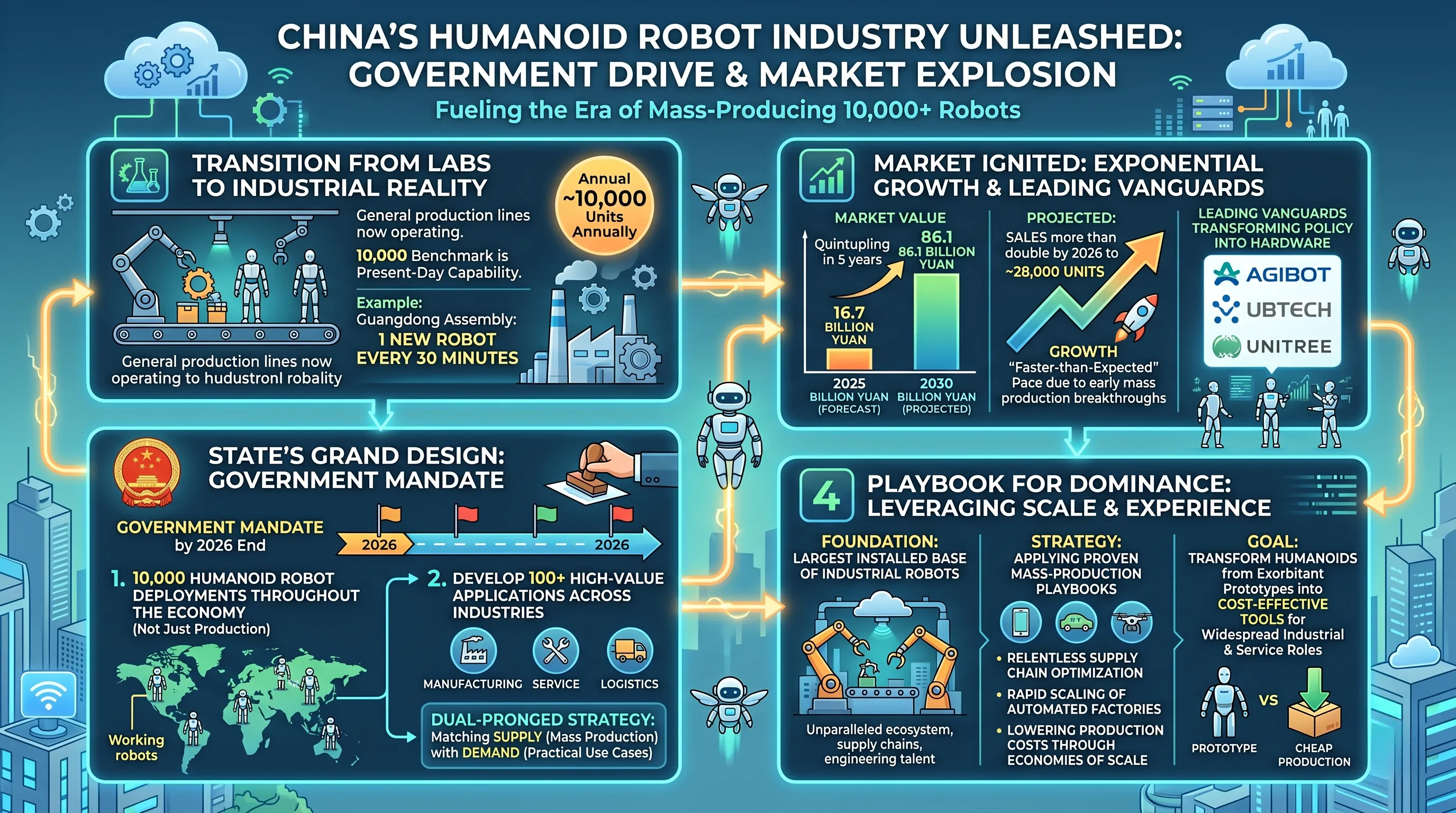
In Guangdong, for instance, general production lines are already operating at a capacity to assemble a new humanoid robot every 30 minutes, culminating in a yearly total of approximately 10,000 units.
This figure is a direct testament to the headline claim, illustrating that the 10,000-unit benchmark is no longer a future goal but a present-day manufacturing capability.
The State's Grand Design: A Mandate for a Robotic Future
This industrial surge is not happening in a vacuum; it is being meticulously orchestrated and accelerated by a clear and aggressive government mandate.
Beijing has laid down a formidable challenge for the nation's tech and manufacturing sectors: by the end of 2026, China aims to have achieved 10,000 humanoid robot deployments throughout its economy.
This is a directive focused on utility, not just production.
The government's vision is for these robots to be integrated into the workforce, performing meaningful tasks.
To ensure this integration is both broad and impactful, the mandate also calls for the development of over 100 high-value applications across Chinese industry within the same timeframe.
This dual-pronged strategy ensures that supply (mass production) is met with engineered demand (widespread, practical use cases), creating a self-reinforcing cycle of growth and innovation.
A Market Ignited: Exponential Growth and Leading Vanguards
The government's push is acting as a massive accelerant on an already fervent market, with growth projections that can only be described as explosive.
The humanoid robot market in China is forecast to reach 16.7 billion yuan in 2025.
From there, it is projected to more than quintuple in just five years, rocketing to an astonishing 86.1 billion yuan by 2030.
The immediate future is just as dynamic, with humanoid sales projected to more than double by 2026 to around 28,000 units.
Industry observers have noted that this market expansion is occurring at a "faster-than-expected" pace, a direct consequence of Chinese companies cracking the code on mass production far sooner than anticipated.
Leading this charge are pioneering companies like AgiBot, UBTECH, and Unitree, which are transforming national policy into commercial hardware and becoming the flagbearers of this new industrial revolution.
The Playbook for Dominance: Leveraging Scale and Experience
China's ability to scale this industry so rapidly is not accidental; it is a calculated strategy built upon decades of manufacturing dominance in other sectors.
The nation possesses the world's largest installed base of industrial robots, which has created an unparalleled ecosystem of supply chains, automation expertise, and engineering talent that can now be pivoted towards the more complex challenge of humanoids.
Crucially, Chinese firms are applying the proven mass-production playbooks perfected in the smartphone, electric vehicle (EV), and drone industries to robotics.
This strategy involves relentless optimization of supply chains, rapid scaling of automated factory processes, and an unwavering focus on lowering production costs.
Just as China made smartphones and EVs accessible to the global mass market through economies of scale, it now aims to do the same for humanoid robots, transforming them from exorbitant prototypes into cost-effective tools for widespread industrial and service roles.
📚 Related Posts
xAI Grok 4.3 Unveiled: Elon Musk's Ultra-Low Cost AI with 1M Token Context, Agentic Power & Custom Voices
🚀 Key TakeawaysxAI's Grok 4.3 is set to redefine the AI market by offering an ultra-low-cost, high-performance agentic AI model, featuring an always-on reasoning structure and a vast 1 million token context window, making advanced AI capabilities signif
tech.dragon-story.com
Hyundai's $26B US Robotics Hub: Mass-Producing Atlas Humanoids by 2028
🚀 Key TakeawaysHyundai Motor Group is making a colossal $26 billion investment in the U.S. to establish a robotics hub (RMAC), targeting the mass production of advanced humanoid robots like Atlas by 2028, with an ambitious annual capacity of 30,000 unit
tech.dragon-story.com
Anthropic Unleashes Claude: SpaceX's Colossus 1 Delivers Massive AI Compute, Doubled User Limits & Paves Way for Space-Based Fut
🚀 Key TakeawaysThe partnership between Anthropic and SpaceXAI secures a massive compute boost for Claude, leveraging SpaceX's Colossus 1 data center with over 300 megawatts and 220,000 NVIDIA GPUs.This strategic collaboration immediately enhances Claude
tech.dragon-story.com


