- The iPhone 16 Pro Max and its A18 Pro chip are experiencing a significant MLX LLM accuracy crisis, with models producing 'garbage' output, especially in 4-bit quantized formats.
- Despite high inference speeds, the A18 Pro's Neural Engine shows critically low accuracy for arithmetic, factual recall, and instruction following, undermining developer trust.
- The community points to undocumented architectural limitations in the ANE for low-precision operations, making debugging on iOS nearly impossible.
- Workarounds include avoiding 4-bit quantization (using 8-bit or FP16), strategic CPU offloading, and staying on the latest MLX framework version.
- Apple has maintained public silence, leading to developer frustration and a potential shift back to cloud-based AI solutions, eroding trust in on-device AI.
Solving the MLX LLM Accuracy Crisis on iPhone 16 Pro Max: A Developer's Reality Check
The promise of powerful on-device Large Language Models (LLMs) on flagship devices like the iPhone 16 Pro Max, powered by the A18 Pro chip, is compelling.
However, developers are currently facing a significant challenge: a persistent accuracy crisis when running quantized LLMs using Apple's own MLX framework.
This issue often results in unpredictable and nonsensical 'garbage' output, particularly on the iPhone 16 Pro Max.
This post explores the core of this problem, outlines the frustrating developer experience, and shares practical workarounds gathered from the community, providing a transparent look at the current state of on-device AI.
The iPhone 16 Pro Max and Its MLX LLM Accuracy Challenge
Since its release, the iPhone 16 Pro Max has been positioned as a device capable of ushering in a new era for on-device artificial intelligence.
Yet, over a year later, the reality for many developers and power users working with the MLX framework has proven frustrating.
There are widespread reports of models delivering frequent, unpredictable, and often outright incorrect outputs.
This problem is most evident in tasks requiring high precision, such as basic arithmetic, logical reasoning, and factual recall.
Models that function perfectly on other hardware, or even in higher-precision formats on the same device, experience severe degradation once quantized for on-device execution.
This directly challenges the foundational promise of a powerful, private, and reliable AI companion built into every user's device.

A Reality Check: A18 Pro's LLM Performance Gap
The A18 Pro chip was marketed with an enhanced Neural Engine (ANE), boasting impressive teraflops of performance designed to accelerate machine learning tasks.
While benchmarks confirm its capability for raw throughput in areas like image recognition, its practical application for modern, quantized LLMs presents a different picture.
The marketing emphasis on raw power has not aligned with the critical need for precision.
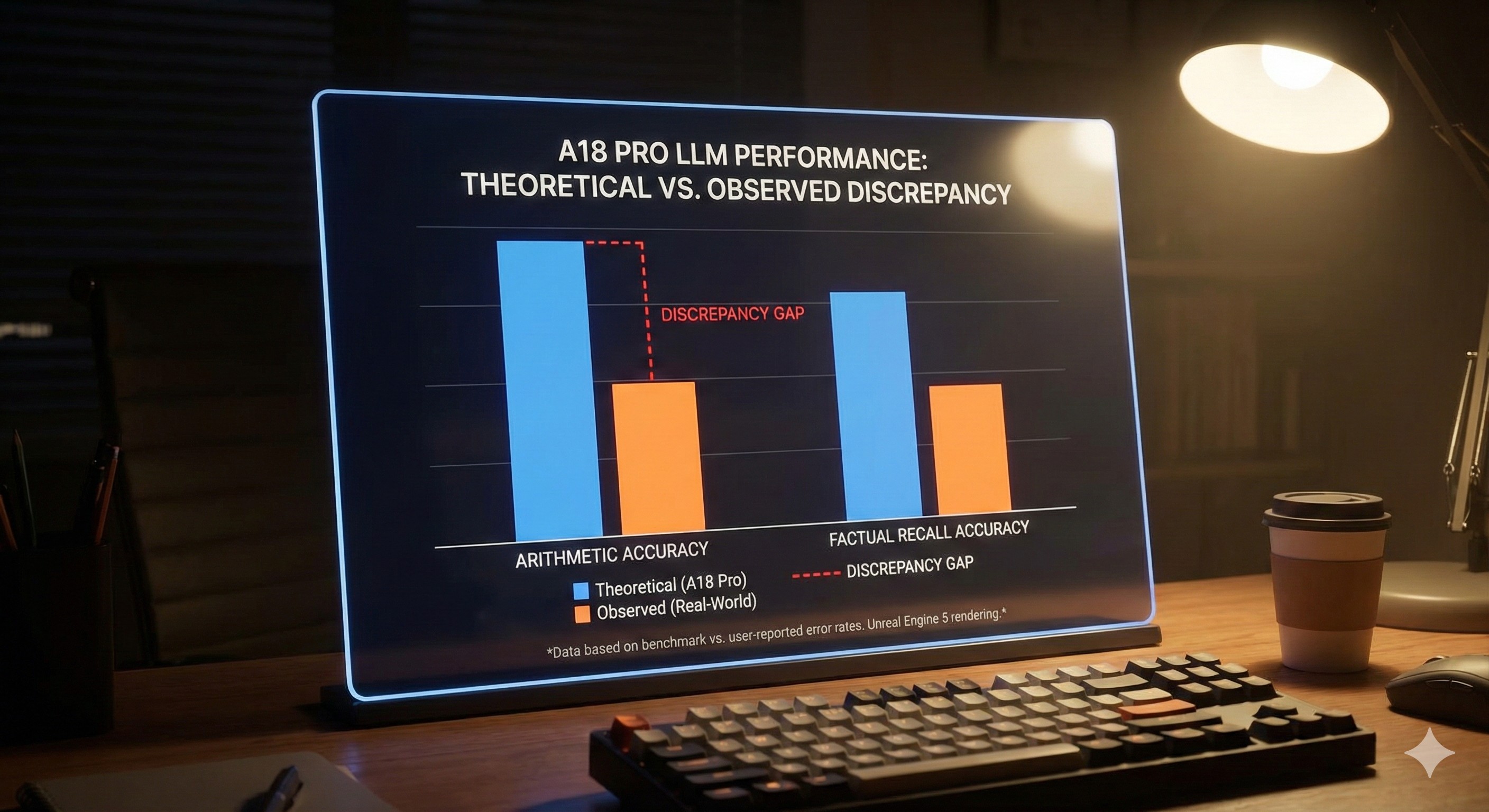
At the heart of the issue is a noticeable gap between the A18 Pro's theoretical capabilities and the flawed execution of low-bit quantized models.
Developers consistently report that while these models run quickly on the ANE, the accuracy is so compromised that the speed becomes irrelevant.
This disparity creates a frustrating developer experience, where the promised hardware acceleration comes at the unacceptable cost of model correctness.
Comparison: Expected vs. Actual Performance of 4-bit Quantized LLMs on A18 Pro
| Metric | Expected Performance (Based on Marketing) | Observed Reality (As of Q1 2026) |
|---|---|---|
| Inference Speed | Very High (Leveraging ANE) | High. The model runs quickly. |
| Arithmetic Accuracy | High (e.g., 8 * 8 = 64) |
Extremely Low. Fails basic math (e.g., 8 * 8 = 63). |
| Factual Recall | Reliable | Unreliable. Frequent hallucinations and incorrect facts. |
| Instruction Following | Consistent | Inconsistent. Can follow simple commands but fails on nuanced or multi-step tasks. |
| Developer Trust | High | Critically Low. Developers are hesitant to ship products. |
The Community's Frustration: 'My iPhone Can't Do Math'
The current situation on the iPhone 16 Pro Max echoes earlier findings.
For example, in early 2024, researcher Rafael Costa highlighted similar precision issues on M-series chips in his article, "My Thousand-Dollar iPhone Can't Do Math".
Now, this problem has become widespread across Apple's mobile ecosystem.
Developer forums and social media are filled with complaints.
A recurring thread on the official Apple Developer Forums, titled "A18 Pro + MLX giving wrong answers for basic math," has garnered hundreds of replies.
GitHub issues on the MLX repository detail similar struggles, with developers providing reproducible code snippets showing models failing simple prompts like "What is 12 + 5?".
The sentiment is clear: despite being the most advanced mobile chip on the market, the A18 Pro's capabilities are being undermined by a fundamental inability to perform reliable computations with the very LLMs it was designed to accelerate.
Unpacking the A-series Neural Engine's Precision Issues
While Apple has not offered an official comment on the matter, the prevailing theory within the developer community points to undocumented architectural limitations within the A18 Pro's Neural Engine.
The issue appears to be specific to low-precision integer formats, especially 4-bit quantization, which is crucial for fitting powerful LLMs within the iPhone's memory and power constraints.
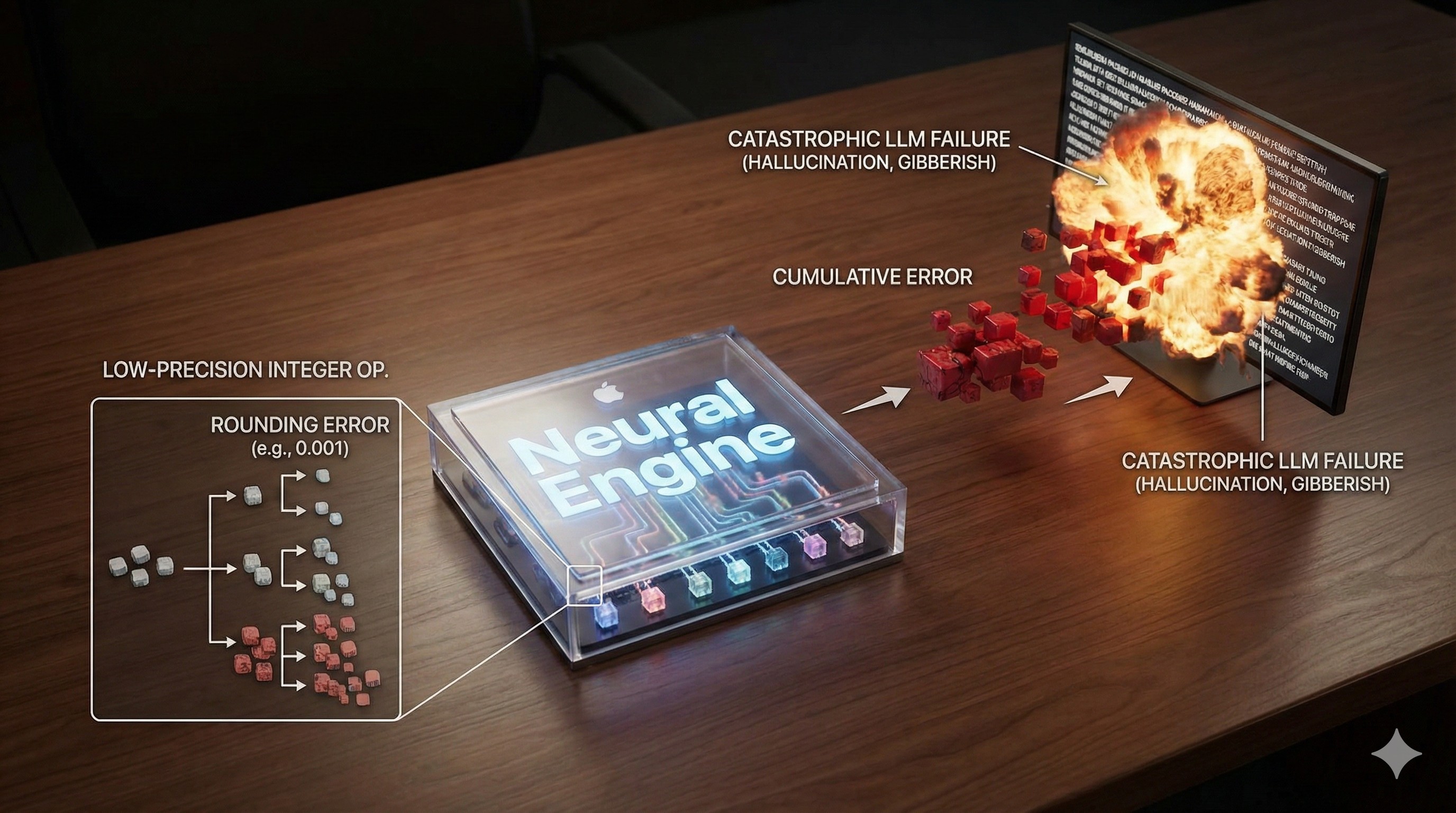
The hypothesis suggests that the ANE's hardware implementation for these low-bit operations introduces minute rounding or processing errors.
While such errors might be insignificant for resilient tasks like image classification, they can cascade catastrophically in the sequential, logic-dependent tasks performed by LLMs.
This implies a potential hardware or low-level software flaw that cannot be easily patched, specifically affecting the delicate balance of weights and biases that enable LLMs to 'reason' effectively.
The Debugging Nightmare: MLX LLMs on iOS
The 'black box' nature of the Neural Engine makes debugging these issues a nightmare for developers.
A common pain point is observing a model that functions perfectly on a Mac (even an Apple Silicon Mac, which often uses different execution paths) suddenly failing silently and unpredictably when deployed to an iPhone 16 Pro Max via Core ML and MLX.
Debugging is nearly impossible.
Developers lack the ability to inspect the intermediate states of the model as it executes on the ANE. They are left with only the final, incorrect output.
This leads to a frustrating cycle of adjusting quantization settings, modifying model architecture, or even re-training, all without a clear understanding of the root cause.
This friction is causing some development teams to abandon on-device MLX implementations in favor of more reliable, but potentially slower, CPU-based inference or a fallback to cloud APIs.

Navigating the Instability: Community Workarounds for MLX LLMs
While an official fix for the ANE's precision issues remains elusive, the developer community has identified and shared several strategies to mitigate the 'garbage' output problem:
- Avoid 4-bit Quantization:
The most effective, though resource-intensive, workaround is to use higher-precision formats.
Models quantized to 8-bit (INT8) or 16-bit (FP16) demonstrate significantly higher accuracy, albeit at the cost of consuming more RAM and energy, and potentially higher latency. - Strategic CPU Offloading:
For critical or highly sensitive parts of a model (e.g., specific attention heads or MLP layers known to be sensitive to precision), developers are experimenting with forcing those operations to run on the CPU.
This bypasses the ANE for those specific calculations and often requires deep expertise and custom model configurations. - Use Newer MLX Versions:
Although not a complete fix for the underlying hardware issue, developers are advised to stay on the latest version of the MLX framework.
Regularly check the official MLX GitHub repository for any updates or potential software-level patches that might offer improvements. - Model Fine-tuning:
Some teams have reported modest success by fine-tuning models using quantization-aware training techniques. This involves attempting to make the model inherently more resilient to the ANE's precision loss, though it is a complex and often expensive solution to implement.

Apple's Stance: Silence or a Forthcoming Solution?
As of February 2026, Apple has maintained public silence regarding these persistent MLX LLM accuracy issues on the iPhone 16 Pro Max.
There have been no official acknowledgements of ANE precision limitations in developer documentation for Core ML or the A18 Pro.
While the MLX framework is open source and has seen community contributions aimed at addressing parts of the problem, a fundamental hardware or driver-level fix can only originate from Apple.
This silence is a growing source of frustration for developers who are investing heavily in Apple's on-device AI ecosystem.
Without clear guidance, they are left to speculate whether this is a permanent hardware limitation of the A18 Pro or a software bug that might be addressed in a future iOS update.
This uncertainty is effectively chilling investment and innovation in on-device AI for the iOS platform.

Eroding Trust: The Broader Impact on On-Device AI
The ongoing MLX accuracy crisis on the iPhone 16 Pro Max is more than just a technical bug; it represents a significant blow to the trust in Apple's broader vision for on-device AI.
The promise of private, fast, and intelligent features is fundamentally contingent on their reliability.
When a flagship device struggles with tasks as basic as arithmetic, which a simple calculator can perform flawlessly, it inevitably erodes user confidence and devalues the entire proposition of local artificial intelligence.
For developers, the calculus is shifting.
The considerable risk, effort, and cost associated with debugging unpredictable on-device models may begin to outweigh the perceived benefits of privacy and speed.
This could potentially lead to a renewed shift back towards more reliable cloud-based AI solutions, inadvertently undermining the very ecosystem Apple has spent years and billions of dollars building.
Until these fundamental accuracy issues are addressed, the 'AI powerhouse' in your pocket remains a promise largely unfulfilled.


