🚀 Key Takeaways
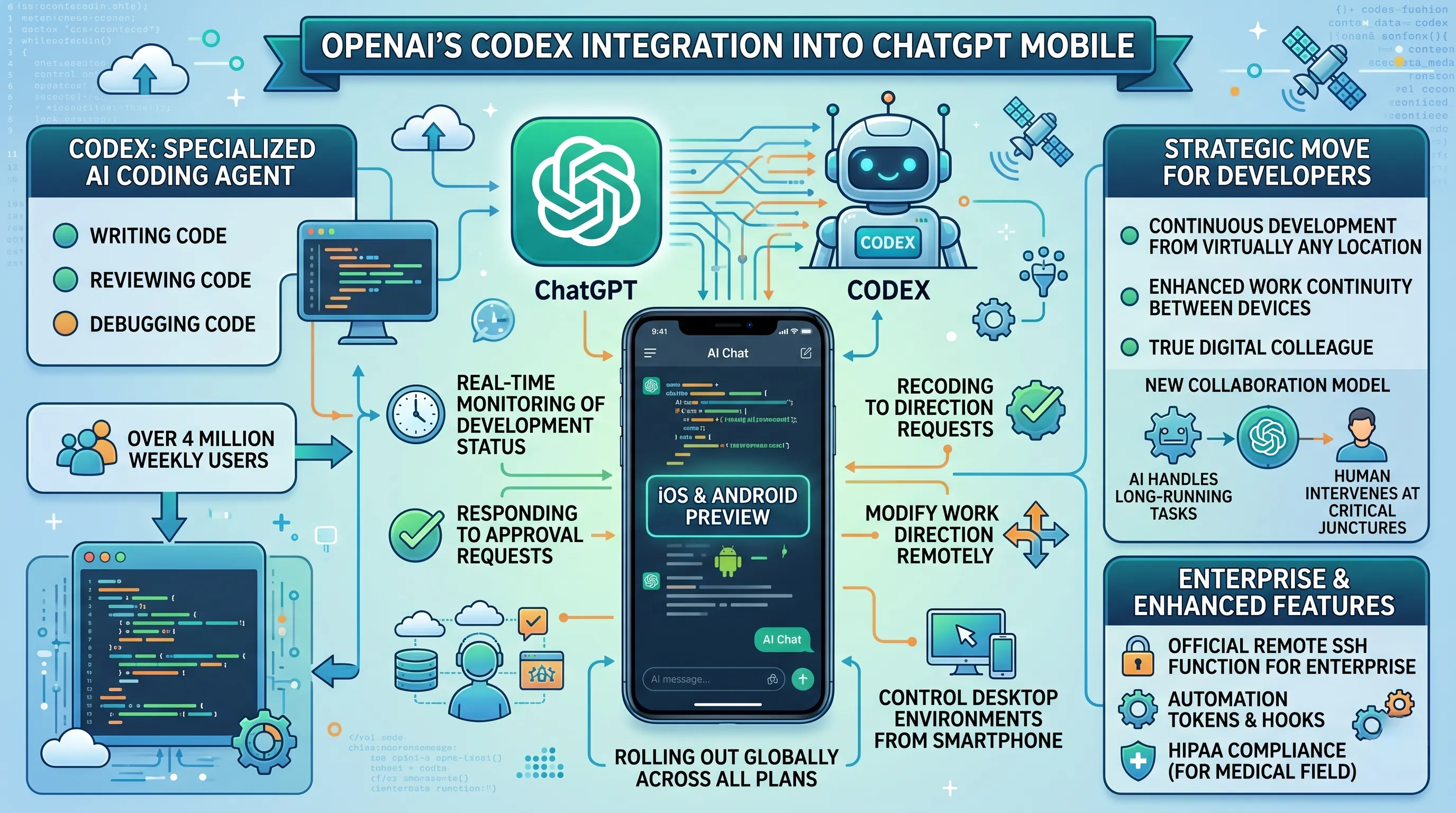
- OpenAI's Codex, a powerful AI coding agent, is now integrated into the ChatGPT mobile app, enabling software developers to perform and manage coding tasks, monitor progress, and control desktop environments anywhere, anytime from their smartphones, fundamentally transforming the mobile development workflow.
OpenAI has unveiled a significant advancement in the realm of AI-assisted software development with the integration of its sophisticated coding agent, Codex, into the ChatGPT mobile app.
This pivotal development, which began rolling out in preview on both iOS and Android across all plans and supported regions, is set to revolutionize how developers interact with their code and manage projects on the go.
This strategic move empowers developers with unprecedented flexibility, allowing them to continue their work and manage complex coding tasks seamlessly, directly from their mobile devices.
Codex, initially launched in April 2025 and already boasting over 4 million weekly users, serves as OpenAI's specialized AI coding agent designed to assist with writing, reviewing, and debugging code.
Its integration into the ChatGPT mobile app extends its powerful capabilities to a new frontier, enabling continuous development work from virtually any location.
Key features include real-time monitoring of development status, responding to approval requests, modifying work direction remotely, and even controlling desktop development environments from a smartphone, thus solidifying its role as a true 'digital colleague'.
This initiative not only allows for enhanced work continuity between devices and locations but also introduces new collaboration models where AI handles long-running development tasks, freeing human developers to intervene at critical junctures.
With the official release of remote SSH function for enterprise environments, along with enhanced enterprise features like automation tokens, Hooks, and HIPAA compliance for the medical field, Codex Mobile is poised to set a new standard for efficient, AI-powered software development in a highly connected world.
1. Unveiling OpenAI Codex Mobile: The Dawn of Ubiquitous AI Coding
The primary catalyst for the new era of AI-powered software development, the central theme of this article, was not a breakthrough in a research lab but a strategic deployment to the devices we carry every day.
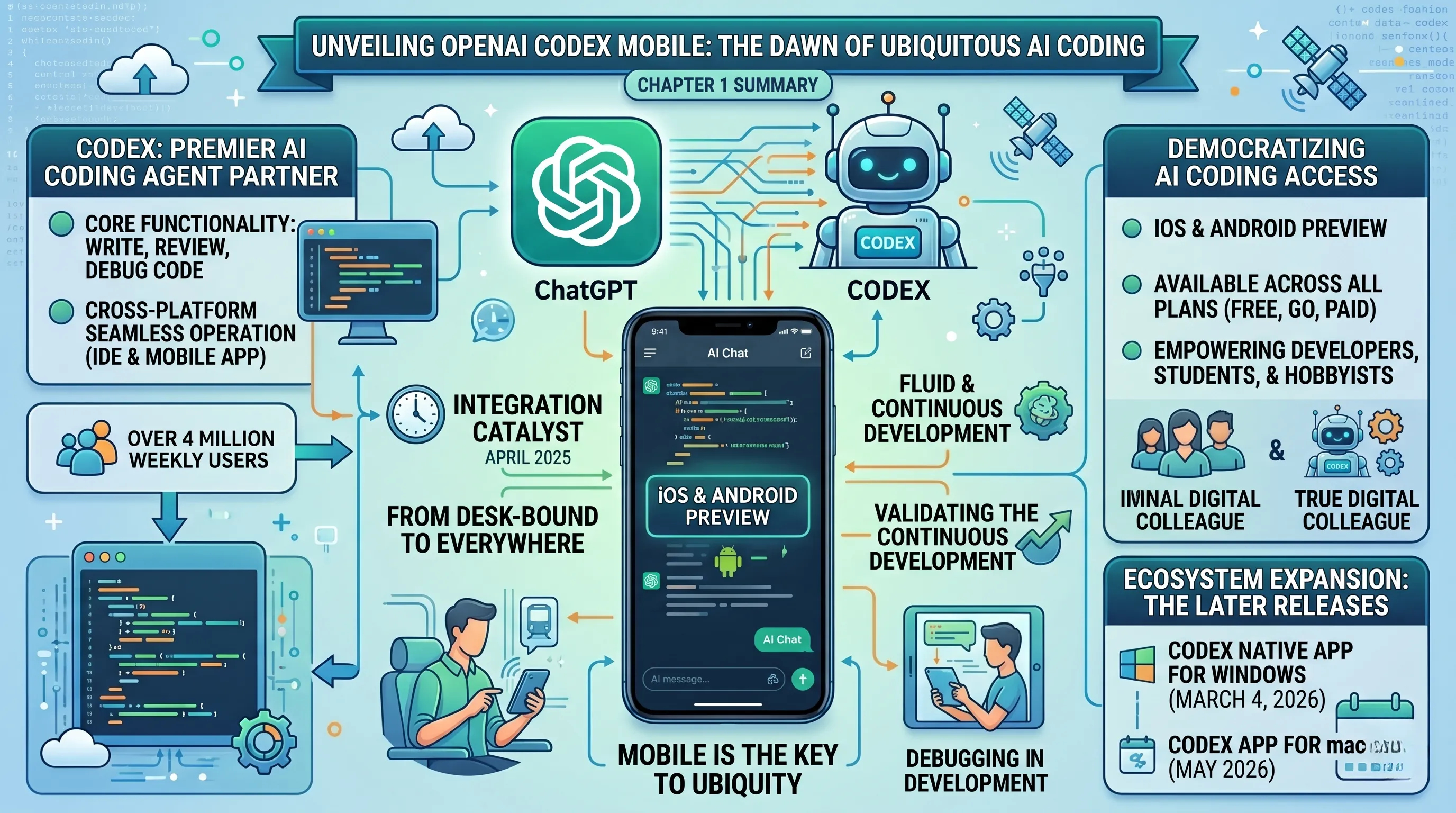
In April 2025, OpenAI initiated this paradigm shift by officially launching Codex, its advanced AI coding agent, and integrating it directly into the widely-used ChatGPT mobile application.
This move was the historical starting pistol, transforming AI coding from a powerful but desk-bound tool into a ubiquitous, ever-present assistant.
The rollout was strategically designed for maximum impact and accessibility.
Codex was made available in preview on both iOS and Android, ensuring near-total market coverage from the outset.
Crucially, OpenAI extended this functionality across all plans, including the Free and Go tiers, effectively democratizing access and removing any financial barrier for curious developers, students, and hobbyists.
This decision to make such a powerful tool widely available is directly responsible for its explosive growth and its role in opening a new chapter for the industry.
The market's response was immediate and overwhelming, validating OpenAI's strategy.
The platform rapidly amassed an active user base of over 4 million weekly users, a figure that solidifies its status not as a niche experiment but as a mainstream development utility.
This staggering adoption rate demonstrates a fundamental hunger in the development community for tools that untether them from a fixed physical workspace.
Core Functionality: A True AI Coding Agent
At its heart, the mobile-integrated Codex functions as OpenAI's premier AI coding agent, designed to be a comprehensive partner in the software development lifecycle.
Its core capabilities are threefold: assisting developers to write, review, and debug code.
This functionality is not confined to a single environment.
Codex was engineered to operate seamlessly across both the traditional IDE (Integrated Development Environment) on a desktop and the new mobile app interface.
This cross-platform nature is the very essence of its contribution to this new chapter of AI coding, creating a fluid and continuous development experience that was previously impossible.
A developer could now start a task in their desktop IDE, review a pull request on their phone while commuting, and debug a critical error from a tablet, all with the same consistent AI assistant.
While the mobile launch was the primary event, OpenAI later expanded the ecosystem with dedicated desktop applications, further solidifying the platform's reach.
A native Codex app was released for Windows on March 4, 2026, followed by the introduction of a Codex app for macOS in May 2026.
These releases signaled a long-term commitment to providing a polished, dedicated experience on every major platform, yet it was the initial mobile integration that truly unlocked the era of ubiquitous AI coding.
2. Seamless Development: Empowering Coders with Advanced Mobile and Enterprise Features
The launch of OpenAI's Codex Mobile, as heralded in this article's main topic, represents far more than just another tool; it signals a fundamental shift in the very fabric of software development. This new era of AI coding is not merely an abstract concept but is built upon a robust ecosystem of features detailed in this section. These capabilities are the concrete mechanisms that untether developers from their desktops, transform the AI from a simple code assistant into a persistent digital colleague, and fortify the entire process with enterprise-grade security and control. It is here, in the seamless integration of mobile and enterprise functionalities, that the promise of a new chapter in AI-powered development truly comes to life.
From Desktop to Pocket: The Unchained Developer
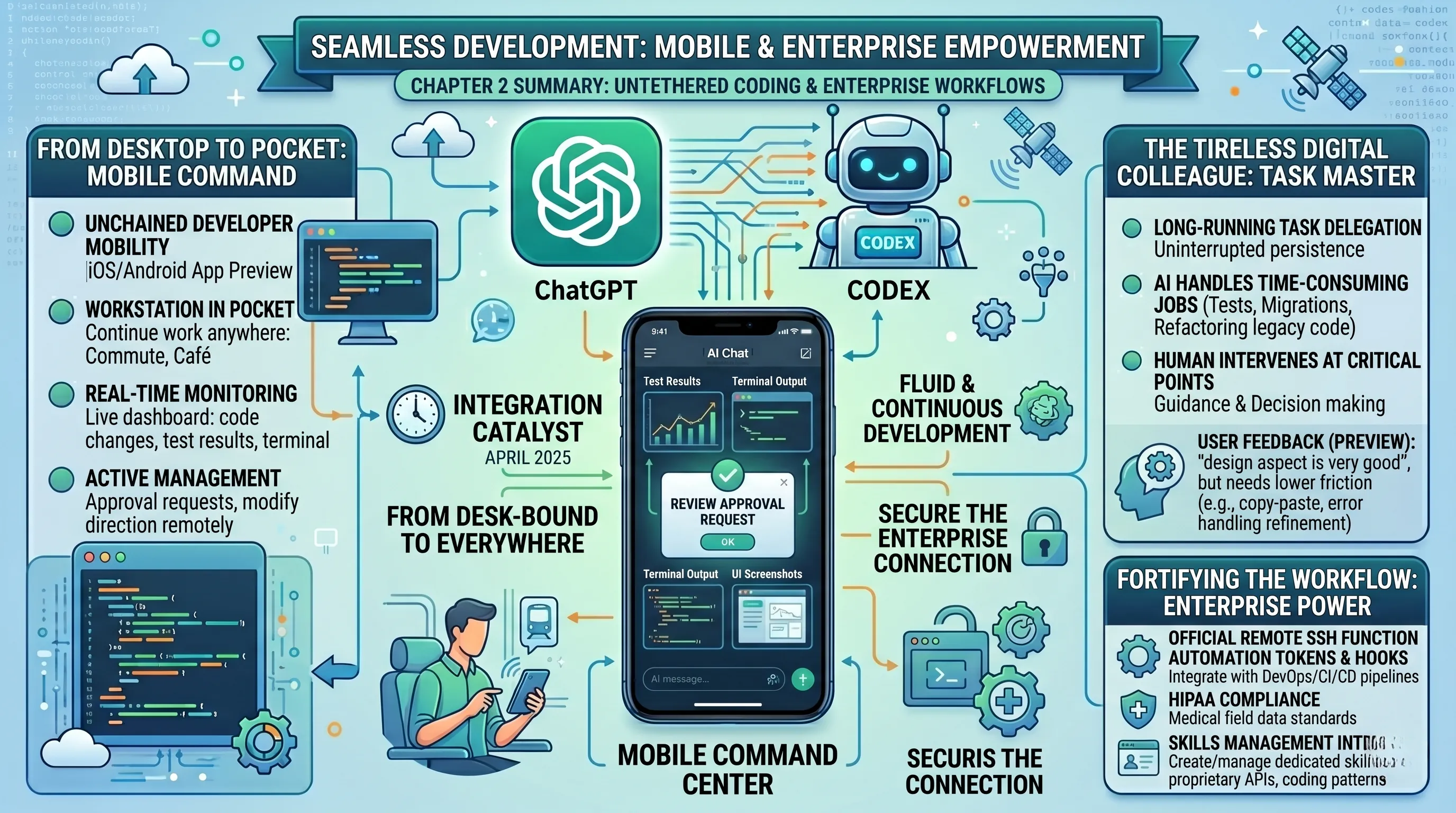
The most immediate and profound change introduced by Codex is the dissolution of the traditional office-bound development environment. By integrating its AI coding agent directly into the ChatGPT mobile app, available in preview on iOS and Android, OpenAI has effectively placed a development workstation in every coder's pocket.
This allows developers to continue development work anywhere, anytime via their smartphone. The experiential value of this cannot be overstated. A developer can now initiate a complex build process at their desk, monitor its progress during their commute, and review test results from a café, all without being physically tethered to a specific machine. This mobility is powered by a sophisticated real-time monitoring system that provides a live dashboard of the AI's activities. Users can remotely observe code changes as they are written, track live test results, view terminal output, and even see screenshots of the user interface being built or tested. This level of transparency is crucial, as it transforms the mobile app from a simple text interface into a comprehensive command center.
Furthermore, the interaction is not merely passive. The system is designed for active management, allowing developers to respond to approval requests and modify work direction remotely. For instance, if the AI agent encounters an ambiguity or completes a milestone, it can pause and request human input. The developer receives a notification on their phone, reviews the context, and provides the necessary guidance to proceed. This two-way communication is what elevates Codex from a tool to a collaborator. It solidifies the ability to truly control desktop development environments from a mobile device, making the smartphone a powerful remote for steering complex coding tasks being executed on more powerful hardware elsewhere.
The Tireless Digital Colleague: Mastering Long-Running Tasks
One of the most significant paradigm shifts enabled by Codex is its support for uninterrupted long-running development tasks. Previous generations of AI coding assistants were largely session-based, operating in a simple prompt-and-response loop. Codex shatters this limitation, establishing a new collaborative model where the AI handles long, time-consuming tasks while humans intervene only at critical moments.
This capability allows a developer to delegate tasks like running an exhaustive integration test suite overnight, executing a large-scale database migration, or refactoring thousands of lines of legacy code. The AI works persistently, and the developer can disengage, knowing that the task is progressing. This transforms the AI into a true "digital colleague" that works around the clock, allowing for a level of productivity previously unattainable. User feedback has praised this aspect, noting that the "design aspect is very good" and that the agent operates smoothly without getting stuck in the kind of repetitive loops that plagued earlier models.
However, the "seamless" vision is still evolving. Early user feedback from the preview stage highlights some practical friction points. One user reported having to manually copy-paste code between their M1 MacBook and a Pixel 6 mobile IDE for testing, a workflow that runs counter to the promise of effortless continuity. Another, more critical piece of feedback pointed out a significant weakness: "No error handling at all. Just AI generated code stacked on top of each other." These critiques underscore that while the high-level architecture is revolutionary, the low-level execution in this preview phase still requires refinement to achieve a truly frictionless experience.
Fortifying the Workflow: Enterprise-Grade Power and Security
For Codex to be more than a novelty for individual developers, it must meet the stringent demands of professional and corporate environments. OpenAI has addressed this directly by embedding a suite of powerful enterprise-grade functionalities into the platform.
A cornerstone of this is the official release of a remote SSH function for enterprise environments. This feature is critical, as it provides a secure and standardized method for the Codex agent to access and operate within a company's private servers and development infrastructure. It moves Codex from operating on public codebases to being a trusted agent within a secure corporate perimeter.
This is complemented by enhanced features like automation tokens and Hooks, which allow enterprises to deeply integrate Codex into their existing DevOps and CI/CD pipelines. Instead of being just a tool for developers, Codex can become a programmable component of an automated workflow, capable of autonomously fixing bugs detected in a build or generating boilerplate code for new microservices.
Recognizing the needs of specialized industries, OpenAI has also ensured HIPAA compliance, making Codex a viable tool for developing applications in the highly regulated medical field. This demonstrates a serious commitment to security and regulatory adherence that is essential for enterprise adoption.
Finally, control and customization are paramount for large organizations. Codex provides a dedicated interface to create and manage "skills"—reusable sets of instructions, access to proprietary APIs, or specific coding patterns. This allows a company to train Codex on its unique internal libraries and best practices. Developers are then given flexible control, with the ability to explicitly ask Codex to use specific skills for a task or allow it to intelligently decide which skill is most appropriate, ensuring that the AI's output consistently aligns with established enterprise standards.
3. Transforming Workflows: User Experience, Collaboration, and Future Refinements
The launch of Codex Mobile, as heralded by our main topic "OPENAI, 'Codex Mobile' Unveils a New Era of AI Coding," signifies more than just a new application; it represents a fundamental reshaping of the developer's daily reality.
This section directly connects to that theme by dissecting the granular impact on the software development lifecycle.
We will explore how Codex Mobile is not merely a tool but an active participant in the coding process, transforming individual workflows, fostering novel models of AI-human collaboration, and revealing, through user feedback, the path forward for future refinements.
The 'Digital Colleague': Forging Uninterrupted Work Continuity
The most profound shift introduced by Codex Mobile is the dissolution of traditional workplace boundaries.
Developers are no longer tethered to their primary desktop environments.
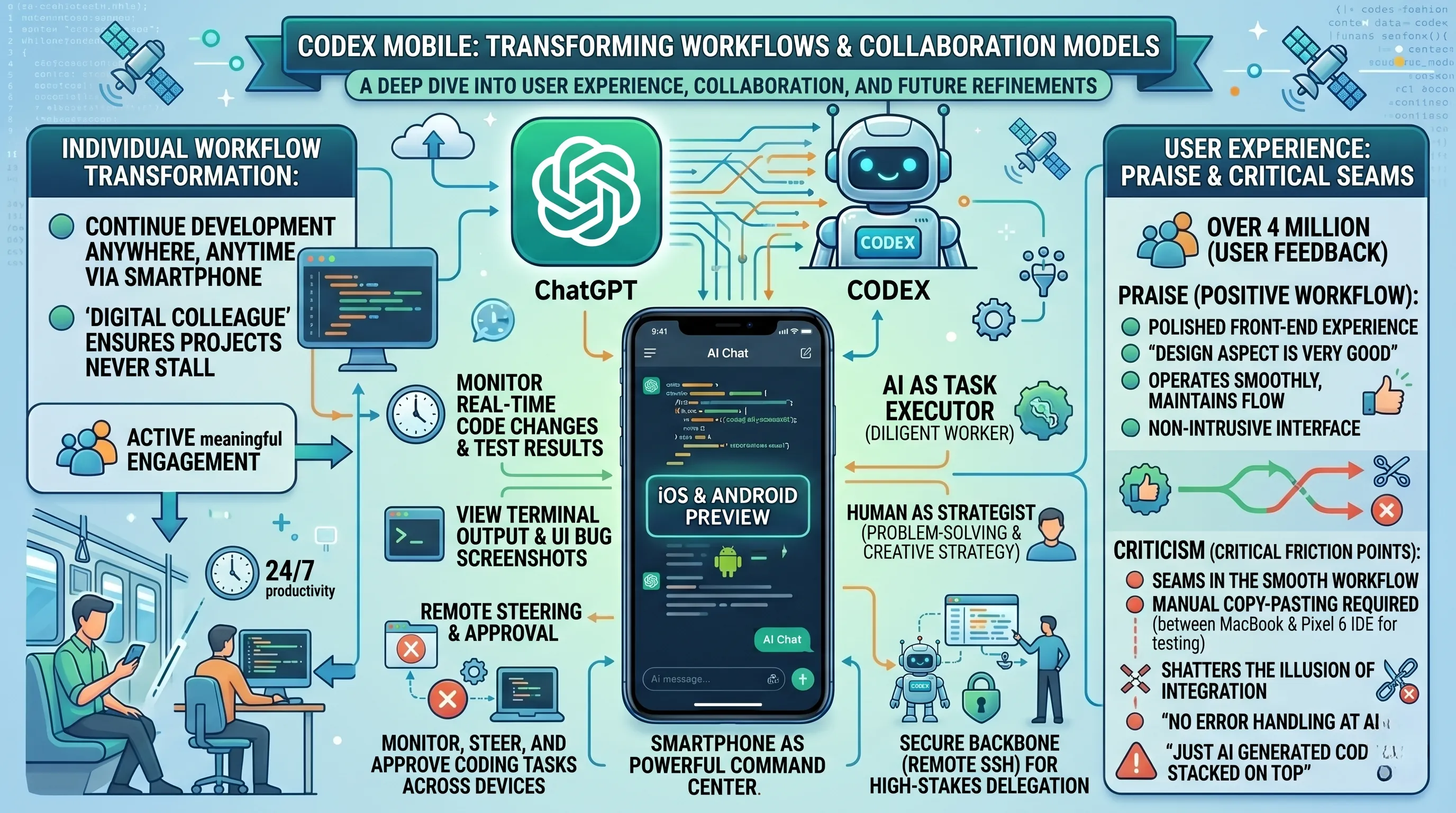
The ability to 'Continue development work anywhere, anytime via smartphone' transforms the concept of productivity, effectively creating a 'digital colleague' that ensures projects never stall.
This isn't just about checking logs on the go; it's about active, meaningful engagement.
A developer commuting home can receive a notification, monitor real-time code changes or test results, view terminal output, and even see screenshots of a UI bug directly from their mobile device.
This constant connectivity fosters a state of perpetual workflow continuity.
Imagine a critical build failing late on a Friday.
Previously, this would necessitate a trip back to the office or a scramble to a laptop.
With Codex Mobile, the developer can immediately respond to approval requests or modify the work's direction remotely, instructing the AI to revert a change or run a different set of diagnostics.
This capability to monitor, steer, and approve coding tasks across devices effectively turns a smartphone from a communication device into a powerful command center for development, allowing for the remote control of complex desktop environments.
A New Paradigm: AI as the Task Executor, Human as the Strategist
Codex Mobile is pioneering a new collaborative model that moves beyond simple code completion.
It enables a structure where the AI handles long, often tedious, development tasks autonomously, while the human developer intervenes only at critical junctures.
The feature supporting 'uninterrupted long-running development tasks' is central to this paradigm.
A developer can initiate a complex data migration, a comprehensive test suite run, or a large-scale code refactoring on their desktop, and then leave the physical workspace.
Throughout this process, Codex acts as the diligent worker, and the mobile app serves as the manager's dashboard.
The human can monitor progress, provide necessary approvals, and make strategic decisions without being bogged down by the minute-to-minute execution.
This is the experiential value of the official remote SSH function for enterprise environments; it provides the secure, stable backbone required for this kind of high-stakes remote delegation.
This AI-human collaboration model frees up invaluable cognitive resources for developers, allowing them to focus on architectural design, problem-solving, and creative strategy, rather than just overseeing execution.
User Experience: A Blend of Smooth Design and Critical Friction Points
Real-world feedback from the over 4 million weekly users provides a crucial, unvarnished look at Codex Mobile's current state.
On one hand, the core user experience has received significant praise.
One user noted that the "'design aspect is very good' and operates smoothly without getting stuck in loops."
For a developer tool, this is not a trivial compliment.
A smooth, intuitive, and reliable interface is paramount to maintaining a state of deep focus, or 'flow'.
An AI tool that gets stuck or requires constant troubleshooting becomes more of a hindrance than a help, and user feedback suggests OpenAI has succeeded in creating a polished and non-intrusive front-end experience.
However, this praise is juxtaposed with sharp criticism that highlights significant seams in the otherwise smooth workflow.
A major point of friction reported by a user involved the "Required manual copy-pasting of code between M1 MacBook and Pixel 6 mobile IDE for testing."
This single issue shatters the illusion of a perfectly integrated ecosystem.
The promise of seamless continuity is broken by a clumsy, manual intervention that feels archaic in the context of an advanced AI system.
It transforms a fluid process into a disjointed one, forcing the user out of their workflow to perform a rudimentary data transfer.
An even more critical gap was identified in the core AI functionality.
A user bluntly stated, "'No error handling at all. Just AI generated code stacked on top of each other.'"
This points to a fundamental immaturity in the current model's ability to self-correct or even recognize its own mistakes.
Instead of intelligently debugging or integrating new code, it simply appends it, creating a precarious structure of code that is likely to be buggy and difficult to maintain.
This lack of sophisticated error handling is perhaps the most significant hurdle OpenAI must overcome.
For Codex Mobile to truly fulfill its promise as a reliable 'digital colleague,' it must evolve from a simple code generator into a system that understands context, anticipates errors, and actively contributes to the stability of the codebase, not just its size.
📚 Related Posts
OpenAI ChatGPT Launches 'Trusted Contact': Bridging AI Safety with Expert-Backed Human Support for User Well-being
🚀 Key TakeawaysOpenAI has introduced a new Trusted Contact feature for ChatGPT, designed to connect users with pre-designated individuals for support during potential crisis situations, thereby strengthening AI's role in real-world support systems.OpenA
tech.dragon-story.com
OpenAI's Real-time Voice AI Trio: GPT-5 Reasoning, 128K Context & Agent Shift with Global Translation
🚀 Key TakeawaysOpenAI has unveiled three new real-time voice AI models (GPT-Realtime-2, GPT-Realtime-Translate, and GPT-Realtime-Whisper) designed to significantly elevate AI capabilities from simple chatbots to intelligent agents capable of understandi
tech.dragon-story.com
GPT-5.5 Instant: OpenAI's Dramatic AI Upgrade | 52.5% Less Hallucinations, Personal Memory & 400K Codex
🚀 Key TakeawaysGPT-5.5 Instant represents a massive leap in AI capability, offering drastically reduced hallucinations (52.5% in high-risk fields) and significantly enhanced factuality, propelling the vision of a truly reliable personal AI assistant for
tech.dragon-story.com


